

























































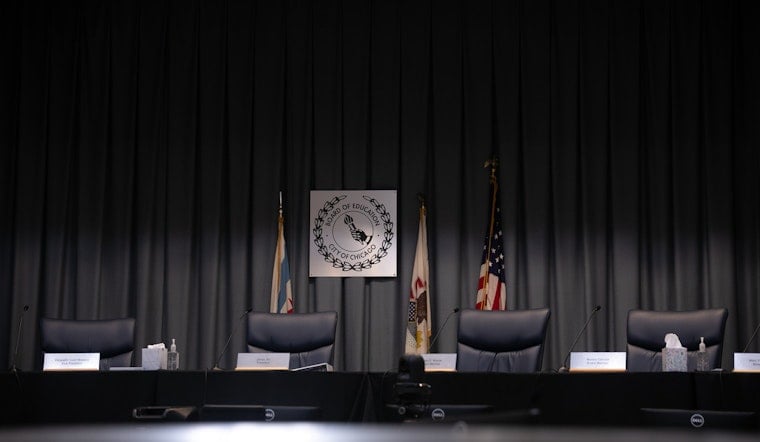
Chicago's school board hit pause this week on a proposal that would send an estimated $5.5 million more to Chicago Arts High School, the former ChiArts campus now fully absorbed into the district, after board members clashed over whether boosting one specialized program means shortchanging dozens of neighborhood schools. The delay came amid a fight so heated that one board member was formally censured for comparing the funding push to corruption.
The proposal, authored by board member Michilla Blaise, would push Chicago Arts High School's per-pupil spending to almost $40,000, well above the district's roughly $20,000 average, according to Block Club Chicago. Blaise, a political consultant appointed to the board by Mayor Brandon Johnson in October 2024 after the previous board resigned en masse, moved her own resolution to the board's September 10 meeting rather than force an immediate vote. Blaise has said the school should receive support to preserve its success and has called the idea that extra funding would siphon resources from other campuses preposterous, per the same report.
Board member Che “Rhymefest” Smith, the Oscar- and Grammy-winning songwriter who co-wrote hits including “Glory” and “Jesus Walks” before joining the Chicago Board of Education, led the opposition. Smith said favoring one program at the possible expense of other schools borders on corruption, and noted that many schools in his South Side district have received no additional arts-program funding at all, the outlet reported. Fellow board member Sean Harden formally censured Smith over the corruption remark, though the underlying funding question remained unresolved as the meeting closed.
A Foundation's Final Day, A District's New Burden
The timing is no accident. The ChiArts Foundation, the private philanthropic organization that spent two decades raising more than $40 million to underwrite the school's five arts conservatories, marked its final day of operations on Thursday. As a contract school, ChiArts had relied on that private fundraising to cover roughly three hours of daily conservatory instruction on top of standard CPS academic funding — money that now has nowhere else to come from.
That gap traces back to the Chicago Board of Education's unanimous November 2025 vote to absorb ChiArts and convert it into a district-managed school effective July 1, 2026, after its contract operator said it could no longer run the campus amid mounting deficits, as CBS News reported at the time. The same board meeting also approved $1.4 million to keep EPIC Academy charter school open through last June before it closed for good — a reminder that Chicago Arts High School is not the only campus the district has had to prop up financially. CPS has separately spent more than $13 million absorbing five Acero charter-network campuses, and the Aspira charter network has closed campuses of its own in recent years.
Conservatory Model Already Trimmed
Chicago Public Schools has already scaled back what was once a nine-hour school day by 50 minutes and shortened the roster of roughly 70 teaching artists who ran the conservatory program last school year, though the district says the $5.5 million would let the school retain more of those artists. CPS created 20 resident-artist positions as part of the transition and has earmarked $5.7 million separately for the school's shift into a district-run campus, which now carries a total 2026-27 budget of $14.4 million. The school will also offer eight Advanced Placement classes and online courses for about 200 students who are not on track to graduate.
CPS official Macquline King told board members the district had preserved the conservatory model to the greatest extent practicable and said CPS needed to build a sustainable new version of the school with strong academic rigor going forward, according to Block Club Chicago. Supporters of the additional funding say it would carry the school for one year while it develops new philanthropic backing to replace what the ChiArts Foundation once provided, and that it would help preserve the conservatory model that has defined the school since it opened as Chicago's first public arts high school in September 2009.
Enrollment Dips as Fiscal Watchdog Weighs In
Preliminary enrollment at the school has slipped by almost 40 students to about 500, even as students, parents, educators and other backers lobbied board members for the extra money. The Chicago Teachers Union represents the school's educators, and the campus draws a student body from across the city that is predominantly Latino and Black — undercutting, Blaise has argued, any characterization of the school as a specialty program for wealthy white kids.
Outside the board itself, Civic Federation President Joe Ferguson urged the board to reject the additional funding in an August open letter, warning that pulling money from other campuses to fund Chicago Arts High School sets what he called a dangerous precedent and reflects, in his words, “the worst kind of Chicago parochialism.” Ferguson, a former Chicago Inspector General who now leads the nonpartisan Civic Federation, pointed to district figures showing that other arts high schools received an average of just $53,000 for arts programming this year — a fraction of what Chicago Arts High School would draw if the board approves the extra $5.5 million. District officials have cautioned that granting the request would require reducing funding for some of those other arts schools, since CPS estimated the full $5.5 million would be needed to cover the additional staff called for in Blaise's resolution.
Debate Unfolds Amid District-Wide Austerity
The fight is unfolding against a backdrop of severe belt-tightening across Chicago Public Schools. The district unveiled a $9.88 billion budget for the 2026-27 school year in July that closed a projected $732.5 million deficit through departmental cuts, spending freezes, staff reductions and as many as five potential employee furlough days, as Chalkbeat has reported. CPS also overhauled how it distributes school funding starting in the 2024-25 school year, replacing its old per-pupil Student-Based Budgeting formula with an equity-focused model that allocates resources based on school community needs rather than raw enrollment, complicating any straightforward comparison of per-pupil spending across campuses.
The debate also lands just months before Chicago holds elections this November to fill all 21 seats of its first fully elected school board, ending the city's status as the only major Illinois district without one, according to WTTW News. Chicago Arts High School was also named this month as one of 15 new additions to the district's Sustainable Community Schools initiative, bringing that program's total to 36 campuses and adding another layer of district investment at the Humboldt Park campus, as Hoodline has previously reported. For now, the $5.5 million question — and the broader argument over whether one arts program should get special treatment while South and West Side schools go without — heads to the board's September 10 meeting for another round.



