

























































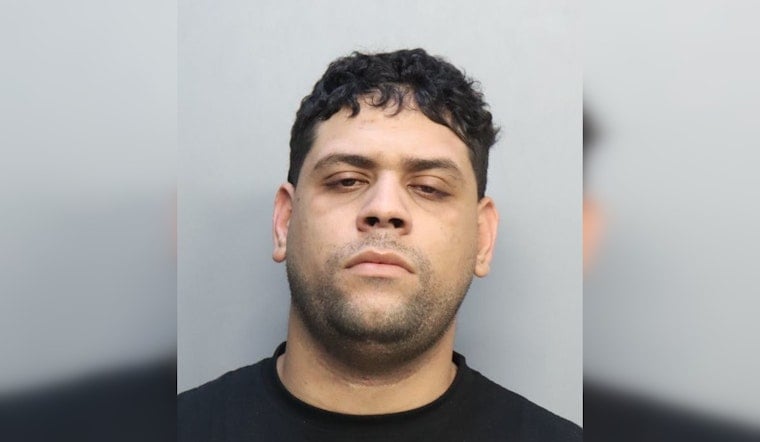
A man accused of helping kidnap and kill a retired Venezuelan police officer in Doral has pleaded guilty to federal charges that carry a mandatory life sentence, closing in on one chapter of a case that first exposed Tren de Aragua's presence in South Florida. Julio Cesar Hernandez-Montero admitted his role in the November 2023 death of José Luis Sánchez Valera, a 43-year-old Doral resident whose body was found stuffed in the back seat of his own Toyota 4Runner near Northwest 28th Street and 37th Avenue.
Hernandez-Montero agreed to plead guilty to conspiracy to commit kidnapping, kidnapping resulting in death, and carjacking resulting in death, according to the Miami Herald. The plea deal means he faces a mandatory life sentence on the kidnapping-resulting-in-death charge, though prosecutors may ask a judge for a reduced term if his cooperation proves substantial — a judge is not obligated to grant anything below that mandatory minimum. As part of the agreement, Hernandez-Montero has agreed to cooperate with federal prosecutors, though the plea documents do not identify what information he might provide or whether it touches on Tren de Aragua's broader command structure.
How the Doral Ambush Unfolded
Prosecutors say six people participated in the conspiracy: Hernandez-Montero, Yurwin Smith Salazar Maita, Yorvi Jose Arenas Lezama, Darwin Jesus Mijares, Yoleidy del Carmen Ilarraza, and Maria Alejandra Lobos Gamez. According to the account reported by the Miami Herald, the group met multiple times at a Miami-Dade hotel before the killing, scouted Sánchez Valera's apartment, and gathered a gun, masks, gloves, and tape. Ilarraza and Lobos allegedly knew that Sánchez Valera sold jewelry and gold, and either Ilarraza or Lobos planned to lure him to another hotel.
Salazar reportedly knew where Sánchez Valera lived. On the night of the attack, Sánchez Valera left the La Quinta Inn near Miami International Airport at about 2:30 a.m., and Salazar, Hernandez-Montero, and Arenas abducted him from the hotel parking lot before restraining him, the outlet's report states. Hernandez-Montero had booked two rooms at South River Suites in Medley, using them since November 2, 2023, according to the same account.
Hernandez-Montero and Arenas then entered Sánchez Valera's Doral apartment and demanded the location of his jewelry, per the Miami Herald's reporting. Arenas — also known as “El Nene” — punched Sánchez Valera several times and threatened his roommate, while prosecutors say Arenas ultimately asphyxiated him. Salazar drove the 4Runner as the group extracted what they could from Sánchez Valera before conspirators stole a safe containing gold, jewelry, and approximately $40,000 in cash, along with his gold jewelry and apartment key. The conspirators then abandoned the 4Runner with Sánchez Valera's body inside. The Miami-Dade Medical Examiner's Office ruled his death a homicide, determining he died from mechanical asphyxia.
A Retired Officer Targeted for His Savings
Sánchez Valera was a former Venezuelan police officer, and relatives previously told Local 10 News that he had accumulated savings in gold jewelry and cash kept in a closet safe — wealth the conspirators reportedly spent time gaining his trust to locate. Security analysts and law enforcement affidavits described the killing as the first documented, confirmed violent crime committed by suspected Tren de Aragua members in South Florida, a milestone reported by the Miami Herald in January 2024. In a federal filing, Arenas claimed the intruders were from Tren de Aragua, though new federal filings reviewed by the Herald do not explicitly identify Hernandez-Montero himself as a member of the gang — an unresolved distinction the case has not settled.
An International Manhunt Spanning Three Countries
After the home invasion, Hernandez-Montero, Arenas, Mijares, Ilarraza, and Lobos fled the United States together, meeting up in Orlando before scattering internationally. Investigators eventually linked Salazar to the crime through a fingerprint and cellphone records, and he was arrested in Broward County in January 2024. Hernandez-Montero was arrested in Panama City the following March, extradited to South Florida later that year.
Arenas Lezama's path to custody took longer. Colombian National Police arrested him in Cali in February 2025, where he had reportedly been posing as a barber while awaiting extradition, according to Diario Las Américas. He remains in Colombian police custody as extradition proceedings continue. Mijares, Ilarraza, and Lobos are still at large.
From Death Penalty Talk to a Federal Plea
The case's prosecutorial path shifted dramatically over nearly three years. In September 2024, Miami-Dade state prosecutors initially announced they would seek the death penalty against Salazar and Hernandez-Montero under state first-degree murder and armed kidnapping charges, according to ADN América. That capital case in Miami-Dade Circuit Court gave way to parallel federal charges, which ultimately produced this week's guilty plea and its mandatory life sentence rather than a death sentence.
The case unfolds against a backdrop of escalating federal action against Tren de Aragua. The U.S. Department of the Treasury's Office of Foreign Assets Control designated the group a significant Transnational Criminal Organization in July 2024, and the State Department went further in February 2025, designating it a Foreign Terrorist Organization and Specially Designated Global Terrorist. By July 2026, the Department of Justice reported it had charged nearly 350 Tren de Aragua members and associates nationwide over an 18-month span, spanning major racketeering and kidnapping cases in Illinois and Texas alongside South Florida prosecutions like this one.
Whether Hernandez-Montero's cooperation will yield useful intelligence on the gang's broader networks remains an open question the plea agreement does not answer. So too does the eventual fate of Arenas Lezama, still awaiting extradition, and the three co-conspirators — Mijares, Ilarraza, and Lobos — who remain unaccounted for internationally.





