

























































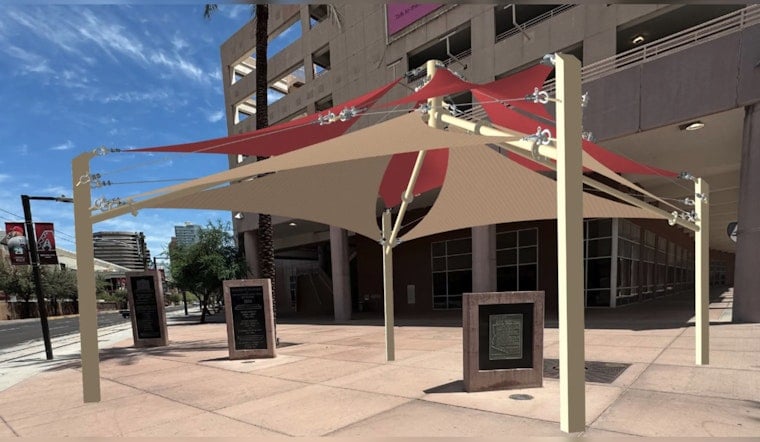
Six manufactured shade canopies are headed for some of downtown Phoenix's busiest and hottest sidewalks, part of a push by Downtown Phoenix Inc. to make walking between Chase Field, the Mortgage Matchup Center, the Phoenix Convention Center and other downtown destinations more bearable during the brutal summer months. The structures will go up along Jefferson and Washington streets, two corridors that see some of the heaviest foot traffic in the urban core.
The project is funded by a grant from Arizona Public Service, according to ABC15 Arizona, which first reported on the canopy plan. The grant totals $200,000 and will pay for custom structures, including a 30-by-30-foot windmill-style canopy at 5th and Jefferson streets that was positioned using a 3D digital model of downtown shade patterns, according to Axios Phoenix. Downtown Phoenix Inc. used thermal and shadow mapping to identify the spots with the greatest sun exposure before choosing locations.
The six canopies will be installed at the southwest corner of First and Jefferson streets, the north sidewalk at Fourth and Jefferson streets, the northeast corner of Fifth and Jefferson streets, and the northwest corner of Washington Street and Central Avenue, among other high-traffic points, per the ABC15 report. Another canopy will go up near Central Avenue and Washington Street. The structures use commercial-grade fabric engineered to withstand Arizona's climate, and some include lighting for nighttime use, providing UV protection and airflow for pedestrians. Downtown Phoenix Inc. expects all six to be installed by the end of the year.
Why Trees Aren't the Answer Downtown
Unlike other parts of the city where planting more trees is the go-to cooling strategy, Downtown Phoenix Inc. says it cannot add trees along the Jefferson and Washington corridors because existing light rail lines and underground infrastructure prevent crews from digging. That constraint helps explain why the organization turned to engineered fabric structures instead. It's a distinction that mirrors a broader statewide shift: Phoenix's 2024 shade strategy moved away from the city's original 2010 goal of reaching 25% natural tree canopy by 2030, as urban planners recognized that desert water scarcity and buried utilities make engineered shade essential in many corridors, according to Smart Cities Dive.
R.J. Price said Jefferson and Washington streets are two of the highest-traffic streets downtown, and acknowledged that the six canopies will not solve all of downtown Phoenix's problems. Downtown Phoenix Inc. hopes the project will eventually expand, with officials saying they hope other stakeholders will support widening its reach. The canopies also directly support the city's Downtown Phoenix Entertainment District Implementation Plan, detailed in an April city council presentation from consultants HR&A Advisors and Multistudio, which recommended shaded walkways along Washington and Jefferson to better connect the ballpark, arena and convention center.
APS's Long History on These Same Streets
Arizona Public Service awarded the grant as part of a statewide beautification initiative marking its 140th anniversary in Arizona. Silvia Capir said APS made a commitment of $1.4 million for projects across the state. That broader initiative funded public space upgrades in 11 Arizona counties in 2026, including baseball field shade structures in San Luis and improvements at Phoenix's historic George Washington Carver Museum, according to APS. There's a bit of symmetry to the utility's involvement: APS installed the first streetlamp in downtown Phoenix at the intersection of Central Avenue and Washington Street, the same corner where one of the new canopies will rise.
A Citywide Plan and a Rising Death Toll
The downtown canopies represent a small slice of a much larger municipal effort. In November 2024, the Phoenix City Council unanimously approved the $60 million Shade Phoenix Plan, a five-year goal to build 550 engineered shade structures and plant 27,000 native trees citywide, according to Courthouse News Service. The funding drew on federal ARPA dollars and local general obligation bonds approved by voters. Phoenix also became the first U.S. city to create a publicly funded, cabinet-level Office of Heat Response and Mitigation back in 2021, a department that oversees both natural canopy expansion and engineered shade structures across the city, per the City of Phoenix.
The stakes behind these efforts have only grown starker. Maricopa County health officials reported 81 confirmed heat-related deaths by mid-August, more than double the 35 confirmed heat fatalities recorded over the same period in 2025, according to 12News. Another 587 deaths remained under investigation for possible heat involvement as of mid-August. That marks a troubling reversal after Maricopa County recorded 430 heat-related deaths in all of 2025, itself a decline from 608 in 2024 and 645 in 2023, with roughly 60% of last year's fatalities occurring outdoors and nearly half involving people experiencing homelessness, per county public health data.
Who Gets Shade First
Earlier city testing of public shade canopy installations recorded surface temperature drops of up to 27 degrees Fahrenheit directly beneath shaded areas compared to exposed pavement, based on data gathered by the Phoenix Office of Heat Response and Mitigation and reported by Hoodline last year. But shade coverage isn't distributed evenly across the metro area. Low-income neighborhoods in Phoenix average 36% less tree canopy coverage than higher-income areas, while minority communities have 45% less shade cover, according to American Forests' Tree Equity Score metrics. Federal and local grants are increasingly being steered toward high-density foot corridors that lack natural shade, a dynamic that helps explain why the downtown project targets some of the busiest pedestrian intersections in the city rather than spreading resources evenly.
Downtown Phoenix Inc.'s six canopies are a modest but visible piece of a much bigger, and increasingly urgent, puzzle. With this year's confirmed heat death toll already outpacing 2025's, and hundreds more cases still under review, officials have made clear that scattered shade projects, however welcome, are not a substitute for the broader $60 million citywide plan still unfolding over the next several years.





