

























































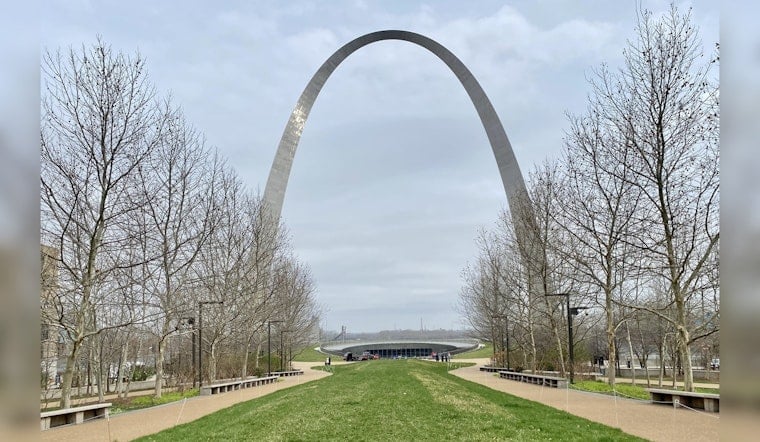
The Gateway Arch will go dark for all of September, its familiar glow switched off each night through the month as part of a National Park Service effort to protect birds migrating through St. Louis. The blackout runs September 1 through 30, with the exterior lights scheduled to flip back on the evening of October 1, 2026.
The lighting shutdown is timed to the peak of fall bird migration, when the skies above St. Louis fill with night-flying songbirds and waterfowl navigating the Mississippi Flyway. As KSDK reports, the National Park Service turns off the Arch's exterior lights to give migrating birds safer passage, a practice the monument first adopted back in 2002. The Arch also had upgraded lighting installed in December 2023, which the station notes significantly reduced flare in the night sky even when the lights are on.
That means St. Louis's skyline will look noticeably different for the next month, with the Arch's stainless-steel curve losing its nighttime shine. It's not just a local quirk of the riverfront — the region sits directly beneath one of the busiest bird corridors on the continent. The Mississippi Flyway carries more than 325 species, representing roughly 60 percent of North American songbirds and 40 percent of the nation's waterfowl, according to the St. Louis Audubon Society.
Why a Glowing Skyline Turns Deadly for Birds
About 80 percent of North American migratory bird species travel at night, relying on the moon and stars for celestial navigation, according to research from Washington University in St. Louis. Artificial city glow and upward-facing spotlights disorient those birds, pulling them off course and into the kind of exhaustion and confusion that can prove fatal.
The stakes are especially high in St. Louis. Cornell Lab of Ornithology research cited by the regional coalition Lights Out Heartland ranks the metro area the 5th most dangerous U.S. city for migrating birds in spring and 6th most dangerous in fall, a consequence of the city's position along a major flyway combined with heavy light pollution. Nationally, building collisions kill between 365 million and more than 1 billion birds every year, according to the U.S. Fish & Wildlife Service — and the danger doesn't end when a bird survives an initial strike. A 2024 study in PLOS ONE, highlighted by the National Audubon Society, found that 60 percent of more than 3,100 collision victims brought to wildlife rehabilitation centers ultimately died, suggesting window strikes are far more lethal than earlier estimates assumed.
Two Decades of Expanding the Blackout
Gateway Arch National Park first began dimming its lights for two-week stretches during spring and fall migrations back in 2002. Park administrators expanded that window to a full 30 days in May starting in 2023, then did the same for September, according to Evansville Living Magazine. The National Park Service's own records document 142 distinct bird species spotted on the Arch grounds through the eBird database, including 27 warbler species that use the urban parkland as a stopover to rest and refuel during migration.
The evidence isn't just visual. In September 2024, DarkSky Missouri deployed acoustic loggers called AudioMoths above the Arch to record nocturnal flight calls, confirming that species including the American Redstart, Cape May Warbler, Chestnut-sided Warbler, Gray-cheeked Thrush, and Chipping Sparrow were passing directly overhead at night, per the National Park Service. The sensors were originally donated for an unrelated eclipse soundscapes project before being repurposed to track the city's after-dark bird traffic.
A Regional Push Beyond the Riverfront
The Arch's September blackout is one piece of a larger regional campaign. The monument is a core partner in Lights Out Heartland, a coalition led by DarkSky Missouri and the National Audubon Society that coordinates voluntary nighttime light reductions across Arkansas, Iowa, Kansas, Missouri, Oklahoma, and Tennessee. Local governments have followed suit — St. Louis County adopted a resolution in 2021 encouraging reduced night lighting during peak migration months, and the municipalities of Ellisville and Clayton passed similar measures in 2021 and 2022, respectively.
This isn't the first time the Arch has darkened its lights this year. Hoodline previously reported on the park's spring lights-out month in May, when the same seasonal practice protected northbound migrants. September's shutdown mirrors that effort for birds now heading south, with the Arch's exterior lights set to switch back on the evening of October 1.





