

























































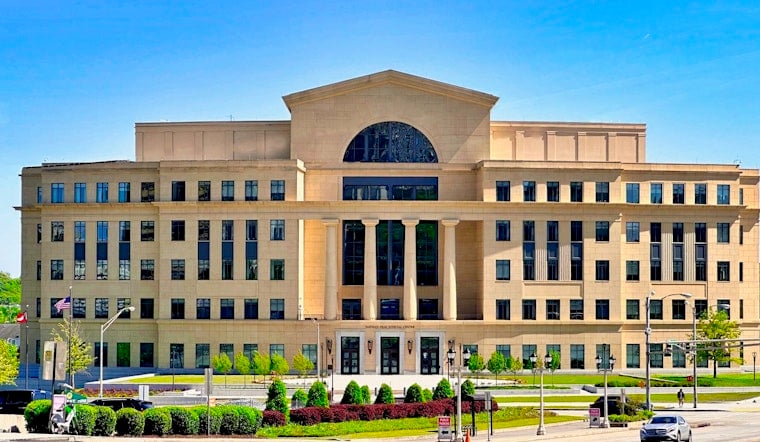
For 181 years, every murder conviction appealed in Georgia went straight to the state's highest court. That changes in July 2027, when the Georgia Supreme Court will stop automatically hearing most non-death-penalty murder appeals, sending them instead to the Georgia Court of Appeals — a court that says it's already buckling under its current workload.
The shift was announced in a concurring opinion Chief Justice Nels Peterson attached to Coleman v. State, a routine ruling affirming Michael Coleman's murder conviction in a 2019 Fulton County shooting. According to The Atlanta Journal-Constitution, the decision marks a historic break from precedent dating back to the Georgia Supreme Court's creation in 1845, when murder appeals began going directly to the state's highest court rather than an intermediate appellate body. Peterson has said letting most murder appeals go to the Court of Appeals will be more efficient, per the AJC's reporting.
Murder cases have quietly become the dominant force on the high court's docket. Between 2022 and 2024, direct murder appeals accounted for 55 percent of all published opinions issued by the Georgia Supreme Court, as reported by WSB-TV. The nine-justice court issued 2,322 opinions in 2024 and 1,600 in 2022, according to the AJC, and the Supreme Court has continued to deny most requests to review other kinds of cases while murder appeals piled up.
An Old Idea Finally Gets Traction
The move isn't new thinking. Peterson's opinion noted that transferring murder appeals revives a recommendation first floated in the late 1990s by then-Chief Justice Robert Benham, aimed at ending the high court's practice of automatically taking on direct non-death-penalty murder appeals, per WSB-TV. Under the state's 1983 constitution, mandatory Supreme Court jurisdiction is reserved specifically for capital cases — meaning the court's decades-long habit of also hearing non-capital murder appeals was, in a sense, voluntary all along.
Georgia last reshuffled its appellate courts in 2016, when the Appellate Jurisdiction Reform Act expanded the Supreme Court from seven to nine justices while moving equity, land title, and will disputes to the Court of Appeals, according to background from Atlanta Personal Injury Lawyer. Non-capital murder cases stayed put with the high court at that time. Even after the July 2027 transfer takes effect, the Supreme Court will retain mandatory jurisdiction over murder cases involving the death penalty and cases raising novel constitutional questions, per The Current GA.
The Court of Appeals Pushes Back
Not everyone on the receiving end is on board. Georgia Court of Appeals Chief Judge Trenton Brown told lawmakers in August that he opposes the transfer under present circumstances, warning that his court already manages roughly 3,300 cases annually while struggling with recruitment and retention. Brown reported that absorbing murder appeals would require additional staff and judges, and the AJC notes his colleagues on the Court of Appeals share his opposition. Judge Shawn LaGrua also opposed the decision to shift most murder cases to the intermediate court, per the same AJC report.
Brown has said the courts are already under significant pressure from litigants, and the structural mismatch runs deeper than raw case counts. Unlike the Supreme Court, where all nine justices weigh in on every case, the Court of Appeals typically decides matters through three-judge panels — meaning future murder appeals will generally get fewer sets of eyes unless a case earns en banc or certiorari review, according to a discussion of the change circulating among Georgia legal observers on Reddit.
A Narrow Window for the Legislature
The timeline leaves little room for error. Georgia lawmakers will have only the early 2027 legislative session — which typically runs January through March — to appropriate the millions of dollars the Court of Appeals says it needs before the July 2027 effective date, according to The Current GA. Miss that window, and the intermediate court could be left absorbing a wave of complex murder appeals without the judges or staff to handle them.
The jurisdictional shift also lands amid a broader reckoning over Georgia's criminal appeals system. In March 2026, seven of the Supreme Court's nine justices signed a concurring opinion in Sanders v. State declaring the state's post-conviction appeals system “broken” and a “mess,” a moment Hoodline covered at the time. That opinion led to a legislative Blue Ribbon Study Committee on Post-Conviction Litigation formed over the summer, according to the Georgia Recorder — underscoring that the murder-appeal transfer is one piece of a larger push by Peterson to overhaul how the state handles criminal appeals after conviction.





