

























































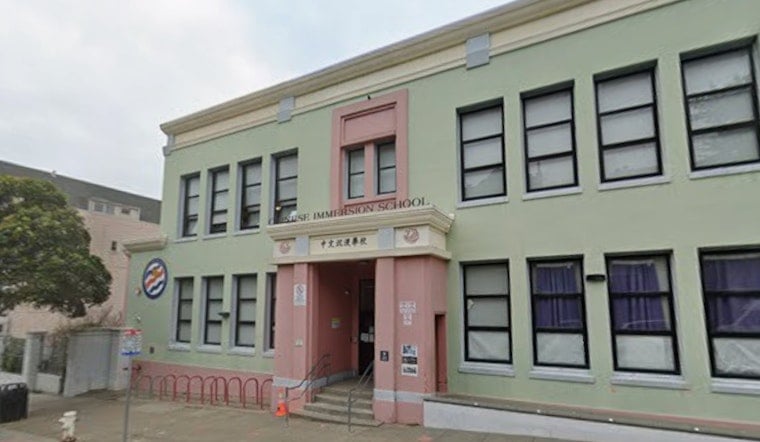
White plastic tarp wrapped around Chinese Immersion School at De Avila this week, a visible sign that a lead paint removal project meant to wrap up before the first bell instead spilled into the school year. Parents arriving for the first day of classes found window replacement and hazardous material work still underway on the historic Haight campus, and some decided to keep their children home rather than send them into a construction zone.
The $1,000,000 project, formally known as SFUSD Project #12367, involves exterior plaster repairs, swapping wood windows for aluminum ones, and removing lead-based paint from the building's exterior, according to bid records reviewed by the San Francisco Builders Exchange. As reported by The San Francisco Standard, a May 26 family newsletter told parents the work would be completed during summer break, and Phase 1 paint removal — covering the school's south and east elevations — was originally scheduled to run from June to October 2026. Neither that May newsletter nor last Tuesday's welcome-back email mentioned the word lead in the subject line or body text, per the outlet's review of the messages.
School officials told roughly 50 parents gathered for a 9 AM meeting Friday in the school auditorium that a late window delivery contributed to the delay, and Phase 1 work has now been pushed to December 30, 2026. Replacement windows aren't expected to arrive until October, and the Standard's reporting notes that window installation was delayed in part by the need to find a second replacement-window contractor. Phase 2 work, covering the north and west elevations, has also slipped, moving from an original June-to-October 2027 window to a new start date of August 30, 2027.
Parents Say They Were Kept In the Dark
Several parents told the Standard the district had not been transparent about the lead issue. One anonymous parent said the school had not shared remote instruction options and that, per an email reviewed by the outlet, some parents had found lead in the school yard themselves. That same parent said flatly that there was no communication from the district about what was happening.
Multiple families said they planned to keep their children home in the coming weeks until the district could demonstrate the campus was safe, and some pulled their kids from the school entirely during the first week of classes. An anonymous parent said she planned to keep her daughter home as well.
District Says Work Is Safe, Committed to Transparency
SFUSD said it takes seriously the health and safety of students, staff, and school communities, and said it is committed to transparency throughout the project, according to the Standard's reporting. The district said the exterior work will last two weeks and will occur outside school hours, and it uses a chemical-based stripping agent specifically to prevent toxic dust from spreading. Katrina Kincade told the outlet it is safe for students to be at school during the work. SFUSD had not, per an email cited by the Standard, provided families with an alternative location during the lead paint removal. An August FAQ distributed to families said the paint removal took longer than originally anticipated, while a May FAQ had said destructive work would occur during summer break.
The regulatory backdrop helps explain why the containment barriers and warning signs went up in the first place. San Francisco's Exterior Lead Paint Work Practices Ordinance, part of Building Code Chapter 36, requires contractors disturbing pre-1979 exterior painted surfaces to set up containment barriers, post warning signs, and notify nearby occupants rather than sanding or scraping paint in the open. Federal rules add another layer: under the EPA's Renovation, Repair, and Painting Rule, elementary schools built before 1978 are classified as child-occupied facilities, meaning any work disturbing more than 20 square feet of exterior paint requires lead-safe certified firms and trained renovators. California's Lead-Safe Schools Protection Act similarly requires public school districts to use state-certified lead abatement workers and follow state health guidelines during repairs, a mandate lawmakers passed in 1992 after surveys found widespread lead paint in older California school buildings.
A 130-Year-Old Building With a History of Lead Concerns
The De Avila campus at 1250 Waller Street dates to 1896, when it opened as the Dudley Stone School and survived the 1906 earthquake and fire before later becoming William R. De Avila Elementary and, in 2009, one of SFUSD's Chinese immersion campuses. That age is precisely why lead paint remains embedded in the building's exterior surfaces; a survey cited by the Labor Occupational Health Program found lead paint present in roughly 96% of public elementary school buildings statewide, making De Avila's situation part of a broader pattern rather than an isolated one.
This isn't the district's first brush with lead concerns. SFUSD has previously found elevated lead levels in drinking water at three schools — West Portal Elementary, Malcolm X Elementary, and San Francisco International High School — in 2017. At International High's gym water fountain, testing that year found 860 parts per billion of lead, about 60 times the federal action threshold, prompting district officials to shut down the contaminated taps and provide bottled water during the shutdown.
The CDC maintains a blood lead reference value of 3.5 micrograms per deciliter to flag children with elevated blood lead levels, and the agency says no safe level of lead in a child's blood has been identified, since even small amounts can cause irreversible neurological damage. SFUSD's own health and safety guidelines acknowledge that children ages 1 to 6 are especially vulnerable to lead exposure and warn that even minor exposure can lead to learning and behavioral difficulties, which helps explain the intensity of the parent reaction this week.
The renovation delay comes as De Avila, a National Blue Ribbon School in 2021 and a three-time California Distinguished School honoree, serves roughly 400 students in grades TK through 5th. SFUSD has separately announced plans for a new wall-to-wall TK–8 Mandarin immersion school set to open for the 2027–28 academic year, part of a broader expansion of language immersion programming across the district.





