

























































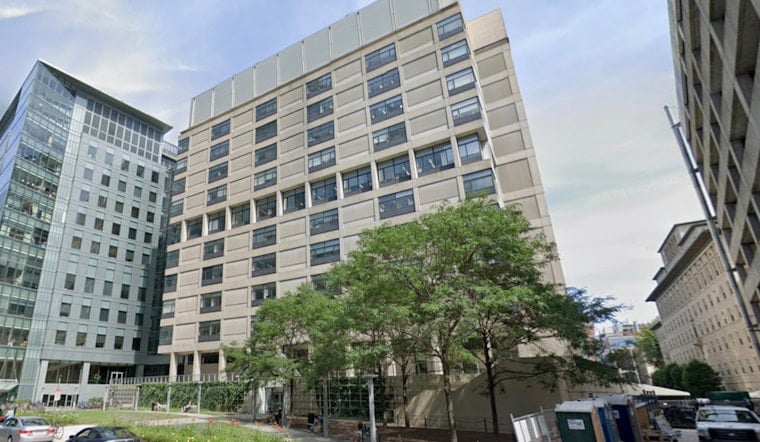
A researcher at a Mass General Brigham laboratory in Boston showered and changed inside a badge-access-only locker room before discovering a hidden camera tucked into the space, prompting a scream loud enough that a building manager heard it and police were called to the scene.
Editor's Note: This article has been updated to correct the identification of the building where the incident occurred.
The discovery happened inside a research lab that Mass General Brigham leases from Harvard, located on Blackfan Circle in Boston, according to WCVB. The outlet reports the locker room space is limited to researchers, with patients and other staff not having access to the area. Mass General Brigham has said the area was secured and that appropriate safety protocols were followed, though the health system has not detailed what that response involved.
The building is the Harvard Institutes of Medicine at 4 Blackfan Circle, a research facility in the Longwood Medical Area originally owned by Harvard Medical School. In 2018, Harvard Medical School sold a leasehold interest in a portion of the building to Intercontinental Real Estate Corporation, a Boston-based real estate investment firm, while Harvard retained ownership of the building in name. The facility houses laboratory and office space for Harvard Medical School, Dana-Farber Cancer Institute, and Brigham and Women's Hospital, reflecting how Boston's life science real estate market often requires health systems to lease specialized floors from universities or private developers rather than owning the buildings outright.
Who Responds When Harvard-Leased Space Is Involved
Because the lab is leased from Harvard but operated within Mass General Brigham's network, it remains an open question which entity is responsible for physical security maintenance and keycard access logs in the space, and who had physical access to the restricted locker room. Security and incident response at Harvard-affiliated buildings on Blackfan Circle typically involves coordinated oversight between private building security, the Harvard University Police Department, and the Boston Police Department, since these facilities share common access points across multi-institutional programs.
According to WCVB, Boston Police did not immediately respond to the outlet's requests for comment. Law enforcement has not publicly named a suspect, and it has not been confirmed whether any footage was extracted from or transmitted by the device.
What Massachusetts Law Says About Hidden Cameras
Under Massachusetts General Laws Chapter 272, Section 105, secretly photographing, videotaping, or electronically surveilling a nude or partially nude person without consent carries a criminal penalty of up to two and a half years in a house of correction, a fine of up to $5,000, or both, according to the Massachusetts Legislature. If the camera also captured audio, the person responsible could face additional felony charges under the state's wiretap statute, which requires all-party consent for recording oral communications and carries penalties of up to five years in prison and fines up to $10,000, per the Massachusetts Wiretap Act as detailed by World Law Digest.
Beyond criminal exposure, Massachusetts law also gives individuals a statutory right against unreasonable or serious interference with their privacy under Chapter 214, Section 1B, which allows victims to pursue civil damages in state court, according to Ambient.ai. Massachusetts courts weigh these civil claims by balancing an employer's operational interests against an employee's reasonable expectation of privacy in changing areas.
A Pattern of Hidden Camera Discoveries in Restricted Spaces
The incident echoes a case Hoodline covered in hospital staff-only spaces, when a hidden camera was found in a badge-access, staff-only restroom at Kaiser Permanente's West Los Angeles Medical Center, leading to a criminal investigation and the arrest of a healthcare system employee. That case, like this one, involved a device placed somewhere staff believed access was restricted to trusted personnel.
Mass General Brigham is the largest private employer in Massachusetts, with a workforce of more than 82,000 people across a network anchored by Massachusetts General Hospital and Brigham and Women's Hospital, according to Healthcare Dive. The health system operates within Boston's Longwood Medical Area, home to 21 medical and academic institutions supporting more than 155,000 jobs and 2.8 million annual patient visits, a density that underscores how tightly secured these badge-controlled research spaces are meant to be.
This is not the first time Mass General Brigham has had to address an internal privacy failure. In April 2024, the health system terminated three employees and notified affected patients after uncovering an internal breach in which personnel had allowed unauthorized individuals to access sensitive system data, as Hoodline reported at the time. It remains unclear whether any new internal review has been launched in connection with the locker room camera, and Mass General Brigham has not released further details beyond confirming that the area has since been secured.





