

























































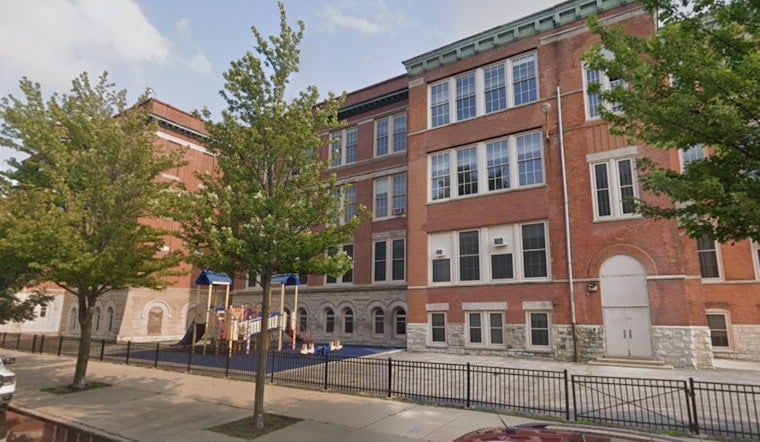
A decade-old plan to turn a shuttered Humboldt Park elementary school into apartments for teachers remains stalled, with a new nonprofit developer now racing to lock down financing while vandalism and break-ins worsen at the vacant building. Von Humboldt Elementary School, at 2620 W. Hirsch St., has sat empty for more than a decade, and the Teachers Village project meant to convert it into 103 affordable homes still needs funding for 42 of those apartments before construction can begin.
As Block Club Chicago reports, The Community Builders, a nationwide nonprofit housing developer, is now under contract to buy the property from New Jersey-based RBH Group and has taken over responsibility for the project and the building itself. The nonprofit says it intends to follow the existing redevelopment plan rather than redesign it, and it plans to finalize project funding by early 2027.
The Community Builders said it is proud to have taken on the role of developer and future owner of the project, according to the outlet's reporting. The group already has a foothold in Chicago: it developed an affordable housing complex in Lincoln Square that opened in 2025, broke ground in April 2026 on the third phase of the Southbridge housing project on the Near South Side, and opened the $50 million Sankofa Village Wellness Center in West Garfield Park that same month after winning the 2023 Chicago Prize from the Pritzker Traubert Foundation.
A Funding Puzzle Years in the Making
The project's finances have long been complicated. The city awarded Teachers Village $18 million in tax-exempt bonds in 2022, and the Chicago Housing Authority initially committed 27 project-based vouchers in 2020 before voting in 2024 to expand that commitment to 61 vouchers, according to Preservation Chicago. That voucher expansion represents an estimated $20.7 million in rental assistance over a 20-year contract term. By 2024, the project's development price tag stood at $50.6 million, though the outlet's reporting notes the updated redevelopment cost remains unclear.
Sixty-one of the planned apartments are earmarked for tenants earning 60 to 80 percent of area median income, while the remaining 42 will carry below-market rents once funded. Federal affordable-housing funding sources come with complicated steps, and the project still needs additional federal money before construction can start. Building records show a permit application has sat incomplete since December 2023, and a recent zoning review was denied, per the same building records cited by the outlet.
Vandalism Fears Mount at the Vacant Building
Alderperson Jessie Fuentes, who represents the 26th Ward, says the building has seen more vandalism and trespassing in 2026, and she has urged neighbors to call 911 when they spot suspicious activity at the site. “Every act of vandalism creates setbacks for affordable housing,” Fuentes said, according to the outlet's reporting, adding that ongoing break-ins jeopardize the building's future. The development team is working to better secure the property as the funding search continues.
The pattern echoes findings from a July 2026 study led by researchers at the University of Chicago and Johns Hopkins Bloomberg School of Public Health, which found that neighborhoods surrounding long-vacant Chicago Public Schools buildings closed in 2013 saw a 10 percent increase in gun violence compared to similar neighborhoods where schools stayed open, according to SFGATE. Building abandonment attracts trespassers, a dynamic that has shadowed Von Humboldt since it closed. Fuentes said the project may receive more low-income tax credits as soon as next month, per her comments to the outlet.
A School With a Contentious Closure History
Chicago Public Schools and then-Mayor Rahm Emanuel closed Von Humboldt as one of 49 schools shuttered in 2013. It was reportedly the only school on that closure list to receive a split vote — 4-2 to close — after two board members visited the site and met with weeping parents and staff, according to DNAinfo. Every other nearby Humboldt Park school closure that year was approved unanimously.
CPS sold the property in July 2015 to nonprofit lender IFF for $3.1 million under community-backed deed restrictions requiring the site to be reused for education, housing, or community services, according to WTTW News. RBH Group later received City Council approval for the Teachers Village project in 2020. The building itself was constructed in three phases: the original structure in the 1880s by architect John J. Flanders, a second building in 1895 by W. August Fiedler, and a third addition in 1921 by Arthur Hussander — making it one of the oldest surviving public school structures in Humboldt Park.
Modeled on a New Jersey Original
The Teachers Village concept is modeled after RBH Group's flagship project in downtown Newark, New Jersey, which was completed in 2017 at a cost of $150 million and transformed five city blocks into a 400,000-square-foot complex with 204 apartments, three charter schools, and 65,000 square feet of retail designed by architect Richard Meier, according to Forbes. During 2017 community feedback sessions in Humboldt Park, RBH Group reconfigured its initial proposal so that roughly 92 percent of residential units would be affordable to people earning average Chicago teacher salaries, after aldermen and neighbors raised gentrification concerns.
The finished Humboldt Park version will include studios and one-, two-, and three-bedroom units, along with a fitness room, a lounge and party room, a bike room, a dog wash station, and 53 parking spots. The Puerto Rican Cultural Center will have offices on the first floor. Illinois lawmakers, meanwhile, instituted a statutory moratorium on CPS school closures during the district's transition to an elected school board, which the CPS board has since extended through the 2026-2027 academic year, according to The Last Ward — a policy shift that has pushed the city toward reusing vacant buildings like Von Humboldt rather than closing more schools.
The Von Humboldt situation fits a broader pattern in the 26th Ward, where officials have pursued adaptive reuse of vacant institutional buildings, including an August proposal to convert a 98-year-old church into housing without on-site parking. For now, neighbors are left waiting on The Community Builders to close the funding gap on 42 apartments while trying to keep the century-old school building secure.





