

























































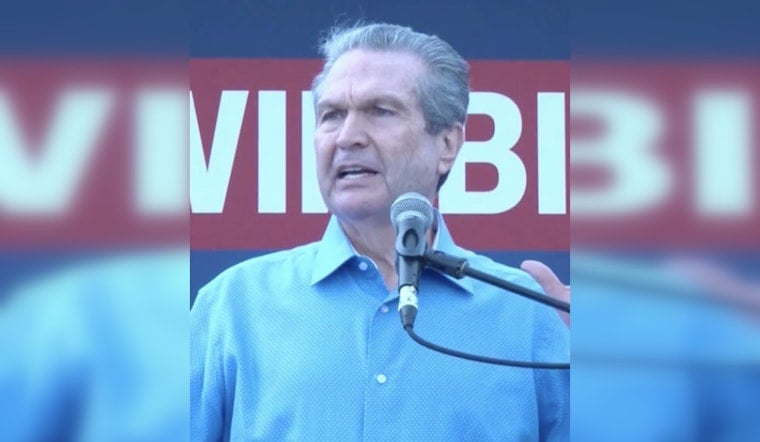
Republican gubernatorial nominee Rick Jackson told an audience in Columbus that Governor Brian Kemp will call up the Georgia National Guard to monitor the state's midterm elections in November. The remark, delivered at a campaign stop on August 13, has reignited a national fight over whether armed personnel belong anywhere near polling places on Election Day.
According to The Atlanta Journal-Constitution, Jackson assured the Columbus crowd that Kemp would activate the Guard, telling attendees, “I know, we're going to have people watching out for us.” The AJC report, written by chief political reporter Greg Bluestein, notes that one attendee at the event voiced fear that Democrats would cheat in the election. Kemp himself declined to comment on Jackson's characterization of his plans, per the same AJC account.
Jackson, who was endorsed by Kemp and appeared alongside the governor at a Character Matters rally in Buford, has built his campaign in part on close alignment with law enforcement. Earlier this month, Jackson announced that 104 of Georgia's 159 county sheriffs — nearly two-thirds of the state's sheriffs, including at least one Democrat — had endorsed his run for governor, according to CBS News. Public safety messaging has been a central pillar of his general-election strategy.
What Federal and State Law Actually Say
The legal picture is more complicated than a simple yes-or-no on troops at polling sites. Under 18 U.S.C. § 592, any civil or military officer of the United States who orders, brings, or keeps troops or armed personnel at a polling site faces up to five years in federal prison, fines, and permanent disqualification from federal office, per the Office of the Law Revision Counsel. That Reconstruction-era statute carries an exception only when military force is needed to repel armed enemies of the United States.
But the AJC's reporting frames this as a distinct issue from federalized troops: the fight is over the National Guard operating under Kemp's own authority. Under the federal Posse Comitatus Act, federal military troops are barred from civilian law enforcement, but state National Guard forces deployed under State Active Duty answer to the governor rather than the president and are not bound by those restrictions, according to Protect Democracy. That distinction creates what amounts to a legal gray area for state-controlled Guard deployments tied to elections, even as Georgia election law otherwise keeps precinct access tightly limited.
Georgia statutes O.C.G.A. § 21-2-413 and § 21-2-414 restrict access inside polling places to credentialed poll workers, designated poll watchers, voters, and authorized local law enforcement managing order, according to Justia Law. Poll managers retain authority to control crowd sizes and prevent voter inconvenience, but the statutes do not explicitly address a state-activated National Guard presence at or near precincts.
Democrats Push Back and Warrant Concern
Sen. Raphael Warnock has said federal law would restrict sending armed officers to polling sites, per the AJC's reporting, while Democrats have filed legal challenges over the prospect of federal intervention in the election and the Democratic National Committee has sought records about programs preparing for potential legal action. The AJC also reports that the Georgia National Guard has already dispatched roughly 300 troops to Washington at the request of Trump administration leaders, and that Republican officials have repeatedly floated the possibility of military involvement around elections. The AJC's report additionally notes that Kemp refused to overturn Georgia's 2020 election outcome and accepted his defeat by Joe Biden that year, and recalls that Donald Trump and Kemp once shook hands together with Army National Guard members in Evans, Georgia, in 2024. The FBI investigated ballot-counting allegations in Fulton County in January, the AJC notes.
Democratic nominee Keisha Lance Bottoms has cast potential military or law enforcement presence at polls as a form of voter suppression, a framing that has intensified since she received a high-profile endorsement in August from the National Democratic Redistricting Committee, led by former U.S. Attorney General Eric Holder, according to CBS News. Holder's endorsement emphasized protecting voter access and opposing partisan gerrymandering across the South.
Other states have moved to head off similar disputes altogether. New Mexico became the first in the nation, in March, to bar federal law enforcement officers and military personnel from being stationed near polling locations, according to LULAC, with several other legislatures introducing comparable measures ahead of the midterms. Department of Defense regulations under 32 CFR § 233.3 separately prohibit military commanders from using their authority to influence votes or ordering uniformed service members to march to polling locations, per the eCFR, citing 18 U.S.C. § 592 as a baseline.
A Race Already Defined by Money and Endorsements
Jackson, founder of Alpharetta-based Jackson Healthcare, self-funded much of his primary campaign to defeat Trump-endorsed Lt. Gov. Burt Jones in the June 16 Republican runoff, per Ballotpedia. He has continued to outspend Bottoms in the general election; campaign finance filings covering May through July showed Jackson raising $6.1 million compared to Bottoms' $3.1 million, a two-to-one advantage previously reported by Hoodline.
Polling has also shown Jackson with an edge among older voters. A mid-July AARP survey of 1,060 likely Georgia voters found 88% of those aged 50 and older reporting maximum motivation to vote, with Jackson leading Bottoms 55% to 42% in that group, with inflation and household affordability cited as top concerns. With the National Guard question now layered atop an already expensive and closely watched race, both campaigns appear headed toward a November fight over not just votes, but who gets to stand near the ballot box while they're cast.





.png)