

























































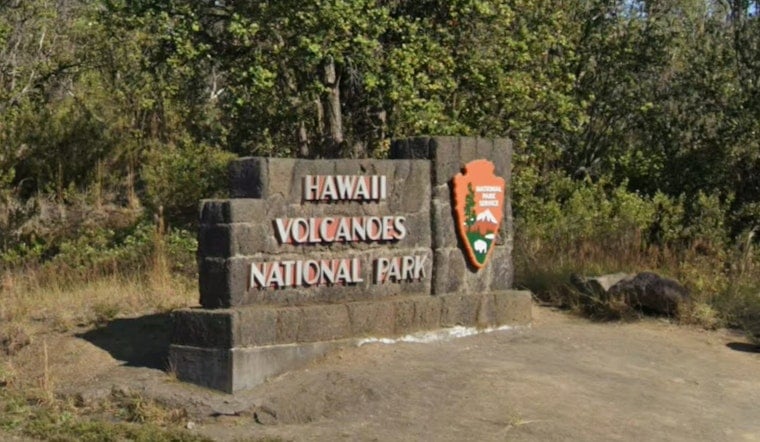
Lava began fountaining full-force from Kīlauea's north vent at 10:30 a.m. HST Tuesday, kicking off Episode 54 of the ongoing Halemaʻumaʻu eruption with fountains that started at 50 to 75 feet and were expected to rapidly climb toward 500 feet. The outburst came less than a day after Hawaiʻi Volcanoes National Park reopened roads that had been shut down by a passing tropical storm, giving visitors and residents a narrow window to catch the volcano roaring back to life.
The full fountaining followed hours of buildup that began with a precursory overflow from the north vent, according to Maui Now. Weak spattering from the north vent had actually started the evening before, at 7:30 p.m. HST Monday, and low-level eruptive activity ramped up further at 6:16 a.m. Tuesday, marked by strong rhythmic gas-pistoning spikes in volcanic tremor occurring every five to ten minutes. Glow from the vents kept intensifying through the night, past midnight, before giving way to Tuesday morning's full fountaining.
In response, the Hawaiian Volcano Observatory raised Kīlauea's alert level from Advisory to Watch and its aviation color code from Yellow to Orange, per the same outlet's report. That shift reflects a routine, standardized protocol the observatory adopted in April 2026 to dynamically move the volcano between Advisory/Yellow during quiet pauses and Watch/Orange whenever fountaining is underway, according to Big Island Now. Under the national USGS alert framework, a Watch designation and Orange aviation code signal that an eruption is underway or imminent with limited hazards, a step below the Warning/Red status reserved for major ash emissions threatening air traffic or communities, per the U.S. Geological Survey.
A Park Reopening Just Ahead of the Eruption
The timing added a wrinkle for Hawaiʻi Volcanoes National Park, which had reopened Crater Rim Drive West to Uēkahuna on Monday, just one day before Episode 54 began, after facilities and roads were closed by the passage of Tropical Storm Moke over the preceding weekend. That left park staff managing storm recovery and eruption response almost simultaneously, as Maui Now's report on the episode makes clear. Eruptive vents and lava flows remained confined to Halemaʻumaʻu crater within the park boundaries, according to the outlet.
Forecasters at the observatory said Tuesday's full fountaining was most likely to start within 12 hours of the morning update, with the broader episode forecast to begin sometime between Tuesday and Wednesday. Low-level precursory activity of the kind seen overnight can stretch on for hours or even days before a fountaining episode fully develops, the outlet noted, which is part of why observatory scientists track gas-pistoning tremor and vent glow so closely in the run-up to each new episode.
How This Episode Compares to Recent Fountaining
Episode 54 arrives roughly two weeks after Episode 53, which erupted August 12 into August 13 with 500-foot lava fountains and an 18,000-foot volcanic plume sustained over 9.6 hours of active fountaining, according to Big Island Video News. That episode ended abruptly at 1:23 a.m. HST before summit inflation resumed and began building toward the next cycle. The current Halemaʻumaʻu eruption sequence, which began in December 2024, set an all-time record for the most lava-fountaining episodes in a single Kīlauea eruption back on June 1 during Episode 48, surpassing the previous mark of 47 episodes set during the 1983-1986 Puʻuʻōʻō eruption, per the U.S. Geological Survey.
Scientists at the Hawaiian Volcano Observatory have attributed the volcano's unusually frequent cycling to a magma supply rate running roughly 25% above its long-term average, as Hoodline reported after Episode 53. That elevated supply builds subsurface pressure quickly, driving the rapid cycles of ground inflation and fountaining that have now produced 54 distinct episodes.
Vog and Ashfall Risks for Downwind Communities
Tephra fall from the eruption's ash clouds is expected to be greatest within three miles of the vents inside Halemaʻumaʻu crater, though lighter ash and Pele's hair may stay suspended in the air and travel much farther depending on wind direction, Maui Now reported. Three livestream camera views of the summit, along with the KPcam and MKcam feeds used to track plume height for aviation purposes, have let observers and pilots monitor the eruption's progress in real time.
Hawaiʻi County Civil Defense has repeatedly advised residents in downwind Kaʻū communities such as Pāhala and Nāʻālehu to disconnect roof-to-tank rainwater catchment systems ahead of fountaining episodes, since many rural Big Island homes rely entirely on catchment for drinking water. The Hawaiʻi Department of Health has also cautioned that standard face masks, including N95, KN95, and surgical masks, block airborne ash and Pele's hair but provide no protection against the toxic sulfur dioxide gas found in vog, a distinction Hoodline has flagged during earlier episodes of this same eruption cycle.



