

























































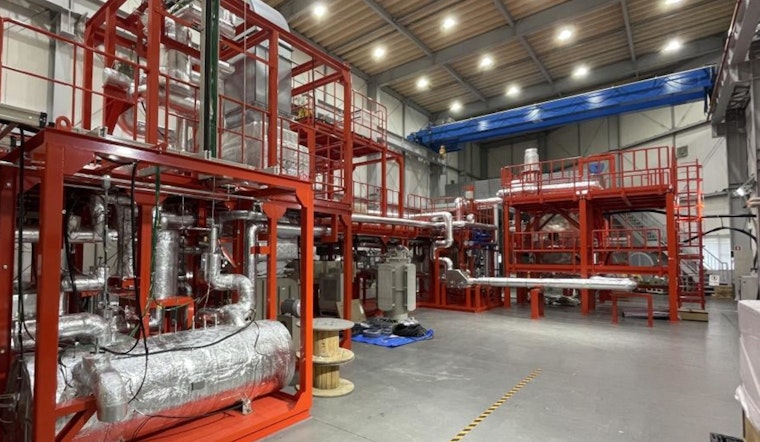
Kyoto Fusioneering is relocating its U.S. headquarters to Anderson County, bringing a $46.9 million capital investment and 51 new jobs to Oak Ridge as the Japanese fusion technology firm partners with Oak Ridge National Laboratory to build a first-of-its-kind testing facility called UNITY-3. The move deepens East Tennessee's growing footprint in the global race to commercialize fusion power, positioning Oak Ridge as a hub not just for research but for the specialized hardware that future reactors will actually run on.
The relocation and jobs figures come from the Tennessee Department of Economic and Community Development, which announced the package alongside details of the company's plans to build critical fusion testing infrastructure at Oak Ridge National Laboratory. According to the Eagle-Tribune, Kyoto Fusioneering will manufacture hardware, components and engineering services in Tennessee under a strategic partnership with the U.S. Department of Energy and Oak Ridge National Laboratory that launched in January 2026. The company describes itself as a fusion technology and integrated systems developer operating globally across Japan, the United States, Europe, and a joint venture in Canada.
UNITY-3 is designed to provide a representative test environment for fusion blanket components exposed to high-energy fusion neutrons, per the Eagle-Tribune's reporting. The facility will test blanket components, fuel-cycle technologies, and supporting data before full-scale integration, including separate-effect testing of blanket and fuel-cycle challenges. It's expected to validate tritium breeding blanket performance by measuring neutron spectra and tritium production in prototypical blankets, and the project has funding from the U.S. Department of Energy in addition to state support.
Why Tritium Breeding Matters for Commercial Fusion
Tritium breeding blankets inside fusion reactors extract thermal energy from high-energy 14 MeV neutrons to generate electricity while simultaneously producing new tritium fuel through neutron interactions with liquid lithium or molten salts, according to Oak Ridge National Laboratory research. Natural tritium is extremely rare, so commercial power plants must achieve fuel self-sufficiency during continuous operation, which is exactly the engineering gap UNITY-3 is meant to close. Oak Ridge National Laboratory, the largest multi-program science and technology laboratory in the Department of Energy system, brings more than eight decades of nuclear science experience to the collaboration, per the Eagle-Tribune. UNITY-3 will be delivered jointly by Kyoto Fusioneering and the laboratory as part of a coordinated, staged de-risking program, with the lab providing shared infrastructure for validating fusion blanket technologies.
The project also fits squarely into federal energy policy. The Department of Energy finalized its Fusion Science & Technology Roadmap in June 2026, laying out a Build-Innovate-Grow strategy aimed at achieving grid-ready commercial fusion power by the mid-2030s through public-private partnerships, according to Orrick. That roadmap explicitly identifies tritium breeding blankets and integrated neutron testing facilities as critical national gaps, meaning UNITY-3 addresses a national priority rather than functioning as an isolated corporate project. Kyoto Fusioneering is also partnering with Idaho National Laboratory and Savannah River National Laboratory, per the Eagle-Tribune, extending its reach across the U.S. national laboratory complex.
Tennessee's Nuclear Recruitment Machine
Tennessee is backing the relocation and UNITY-3 through its Nuclear Energy Supply Chain Investment Fund, an initiative Governor Bill Lee established in 2023 that has committed roughly $47 million across 14 nuclear-related projects and helped recruit more than $8 billion in private capital, according to Baker Donelson. Lee proposed adding another $25 million to the fund earlier this year, which would expand its total capacity to $95 million. The fund is the same mechanism that helped bring Radiant Industries' $280 million microreactor factory to Oak Ridge last October.
Kyoto Fusioneering's arrival adds to a fast-growing cluster of advanced nuclear projects in the region, sometimes referred to as the Oak Ridge Corridor. TRISO-X received an $11 million state grant in July for a commercial nuclear fuel campus, and local development officials have actively promoted East Tennessee as one of the nation's premier nuclear innovation ecosystems, per ANS Nuclear Newswire. State officials also pointed to the broader U.S.-Japan investment relationship during the announcement, per the Tennessee Department of Economic and Community Development: Japan is Tennessee's largest source of foreign direct investment, with more than 200 Japanese corporate entities operating in the state accounting for over 48,000 jobs and nearly $21 billion in cumulative capital investment.
Part of a Global Fusion Buildout
UNITY-3 represents the third phase of Kyoto Fusioneering's international infrastructure strategy, complementing the operational UNITY-1 thermal cycle facility in Kyoto, Japan, and the UNITY-2 tritium fuel cycle facility under construction at Canada's Chalk River Laboratories, according to World Nuclear News. UNITY-2 is being built through Fusion Fuel Cycles Inc., a joint venture between Kyoto Fusioneering and Canadian Nuclear Laboratories. Founded in 2019 as a spinout from Kyoto University, Kyoto Fusioneering completed a ¥9.4 billion (roughly $64 million) Series C extension and debt financing round in September 2025, bringing its cumulative equity capital raised to ¥16.2 billion (about $110 million), with investors including Kyocera, JERA, Sumitomo Mitsui Trust Bank, and Mitsui Fudosan, according to FusionXInvest.
The Oak Ridge announcement lands amid a historic surge of capital into the fusion sector. Private investment in global fusion companies reached a record $4.48 billion across 56 companies in the 12 months leading to July, a 69% increase over the prior year, bringing total private funding in the sector to $14.24 billion since 2021, according to Enlit World. The Eagle-Tribune's reporting notes that more than $100 million in private capital has flowed into fusion worldwide over the past year tied to activity like Kyoto Fusioneering's. Industry surveys have also found that companies are rapidly shifting focus from physics research toward hardware supply chains and siting agreements, mirroring Kyoto Fusioneering's approach of supplying components like tritium breeding blankets, gyrotrons, and fuel cycle loops rather than designing its own reactor.
That business model appears to be catching on industry-wide. According to the Fusion Industry Association's 2026 supply chain survey published in June, 54% of global fusion companies plan to contract with external specialized suppliers like Kyoto Fusioneering for fusion fuel cycle systems rather than developing them entirely in-house, per NucNet. Fuel cycle systems and high-temperature first-wall materials were cited as the primary technological bottlenecks facing the industry. For Oak Ridge, that positions Kyoto Fusioneering's new headquarters as a bet that whoever solves the supply-chain problem first could become indispensable to nearly every commercial fusion developer racing toward the grid.





