

























































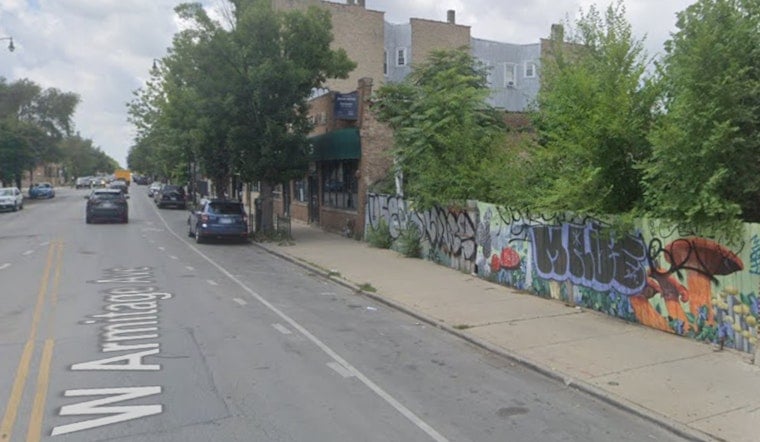
A vacant lot and a long-shuttered welding shop on Armitage Avenue in Logan Square could soon give way to a five-story building with 38 apartments, under a revised proposal now up for community review. The project at 3208-3216 W. Armitage Ave. would demolish the old Armitage Welding building and requires a zoning change before it can move forward.
The plan marks the third amended proposal for the site, according to Block Club Chicago. Developer Studio Oakley, the Chicago-based investment firm behind the project, has been refining its ambitions for the block since first floating a five-story mixed-use building with four stories of 20 apartments and ground-floor retail back in 2025. That original version included four below-market units; the current plan calls for 38 modern apartments with ground-floor commercial space, up from an interim version that had proposed 36 apartments.
Armitage Welding operated at 3212-3216 W. Armitage Ave. before closing in 2020, and the building has sat on the market since then, per the outlet's reporting. Studio Oakley does not currently own the lots that make up the proposed development site, though the firm does own the neighboring building at 3204 W. Armitage Ave., where it renovated four apartments and where the wine bar Outside Voices now operates. The BLNK Haus gallery, which once occupied 3206 W. Armitage Ave., moved out a few years ago.
Affordability Pitch Goes Beyond City Minimums
Studio Oakley is proposing that below-market units make up 30 percent of the project's market-rate apartments — well above the 20 percent baseline that Chicago's 2021 Affordable Requirements Ordinance generally requires for residential developments of 10 or more units seeking a zoning map amendment, according to the City of Chicago Department of Housing. The Armitage plan includes 11 below-market units total: six reserved for households earning 60 percent of area median income, two for households at 40 percent AMI, and additional units opening apartments to people earning just 15 to 20 percent of area median income.
Company officials told Block Club Chicago that Studio Oakley wants to bring more below-market units to the area and address the housing need while still turning a profit. Co-founder Eric Kogan said the firm's mission is to expand the city's housing stock — both market-rate and affordable — while preserving historic buildings in high-demand areas. Officials also said the deeper affordability approach is meant to enhance socioeconomic diversity in the development.
That extra affordability push is tied to a partnership Studio Oakley has struck with the Chicago Housing Authority's mobility counseling services program, which works with developers in areas with low poverty and crime rates to help place families in housing. The partnership allows the Armitage proposal to increase its affordability share by 10 percent, and lower-income tenants could end up in market-rate apartments at either the Armitage site or Studio Oakley's other nearby project.
Community Benefits Deal With Puerto Rican Cultural Center
Kogan said a community benefits agreement tied to the project will be drafted and signed by the Puerto Rican Cultural Center. That institution has organizational ties to 26th Ward Alderperson Jessie Fuentes, who previously served as Director of Policy and Youth Advocacy at the center before winning her council seat in 2023, according to the 26th Ward Office. The Northwest Side Neighborhood Alliance has voiced support for the proposal.
The 26th Ward Office hosted a community meeting on the proposal on August 19, and Fuentes announced the resident feedback deadline of October 1 in her ward newsletter. Fuentes runs a community-driven zoning process in the 26th Ward, gathering public input during structured comment periods before deciding whether to back zoning map amendments in City Council. Whether she will ultimately support the required change remains an open question the ward office has not yet resolved.
Parking, Bike Spaces, and a Second Project Nearby
The Armitage plan includes only 10 on-site parking spaces alongside 56 bike parking spaces — a ratio made possible under Chicago's Connected Communities Ordinance, which lets developers of transit-served properties near CTA stations or high-frequency bus lines reduce off-street parking mandates and gain density bonuses by-right, per Elevated Chicago. The ordinance has reshaped how infill projects like this one get built across the city's transit corridors.
Studio Oakley proposed its second new-construction project in Logan Square this summer, a separate five-story building at 2758 N. Mozart St. at the corner of Mozart Street and Diversey Avenue. That plan calls for 40 apartments, ground-floor retail, four two-story duplex townhomes, and eight affordable units under the city's inclusionary zoning rules, as Urbanize Chicago reported. A decision is also pending on a separate 31-apartment proposal from another developer at 3265 W. Armitage Ave., according to the 26th Ward Office.
The flurry of proposals lands against a backdrop of citywide housing scarcity. Chicago issued just 1.36 residential building permits per 1,000 residents in 2023, compared with an average of 4.71 permits per 1,000 residents across the nine other largest U.S. cities, according to an October 2025 report from the Illinois Policy Institute.
Preservation Rules Loom Over Gentrifying Blocks
Any redevelopment on this stretch of Armitage also unfolds under the Northwest Side Housing Preservation Ordinance, which the City Council passed in September 2024 with enforcement beginning in March 2025. The measure established demolition surcharges and tenant purchase options meant to curb gentrification-driven displacement across Logan Square, Avondale, and Humboldt Park, per the 26th Ward Office. Hoodline has previously reported on tenants racing to use those preservation tools, though by April, three tenant groups on the Northwest Side had attempted to exercise their right of first refusal under the Tenant Opportunity to Purchase Act pilot without completing an acquisition, according to The Daily Line.
Whether the deep-affordability units serving families at 15 to 20 percent AMI ultimately receive final CHA subsidy approvals remains unresolved, as does how nearby residents will respond to the reduced parking ratio once public comment wraps up. For now, the project joins a growing list of Logan Square proposals — including a nearby vacant hotel redevelopment Hoodline covered — testing how far the ward's community-driven review process will bend before October 1.



