

























































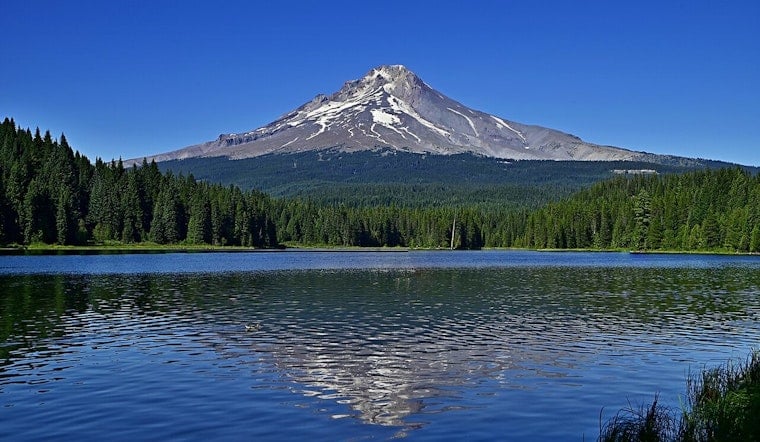
On a summer afternoon in August 1926, 7-year-old Jack Strong wandered away from his family's camp at Paradise Park on Mount Hood to find his older brothers and took a wrong turn instead. He would spend the next four days alone on the mountain, surviving on huckleberries and fish he caught with his hands, before rescuers found him 30 miles away, hiking near Reid Glacier.
Jack's brothers, Ray and Winston Strong, had gone fishing at Lost Creek, and when the boy could not find them, he kept walking in the wrong direction, according to OregonLive. Jack later said he cried for the first 15 minutes after realizing he was lost, but he calmed down and pressed on, fishing in a separate pool and eating what he caught raw. His mother, meanwhile, left a note telling searchers to find a phone and call his father. Ray and Winston traced the boy's path from Lost Creek to the Sandy River before seeking help from U.S. Forest Service rangers, who assembled a search team.
What followed was one of the largest wilderness searches the region had seen. Local newspapers called on woodsmen to join the hunt, a nearby shingle mill and lumber company shut down operations and sent all of its workers into the field, and a detachment of infantry from the Vancouver Barracks joined the effort. The Mazamas and the Trails Club of Oregon, established outdoor groups active in early Pacific Northwest mountaineering, also joined the search, per the same OregonLive account. A dozen women stayed behind to cook meals for the search party, while Jack's father searched near the Sandy River, reportedly telling rescuers at one point, “I'll kill you if it's not true,” when word of a possible sighting reached camp.
Federal Officials Opened Restricted Watershed for the Search
The scale of the operation was extraordinary enough that the federal government opened the Bull Run Watershed Reservation to searchers, an exception to strict rules that have closed the area to public entry since 1904. The watershed has served as Portland's primary municipal drinking water source since 1895 and today supplies water to nearly a quarter of Oregon residents, according to the City of Portland. Letting search parties into the protected 102-square-mile reservation underscored just how urgently authorities were trying to find the boy.
Search parties used a signal of two rifle shots followed by two more a minute later as they combed the mountain's slopes and canyons. Jack, meanwhile, kept moving on his own, eventually reaching Yocum Ridge, a rugged overlook on Mount Hood's west flank that sits at roughly 6,000 feet elevation and faces Reid Glacier and Sandy River Canyon, according to Off the Beaten Trail. The hike from Ramona Falls to that overlook involves nearly 3,700 feet of elevation gain, terrain that would challenge an experienced adult hiker, let alone a 7-year-old on his own.
Found Alive Near the Glacier He Could Not Cross
Jack could not find a way across Reid Glacier, and it was there that three Crag Rats searchers, P.J. Bucklin, Jesse Pully and L.M. Baldwin, approached from the other side and spotted him. He was alive, chapped in the face and hands from exposure, but according to an Oregon Journal report at the time, he was “fit as a fiddle.” Jack reportedly said he had not really been scared and did not understand why hundreds of people were out searching for him. He had spent three nights along the Muddy Fork stream, slept in grass, and eaten huckleberries and creek fish to survive, before insisting on walking part of the way back down the mountain on his own rather than being carried.
The Crag Rats brought him the rest of the way down Mount Hood, where he reunited with his parents after four days lost in the wilderness. The rescue was among the first carried out by the group, which had just formed that year and would go on to save scores of people from Mount Hood and beyond in the century since, per OregonLive's account. The Oregon Journal published its account of the rescue on August 16, 1926, written by George S. O'Neal. Jack Strong died in 2010.
A Century-Old Rescue, and a Legacy That Still Climbs
The Hood River Crag Rats are widely recognized as the oldest official mountain search and rescue team in the United States and a charter member of the Mountain Rescue Association, according to Coffee or Die Magazine. Just months after finding Jack, the group notched another early success in January 1927 when searcher Bill Cochran located 16-year-old skier Calvin White Jr., who had survived three days lost near Government Camp and lost several toes to frostbite. Those consecutive missing-youth rescues helped establish the volunteer team's public reputation in its earliest years.
A century later, the group's work looks different but the mountain's dangers have not changed. In 2025, the all-volunteer Crag Rats spent 54 days on active rescue missions, the second-busiest year in the organization's 100-year history, according to KPTV. Active members are still required to climb both Mount Hood and Mount Adams every year to maintain their eligibility on the team. Search and rescue physician Christopher Van Tilburg chronicled the group's full history in his 2025 book, Crisis on Mount Hood: Stories from 100 Years of Mountain Rescue, tying the Jack Strong search to the broader legacy of alpine rescue on the 11,249-foot peak.
Mount Hood still draws roughly 10,000 summit climb attempts a year, and local sheriff's departments and volunteer teams respond to somewhere between 25 and 50 search and rescue missions annually, per Wikipedia's entry on the mountain's climbing accidents. The mountain's deceptive weather has produced tragedy since Jack's rescue, including the deadliest search and rescue disaster in its history in May 1986, when seven high school students and two teachers from Oregon Episcopal School froze to death in a sudden blizzard while retreating from the summit, as reported by Outside Magazine. Hoodline's own coverage of the mountain has tracked that ongoing risk, from a Gresham mountain biker search that drew the Crag Rats back into a multi-agency operation last year to more recent alpine rescues and recoveries on the peak. A hundred years after a 7-year-old outwalked a search party of hundreds and lived to tell about it, Mount Hood remains as unpredictable as ever, and the volunteers who watch over it are still climbing to meet it.





