

























































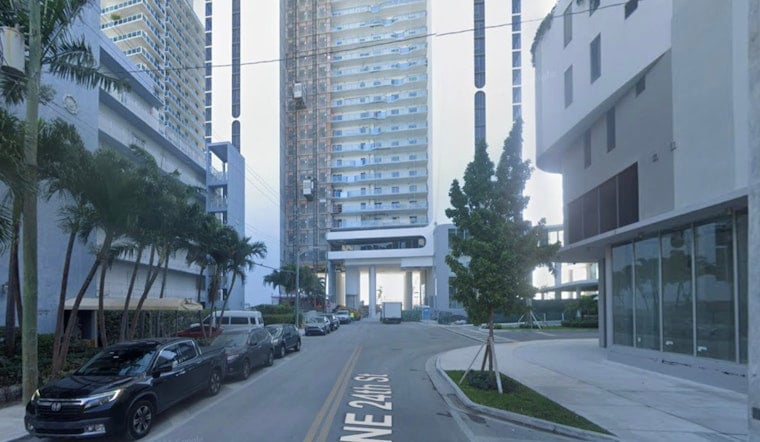
A man barricaded himself inside a unit at the Aria Reserve towers in Edgewater on Monday morning and suffered an apparently self-inflicted gunshot wound before being taken into custody, according to Miami police. Officers responded to the luxury waterfront high-rise near Northeast 7th Avenue and 24th Street around 7:30 a.m. after gunfire was heard coming from inside the unit.
Miami police officials said the man barricaded himself inside the apartment where the shots rang out, as reported by NBC 6 South Florida. SWAT crews, negotiators, and Miami Fire Rescue crews all responded to the scene as the standoff unfolded. Police say a second person was also inside the apartment with the man at the time.
The man was ultimately taken to a local hospital, where he was reported by police to be alert. He has since been taken into custody following the barricade incident, though it remains unclear whether he now faces any criminal charges.
Inside the Twin-Tower Complex Where It Happened
The standoff played out at Aria Reserve, a luxury 62-story, 649-foot waterfront twin-tower condominium development built by The Melo Group at 700 NE 24th Street, with its South Tower delivered in 2025. The complex sits on a five-acre waterfront parcel along Biscayne Bay, according to listing details cited by Zillow. Hoodline previously reported on the North Tower nearing completion earlier this year, and the building has also drawn attention for high-profile listings, including a penthouse put up for sale by music producer Poo Bear.
High-rise towers like Aria Reserve present distinct tactical challenges for police, given their private elevator foyers, extreme floor heights, and limited entry points. The City of Miami Police Department's SWAT unit and Hostage Negotiation Team conduct roughly 200 specialized operations annually, responding to barricaded subjects, armed standoffs, and suicidal individuals across the city, per the department. Standard tactical guidelines for these incidents call for establishing inner and outer perimeters, deploying crisis negotiators to open verbal communication, and coordinating closely with emergency medical services.
Edgewater's Growing Density Strains Emergency Response
The response fell under Miami police's East District, which combined Edgewater, Brickell, and Downtown into a single command in August 2025 to manage roughly 120,000 annual service calls in the city's densest urban corridors, Hoodline previously reported in coverage of a separate Brickell assault case. The restructuring reflects how quickly the area has transformed: developers spent over $500 million on Edgewater land acquisitions between late 2020 and mid-2022, creating a pipeline of nearly 6,000 residential units concentrated along the bayfront.
That density boom has already strained city infrastructure well beyond emergency calls; Hoodline reported earlier this month that Miami is pouring $14 million into Edgewater drainage upgrades as flood risk threatens 72% of homes in the neighborhood surrounding towers like Aria Reserve. Monday's standoff is also not the first time this year that Miami SWAT has been dispatched to the neighborhood, following an earlier raid on a smoke shop in the area.
What Happens Next Under Florida Law
Open questions remain about the relationship between the man and the second person who was inside the unit, and whether any domestic violence allegations or additional charges will follow. Also unresolved is whether police will pursue an involuntary mental health hold or a firearm seizure petition, two distinct legal paths available under Florida law following incidents like this one.
Under Florida's Mental Health Act, commonly known as the Baker Act, officers may take a person into custody for an involuntary 72-hour psychiatric evaluation if recent behavior suggests a substantial likelihood of serious harm to themselves or others, according to the Florida Department of Children and Families. Receiving facilities must conduct a mental health examination within 24 hours of arrival, and patients held under the law retain statutory rights, including treatment with individual dignity and the right to communicate privately with family, legal counsel, or advocates unless clinically restricted, per Recovery.com.
Separately, Florida Statute § 790.401, the state's Risk Protection Order or so-called red flag law, allows law enforcement agencies to petition a circuit court to temporarily bar individuals in crisis from possessing or purchasing firearms for up to 12 months, according to the Brancato Law Firm. Courts can issue these orders on an emergency, ex parte basis the same day a petition is filed, requiring immediate surrender of firearms to police, though a full evidentiary hearing must follow within roughly 14 days, per criminal defense attorney Michael White. If firearms were seized during a mental health evaluation without such an order, state law requires agencies to make them available for return within 24 hours of a patient's documented release, according to the Florida Senate.




