

























































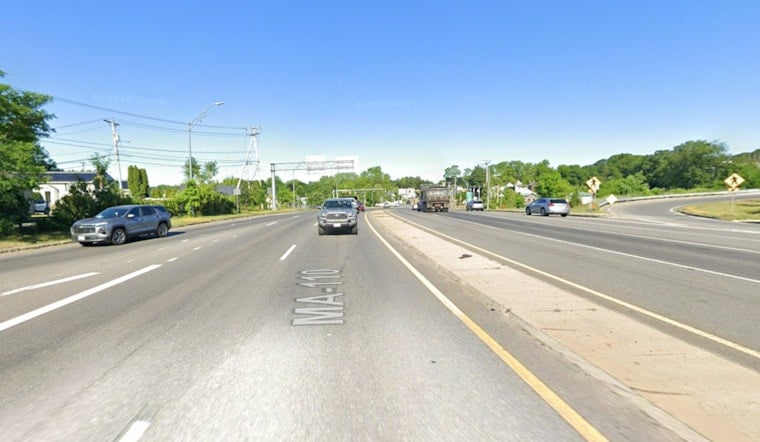
Drivers along Route 110 between Lowell, Dracut and Methuen have spent months navigating cones, drums and lane shifts as MassDOT presses ahead with a $17.6 million construction project designed to force traffic to slow down on a road that has carried a 45 mph speed limit for decades. The agency says the roughly 6-mile overhaul is meant to make the corridor safer by encouraging drivers to ease off the gas, even as some residents say the ongoing work has made their daily commute worse before it gets better.
Among the frustrated is a driver named Lia, who told WCVB that “a massive project going on through this stretch has been an absolute nightmare for months with no end in sight.” Lia also raised concerns about nighttime visibility along the corridor and questioned why sidewalks and bike lanes were being added at all, even as she acknowledged that drivers have routinely traveled faster than the posted 45 mph limit on Route 110. MassDOT has said the project is designed specifically to counter that kind of speeding by reshaping how the road looks and feels to drivers.
Narrower Lanes And New Safety Features Take Shape
The project includes narrower travel lanes and buffered bike lanes, both features MassDOT is counting on to naturally slow traffic without shrinking the road's overall capacity. According to the state's Project Development and Design Guide, 11-foot travel lanes are considered an effective speed-management tool because narrowing a driver's visual field tends to reduce speed while keeping the same number of lanes open, per guidance published on Mass.gov. The state's finalized design, detailed by Methuen Life Magazine, reallocates the existing pavement into those two 11-foot travel lanes alongside two 4-foot buffers featuring sinusoidal “mumble” rumble strips, a 5.5-foot sidewalk on the north side, and a dozen median islands, six of which sit within Methuen.
That final design represents a significant pivot from MassDOT's original plan. State engineers had initially proposed a continuous 10-foot protected shared-use path along the road's south side, paired with corridor-wide guardrails and a dense run of flex posts, before backing off in 2024 after local residents and business owners pushed back over concerns about property access and aesthetics. The revised layout that emerged instead calls for separate 5-foot buffered bike lanes on both sides of the road and trims the total number of flex posts to 176, the outlet reported.
Construction Drums And A New Beacon Sign In Methuen
Until the median islands are finished, MassDOT says construction drums surrounding those work zones are providing drivers with additional visibility in the meantime. The contractor has also installed 17 new driver speed-feedback signs throughout the project area, and MassDOT has added a beacon-enhanced flashing warning sign system at the Wheeler Street intersection in Methuen. That intersection was previously flagged in a city traffic study that recorded six motor vehicle collisions there between 2015 and 2021, according to a report from the City of Methuen, which noted the intersection handles heavy turning traffic from surrounding residential neighborhoods and commercial areas.
The rumble strips being installed along the shoulder buffers aren't just about noise or nuisance. MassDOT's safety projections indicate that rumble strips along arterial shoulder buffers can reduce run-off-the-road crashes by 21% to 43%, per the same Methuen Life Magazine report, a meaningful figure given that run-off-road collisions are among the most common severe crash types on suburban arterial roads like Route 110.
A Corridor With A History Of Speed And Tragedy
The stakes behind the project aren't abstract. In June 2025, a collision on Route 110 in Dracut resulted in the death of a Lowell man riding a scooter, a tragedy Hoodline previously reported that underscored the ongoing safety risks along this stretch of road. Local residents have frequently pointed to high vehicle speeds and poor nighttime visibility as persistent hazards on the corridor, concerns that echo the ones Lia raised to WCVB.
Route 110's role as a heavy commuter route between Lowell, Dracut and Methuen traces back decades. A planned western extension of Route 213 to Route 3 was canceled in the 1960s amid environmental concerns and local opposition, according to local history shared on Facebook, which noted that the unbuilt highway segment ended up redirecting regional traffic onto surface routes like Route 110 and Route 113 instead.
Cost, Funding And What Comes Next
MassDOT has designated the initiative as Project ID 608816, with a primary construction bid of $15.4 million and overall project costs reaching approximately $20.5 million once other expenses are factored in, funded 80% through federal aid and 20% through state funds, according to MassDOT project information. The project spans 6.3 miles from the Merrimack River bike path in Lowell east to Riverside Drive in Methuen and is expected to wrap up by summer 2027, per the project timeline.
Once construction is complete, MassDOT plans to conduct a formal post-construction speed study to evaluate how drivers actually behave on the redesigned road and determine whether the posted speed limit should be permanently lowered below its historical 45 mph mark, a step state guidelines require before any such change can be made. Separately, the City of Methuen has also been managing an ARPA-funded drainage project along Lowell Street near East Capitol Street since May 2025, aimed at fixing chronic street flooding, according to the City of Methuen — one more piece of construction compounding delays for drivers already navigating the Route 110 work.





