

























































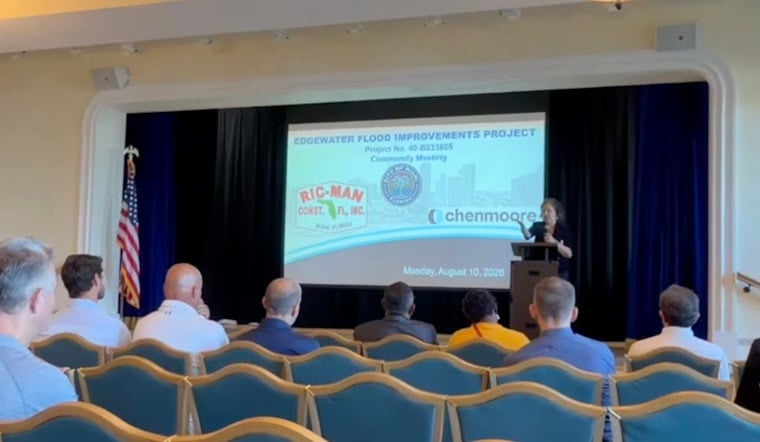
Edgewater residents packed into a community briefing to learn about a $14 million stormwater improvement project aimed at the flood-prone corridor along NE 21st through 24th Streets, where standing water has long stalled cars and stranded neighbors during heavy rain. The project promises upgraded drainage designed to reduce the recurring flooding that has plagued the low-lying Biscayne Bay-adjacent neighborhood for years.
According to a City of Miami announcement, the gathering was meant to walk residents through the scope of the work and how it will serve the NE 21st–24th Streets area. City capital project records register the effort as Project 40-B233805, officially named “Edgewater Flood Improvements Phase I – NE 4 Ave to Biscayne Bay, NE 22 St to NE 24 St,” and the scope includes a new stormwater pump station, upsized inlets and pipes, and street reconstruction, per the city's capital project documentation. The project falls under the city's Office of Capital Improvements.
A Neighborhood That Has Already Flooded Badly
The upgrade is not a preventative measure dreamed up in the abstract. During a severe tropical weather system in June 2024, relentless downpours submerged NE 23rd Street, leaving residents stranded and vehicles stalled, and forcing the city to run 26 flood pumps — 14 permanent and 12 temporary — just to keep the water under control, as reported by CBS News. That episode underscored how vulnerable the corridor is once South Florida's rainy season kicks into gear.
The stakes are not shrinking. Climate risk assessments published by First Street Foundation in 2026 found that 72% of all properties in Edgewater — 362 properties in total — face a major risk of severe flooding over the next 30 years, according to data compiled by Redfin. That figure puts the NE 21st–24th Streets project in stark context: this is one small piece of a much larger vulnerability across the neighborhood.
Part of a Much Bigger, Multibillion-Dollar Plan
The $14 million project fits inside Miami's broader Stormwater Master Plan, updated in April 2022 with engineering firm CDM Smith, which identified $600 million in near-term priority drainage upgrades across flood-prone neighborhoods including Edgewater. The same plan estimates that fully adapting the city to long-term climate impacts will ultimately cost more than $5 billion, per reporting from Miami Today. City officials are also pursuing complementary coastal defenses nearby: Project 40-B233810, part of the city's District 2 resilience schedule, calls for replacing eight deteriorating seawalls along Biscayne Bay in Edgewater between NE 22nd Street and NE 34th Street.
Federal dollars have chipped in too. Community project funding enacted through the Consolidated Appropriations Act in March 2024 included $1 million for the City of Miami earmarked for municipal drainage improvements, roadway widening, and sidewalk safety, according to the office of U.S. Rep. Maria Elvira Salazar.
Density-for-Resilience Deal Adds a Wrinkle
The drainage push is unfolding alongside a contentious zoning proposal from District 2 Commissioner Damian Pardo, whose account tagged the city's announcement of the stormwater briefing. In November 2025, the Miami City Commission voted on first reading to approve Pardo's plan allowing developers in Edgewater to double their buildable density from 150 to 300 units per acre in exchange for paying a $35,000-per-unit fee into a dedicated Resilience Trust Fund that would help pay for pumps, seawalls, and road elevations, as reported by The Real Deal.
That tradeoff arrives as Edgewater is already in the middle of an intense high-rise residential boom, including the twin-tower, 62-story Aria Reserve complex at 700 NE 24th Street — placing more residents directly inside the same flood corridor the new pump station is meant to protect, according to listings site Serhant. Critics have pointed to a separate wrinkle: city financial records in early 2026 showed $127 million in previously approved Miami Forever Bond funds sitting unissued because design and permitting phases for various resilience projects weren't yet construction-ready, Political Cortadito reported.
Trees as a Parallel Line of Defense
Not all of the neighborhood's flood-fighting strategy involves concrete and pumps. Research from Florida International University has highlighted how mature urban tree canopies absorb stormwater runoff and reduce extreme heat, a finding that has fueled community pushback against developer tree removal permits in Edgewater in recent months, as Hoodline has reported. That tension echoes a forged-permit tree fight in Buena Vista, where residents have raised similar concerns about losing green infrastructure just as the city tries to shore up drainage elsewhere.
For now, the NE 21st–24th Streets project represents a concrete, funded step for a neighborhood that has spent years watching its streets disappear under rainwater. Whether it, along with the seawall replacements and the density-for-resilience fund, can keep pace with both the rain and the rising skyline remains the open question hanging over Edgewater's next building boom.





