

























































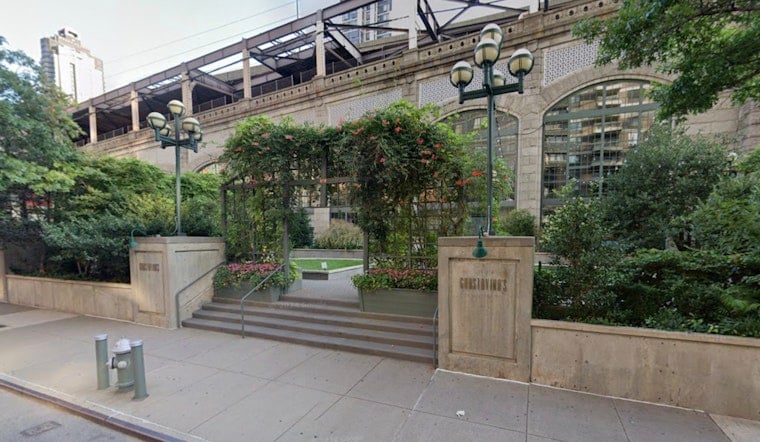
A group of Midtown East residents has sued New York City and the luxury event venue Guastavino's, alleging the business spent roughly two decades treating a city-owned plaza near the Queensboro Bridge as its own private garden — barricading entrances, posting no-trespassing signs, and even getting people arrested for sitting in a space that belongs to the public. The plaza sits under the bridge near East 59th Street and 1st Avenue in Midtown East, and it centers on a large fountain donated to the city by the Municipal Art Society of New York.
According to amNewYork, the lawsuit alleges Guastavino's used barricades, no-trespassing signs, private security guards, and an arrangement with the local NYPD precinct to keep the public out of the plaza, evicting people on a daily or near-daily basis. The suit further claims the venue and a commercial real estate developer falsely asserted the plaza was private property, helping to evict, arrest, and charge members of the public with trespassing for simply being there. Guastavino's operates beneath the landmarked Guastavino tile vaults of the Queensboro Bridge approach, a space that opened as a public restaurant in 2000 before converting into an exclusive private event hall in 2006, according to Courthouse News.
A Pandemic Workout Led to an Arrest
Lead plaintiff Sean Basinski said he began using the plaza to lift weights and get fresh air during COVID-19 gym closures in 2020, but security guards repeatedly ordered him to leave. Per Courthouse News, that conflict escalated to a December 2025 arrest by NYPD officers after Basinski refused to vacate the public space; he was arrested for trespassing while sitting in the plaza and taking photos, and the case against him was reportedly dismissed a few months before publication. Basinski said he was told to leave the plaza without adequate reasoning, and he estimated the plaza has been contested for approximately 20 years. He also said he had heard from dozens of neighbors who reported being kicked out or incorrectly told the space was not public.
Other residents described similar experiences. Iskander Khan, 21, who grew up in the area, said he was kicked out of the space by security as a child and called for clearer signage identifying it as public. The plaza's fountain inscription itself denotes the space as public, and the site has been a city-owned public space for decades, dating to around 1900 when the city acquired the land to build the Manhattan approach for the Queensboro Bridge, per Courthouse News.
Venue Sold Access as a Private Perk
The lawsuit alleges Guastavino's sold use of the public plaza — and the illusion of exclusivity — to event clients, according to the suit's claims. Courthouse News reports the venue erected tall trellises, roped off entrances, and marketed private event packages priced from $150,000 to $300,000 that promised exclusive outdoor garden access, with clients reportedly paying up to $300,000 to hold events there. The suit also alleges Guastavino's accepted payment for a high-profile film shoot staged in the public plaza, and that its website advertised the space as its private garden, per the lawsuit. The suit further claims Guastavino's never obtained a city permit for use of the outdoor public space for those events.
City Council member Julie Menin, who represents the district that includes the plaza, said public spaces must remain accessible for all New Yorkers. She requested that city agencies investigate the matter. Council members have also considered stronger enforcement against private businesses that misuse or restrict access to public spaces, and Brice Peyre said residents had complained about private businesses taking advantage of public spaces and the city's Privately Owned Public Spaces program, calling for enforcement of existing regulations and consideration of financial or stepped-up penalties. Virginia Maloney has focused on private businesses' use of public spaces and POPS as well.
Venue Removes Signage, Says It's Working With the City
In a statement following the lawsuit, Guastavino's acknowledged the plaza is public and confirmed it removed signage incorrectly labeling the space a private garden on Tuesday morning, according to Patch. New signage will be installed to clearly indicate the space is public, and the venue said it is working with the city to come up with a path forward that accommodates event egress safety. Private businesses that build near or around plazas like this one typically sign leases with the city requiring the space to remain public. Both City Hall and the NYPD did not respond to requests for comment on the lawsuit, per amNewYork.
Beyond seeking court-ordered public access, the lawsuit demands an accounting of profits Guastavino's generated from monetizing the public plaza and seeks financial restitution placed into a court-approved Midtown East restoration fund dedicated to preservation of public space in the neighborhood, according to Courthouse News. The suit, filed August 24, 2026, also seeks damages on behalf of people who were kicked out of or denied access to the plaza over the years. Residents say the space is especially important to the neighborhood because the area has historically had little green space nearby.
Part of a Wider Pattern Across NYC Plazas
The dispute lands amid a broader citywide reckoning over privately owned public spaces, known as POPS, which were established under New York's 1961 Zoning Resolution. That policy let developers build 10 square feet of bonus indoor floor space for every 1 square foot of public plaza provided, yielding more than 590 plazas across 80 acres and 16 million square feet of bonus building area citywide, as Hoodline previously reported. That portfolio is valued at an estimated $10 billion, yet non-compliant owners had paid just $1.4 million in total historic fines, with roughly 20% of POPS landlords found actively violating their zoning agreements. Earlier this month, the city's Department of Buildings announced increased fines of up to $25,000 for commercial property owners who lock out or block public access to designated plazas.
For now, the fate of the East 59th Street plaza — and whether Guastavino's will face financial penalties for years of alleged restricted access — remains before the courts. City agencies are continuing to investigate the matter at Menin's request, while residents like Basinski and Khan wait to see whether the promised new signage, and any broader policy changes, will actually keep the plaza open to the public going forward.





