

























































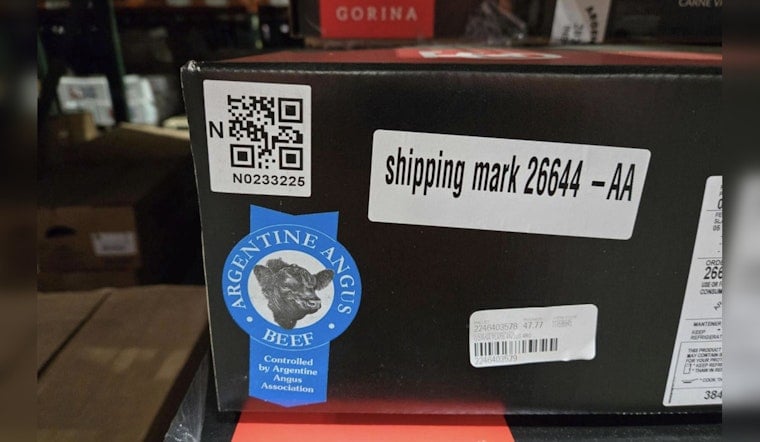
Nearly 30,000 pounds of raw Argentine beef sent to distributors and retail outlets across Florida and Texas is being recalled after federal officials discovered the shipment never went through a required import safety check. The U.S. Department of Agriculture has classified the recall as Class I, its highest risk designation, meaning there is a reasonable probability that using the product could cause serious health consequences or death.
The recalled beef, 29,628 pounds of raw boneless cuts, was imported by Corte Argentino USA LLC, a company based in Aventura, Florida, according to Fox 5 San Diego. Federal inspectors found that the shipment bypassed a mandatory reinspection that all imported meat must undergo after clearing customs. Under the Federal Meat Inspection Act, every commercial shipment of imported meat entering the United States must pass through port-of-entry reinspection by USDA Food Safety and Inspection Service inspectors at an approved facility, after first clearing Customs and Border Protection and Animal and Plant Health Inspection Service checks. That reinspection step verifies official foreign certificates, labeling and general product condition, and includes random pathogen testing.
The products were produced between May 15 and May 20, 2026, and carry use-by or freeze-by dates ranging from September 15 to September 20 this year, according to FSIS. That wide window between production and freeze-by dates means a substantial portion of the beef could still be sitting in commercial or home freezers months after it was packaged.
What's Included in the Recall
The recalled items span several cuts commonly sold under Argentine labeling, including topside cap off (labeled nalga ad s/tapa), eye round (peceto), top sirloin butt (cuadril sin tapa), a flat cut labeled carnaza cuadrada, and knuckle (bola de lomo). Affected boxes are marked with establishment number 2025, lot number 26644-AA, and bear the label Frigorifico Gorina SAIC.
That processor, Frigorifico Gorina, operates out of La Plata, Argentina, under SENASA establishment number 2025 and ranks among the country's largest meatpackers, generating between 14% and 16% of Argentina's total fresh, chilled and frozen beef exports. The plant is one of roughly 20 Argentine facilities certified by Argentine Beef USA under SENASA and recognized under USDA equivalency rules to export beef to the United States, meaning the facility itself was authorized to ship here — the failure occurred somewhere in the chain that was supposed to route the meat through reinspection. Corte Argentino USA, founded in 2020, serves as Frigorifico Gorina's exclusive U.S. distributor, supplying grass-fed and grain-finished certified Argentine Angus beef to wholesale, retail and foodservice accounts, according to the importer's own company profile. On its website, the company describes serving customers in Miami and throughout the United States.
No Illnesses Reported, but Questions Remain
FSIS reported that no illnesses have been connected to the recalled meat so far. Even so, the agency automatically categorizes uninspected meat entries as potential Class I hazards because their safety status is unknown, and it is urging consumers not to eat the affected beef and instead to throw it away or return it. A Corte Argentino representative told Fox 5 San Diego the company was unable to confirm whether distributors in Florida and Texas had further shipped the beef to other states.
An FSIS communications representative also told the outlet the agency could not comment on the recall classification or say whether all products that bypass required inspection are automatically labeled Class I. It remains unclear exactly how the shipment moved from the port of entry into distributor channels in Florida and Texas without triggering the inspection hold that is supposed to catch such gaps. FSIS said the missed reinspection surfaced through routine reviews of import logs and documentation, not from consumer complaints or reported illnesses, according to WFAA.
Federal Checks Continue Across State Lines
Under standard FSIS Class I recall procedures, the agency is required to eventually compile and release a full list of retail consignees, the grocery stores, delis and commercial accounts that received the recalled meat, once distribution tracing is complete. Because wholesale distributors buy in bulk, building that retail-level list can take investigators time. In the meantime, federal compliance officers are required to conduct recall effectiveness checks across wholesale and retail distributors in Florida and Texas to physically verify the beef has actually been pulled from commerce.
The Corte Argentino recall is not an isolated case. On the same day FSIS announced the beef recall, it issued a separate Class I recall for Shan Distribution Network covering 5,084 pounds of frozen swai fish imported from the UAE without proper inspection or eligibility, underscoring active federal scrutiny of imported food shipments in early August. Days earlier, on July 28, Maple Leaf Foods recalled 12,036 pounds of Canadian smoked bacon across the Pacific Northwest after it skipped the same import reinspection step, a Class I action that likewise involved no reported illnesses.




