

























































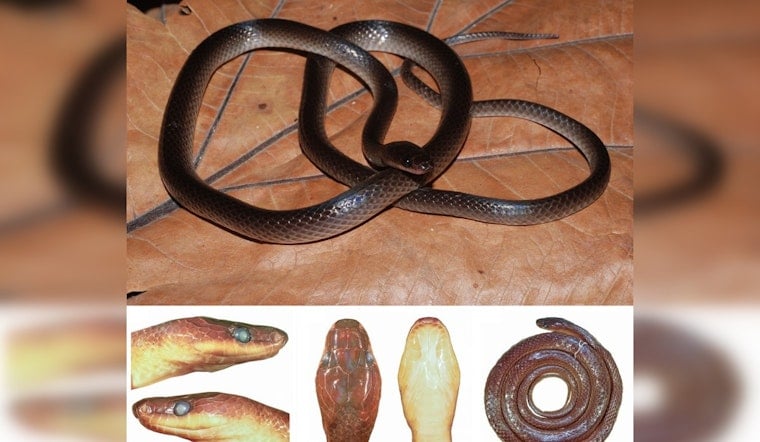
A newly confirmed species of groundsnake slithering through the lowland rainforests of New Guinea now carries the name of one of rock's most recognizable guitarists. Researchers have formally described Lielaphis slashi, a reddish-brown, non-venomous reptile measuring about 28 inches long, naming it in honor of Guns N' Roses guitarist Slash, a lifelong reptile enthusiast whose personal collection has included anacondas, Burmese pythons, and a red-tailed boa constrictor.
The species was formally described in a paper published August 11 in the taxonomy journal Zootaxa, authored by lead researcher Tianqi Huang alongside senior author Sara Ruane, an associate curator of herpetology at Chicago's Field Museum, according to Zootaxa. As reported by FOX5 Las Vegas, researchers studied and classified the snake, confirming it produces no venom that could seriously hurt a person and identifying it as a distinct member of the Papuan groundsnake genus Lielaphis, found in New Guinea. The team combined high-throughput genetic sequencing with physical scale examinations to confirm the animal was a species of its own rather than a visual match for its relatives.
A Childhood Magazine Cover Sparks a Career
The naming carries a personal backstory for Ruane, whose fascination with reptiles was shaped in part by a 1995 issue of Reptiles Magazine featuring Slash holding his pet reticulated python on the cover. Per Nautilus, Ruane had been a Guns N' Roses fan since first grade, long before that childhood interest evolved into a career studying snakes at a major natural history museum. Slash later visited the Field Museum, where he was photographed with Ruane and her copy of that same Reptiles Magazine issue, and the guitarist said he is extremely honored to have the snake species named after him, according to FOX5 Las Vegas.
Slash's connection to herpetology runs deeper than a single magazine cover. He detailed his extensive menagerie of reptiles in mid-1990s media interviews, and the same fascination has surfaced repeatedly throughout his music career, per Nautilus. He formed the rock group Slash's Snakepit in 1994, a band that featured members from Guns N' Roses, Alice in Chains, and Jellyfish, and he later named his blues concert tour the S.E.R.P.E.N.T. Festival, according to CBC News. FOX5 Las Vegas also notes that Slash supports museums and zoos, reflecting an interest in reptiles that extends well beyond his stage persona.
Two Decades From Field Collection to Formal Description
The holotype specimen that became Lielaphis slashi was first collected at night in 2006 by Louisiana State University curator Christopher C. Austin in the northeastern lowlands of mainland New Guinea, according to Zootaxa. The specimen then sat in museum collections for roughly a decade before genetic testing began in 2016, illustrating how long undiscovered biodiversity can wait in storage before advances in sequencing technology allow scientists to separate a distinct species from close relatives. The formal identification brings the total number of recognized species within the genus Lielaphis to 20, up from 19, according to Zootaxa, a genus that was recently resurrected to help categorize cryptic biodiversity across New Guinea.
Like other members of its genus, Lielaphis slashi is a nocturnal hunter that forages around the bases of trees, according to Discover Wildlife. New Guinea, where the species was found, is home to the world's third-largest remaining rainforest tract and contains more than 5 percent of Earth's terrestrial plant and animal species, the outlet reports, even though much of that biodiversity remains undocumented by science.
Conservation Stakes Behind the Celebrity Headline
Biologists involved in the study noted that the lowland forest habitat where Lielaphis slashi lives faces environmental pressure from human activities including coffee farming and mining, according to Noise11. Researchers emphasize that species without formal taxonomic descriptions cannot be legally protected, making discoveries like this one more than a novelty — they are a necessary first step toward conservation planning in a region where development can outpace scientific documentation.
Naming newly discovered species after musicians has become something of an established pattern in taxonomy. Noise11 points to past examples including a bright yellow huntsman spider named Heteropoda davidbowie for David Bowie and a horse fly named Scaptia beyonceae for Beyoncé, part of a broader trend of scientists drawing on pop culture to raise public awareness for wildlife and the threats facing it.





