

























































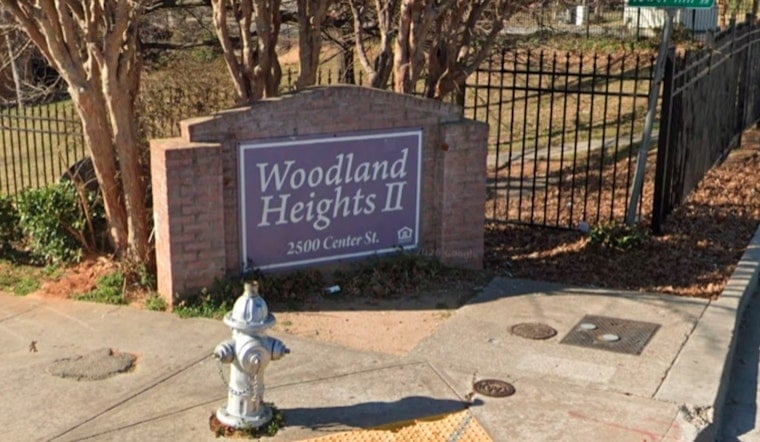
Residents at a Northwest Atlanta apartment complex say they have gone months without working air conditioning, with one tenant describing an HVAC system that clicks on and then shuts off because there is no air moving through the line. At Woodland Heights, tenants say complaints to management, code enforcement, and even the federal government have produced no change.
A resident named Elrico, a certified plumber, told Atlanta News First he has lived almost three months without air conditioning and that the heat inside his home can become unbearable. He said he has repeatedly asked the rent office about getting it fixed, and that management told him it lacked the equipment to make the repair. Elrico also said the air-conditioning technician who used to service the property no longer works there, and he has a one-year-old baby at home.
Another tenant, Cashly Jordan, said her heating and air have not worked since she moved in nearly a year ago and that her home currently has no air conditioning at all. Jordan, who has a one-year-old daughter, said she once used her stove for warmth when her daughter was five months old. A separate resident reported that her air conditioning has been out for three months and that her daughter suffered nosebleeds at home because of the heat.
Tenants Say Complaints Go Nowhere
Residents say they have contacted property management, city code enforcement, and the U.S. Department of Housing and Urban Development about the conditions, but that nothing has changed as a result. Jordan said residents in the community are treated unfairly, and she believes some tenants are treated differently than others. She also said she is worried about how the household will manage without working HVAC as fall and winter approach.
The property is owned by Reservation Limited Partnership, described as a California-based LLC. The station reported it reached out to both the ownership entity and to HUD about the air-conditioning and HVAC complaints but had not received a response from either as of publication. Elrico said management has indicated plans to eventually hire someone to fix the air conditioner, though no timeline has been given.
A Pattern of Neglect Documented for Years
Woodland Heights has received dozens of code violations and complaints from the City of Atlanta dating back to 2020, according to the station's reporting. That pattern is corroborated by a separate investigation from Atlanta Civic Circle, which found the Atlanta Solicitor's Office logged at least 87 official code enforcement complaints from the complex's tenants between 2020 and mid-2025 — covering carbon monoxide leaks, water leaks, pest infestations, exposed wiring, collapsing ceilings, and missing smoke detectors across the 354-unit property.
That outlet also reported that the complex's owner, identified there as Rolling Bends | Preservation Limited Partners, has repeatedly paid city code enforcement fines rather than making structural repairs. Those municipal fines max out at $1,000 per offense, and city prosecutors have noted that the cap allows out-of-state investors to absorb penalties again and again rather than fix the underlying problems, per the same outlet's reporting.
Federal Inspections Didn't Catch the Problems
Despite the documented leaks, mold, and code complaints, HUD awarded Woodland Heights physical inspection scores of 96 in April 2024 and 81 in December 2024 under its Project-Based Rental Assistance contract, according to Atlanta Civic Circle's reporting. The gap between those passing scores and tenants' ongoing accounts of dilapidation has drawn scrutiny before: in September 2023, U.S. Senators Jon Ossoff and Sherrod Brown launched a formal inquiry demanding HUD explain why federally subsidized properties across Georgia keep receiving public funds despite widespread health and safety violations, according to the Atlanta Journal-Constitution.
Woodland Heights was also targeted under Atlanta Mayor Andre Dickens' Safe and Secure Housing initiative, launched in 2023 to direct code enforcement and legal resources toward prosecuting serial code-violating apartment complexes. In August 2025, Atlanta City Councilmember Dustin Hillis, local housing advocates, and the American Descendants of Slavery Advocacy Foundation organized door-to-door campaigns at the complex to gather enforceable violation data for the City Solicitor, aiming to build enough documented cases to make continued non-repair economically unviable for the owner.
What the Law Actually Requires
Georgia's Safe at Home Act, known as HB 404 and signed into law in 2024, established a statutory duty requiring landlords to maintain rental housing fit for human habitation and explicitly classified air conditioning as an essential utility that landlords cannot cut off or leave unmaintained. Before that law passed, Georgia was the only state in the country without an explicit statutory warrant of habitability, according to reporting cited in Hoodline's coverage of a similar case.
Enforcement remains slow, however, because state lawmakers acknowledged during 2026 legislative discussions that HB 404 intentionally omitted a specific definition of what counts as fit for human habitation in order to secure the bill's passage, leaving the standard to case-by-case court interpretation. Georgia law also allows tenants to use repair-and-deduct remedies for essential fixes, but caps total deductions at one month's rent or $500, whichever is greater — an amount far below what a central air conditioning replacement typically costs, according to Georgia Legal Aid.
The City of Atlanta Housing Code does not explicitly require residential buildings to be built with air conditioning, but under Georgia landlord-tenant doctrine, landlords are obligated to repair and maintain any cooling system that was included at the start of a lease, per guidance from ATL 311. For tenants like Elrico and Jordan, that leaves the same question repeated across metro Atlanta's federally subsidized housing stock: whether a legal duty to fix a broken air conditioner means much if the penalties for ignoring it remain cheaper than the repair itself.





