

























































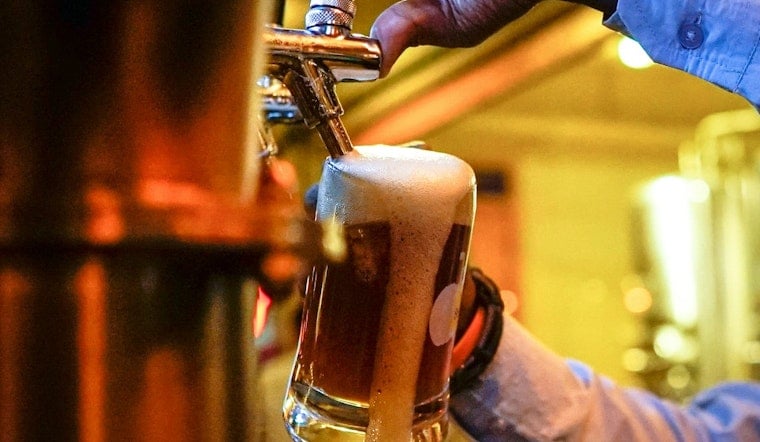
Old Town Oktoberfest returns to Wells Street between Schiller and Evergreen streets for its second year, running Friday, September 18 through Sunday, September 20, with bratwurst, giant pretzels, ice-cold beer, and the crowd-pleasing masskrugstemmen stein-holding competitions. The 2026 festival will run from 5pm to 10pm on Friday, 11am to 10pm on Saturday, and 11am to 8pm on Sunday, with a suggested gate donation of $10 supporting neighborhood programming and festival costs. The gathering sits just steps from a business that has poured drinks on that same block since 1888, giving the young festival an old-world backdrop it didn't have to invent.
A Festival Born Last Year, Already an Annual Tradition
The festival is only in its second year, having debuted in September 2025, when it drew thousands of attendees across a single block of Wells Street, according to Eventeny. That turnout was enough for community organizers to lock the event in as an annual fall fixture for 2026. It's hosted by the Old Town Merchants & Residents Association, a community development non-profit that traces its roots back to 1971, when it began as the Old Town Chamber of Commerce, per the Old Town Merchants & Residents Association. The group also runs the neighborhood's Wells Street Art Festival each June, and this fall event adds live music, local artisans, and what organizers describe as authentic food and festive traditions, along with a giant LED viewing area for the crowds.
Christopher Donovan, a board member of the association, is also co-owner of Glunz Tavern and The House of Glunz, tying the festival's leadership directly to one of the block's oldest institutions. WGN-TV, which first reported on the festival timing alongside a recipe segment, notes the connection between the event's organizers and the neighborhood's longtime businesses, as detailed in a WGN-TV Lunchbreak segment from Kristina Miller.
The Oldest Wine Shop in the Country Sits on the Same Block
The House of Glunz, located at 1206 N. Wells St., is recognized as the oldest family-owned wine and spirits store in the United States. Founder Louis Glunz Sr. arrived in Chicago from Westphalia and opened the shop at Wells and Division streets in 1888, shortly after settling in the city following the Great Chicago Fire, according to The House of Glunz. Glunz Tavern, the family's adjoining bar at 1202 N. Wells St., was founded that same year but has a far more complicated history than a simple century-and-a-half of continuous operation.
When National Prohibition began in 1920, the Glunz family had to shutter the tavern, but they kept the retail shop alive by selling sacramental wine to the Catholic Church and medicinal alcohol under doctors' prescriptions, per Decanter China. Louis Glunz Jr., who had a chemistry background, also offered home brewing supplies alongside the legal medicinal liquors during that stretch. The tavern itself then sat vacant for 92 years until fourth-generation family members restored and reopened the 48-seat space in 2012, furnishing it with original 1900-era pieces and family heirlooms, as reported by Time Out.
The End of a 133-Year Beer Partnership
The tavern also just closed out a much longer chapter in Chicago brewing history. Louis Glunz Sr. became the first official bottler for Milwaukee-based Schlitz Beer outside its home brewery, a role that began at the 1893 World's Columbian Exposition and stretched on for 133 years until Chicago's final keg of Schlitz was poured at Glunz Tavern this month, according to Smithsonian Magazine. Tied-house systems and local distribution deals like that one once defined how Chicago's neighborhood bars operated, the outlet notes.
German Roots Run Deeper Than the Festival
Old Town's German character predates both the tavern and the festival by decades. German and Luxembourgish immigrants settled the low-lying farmland north of Division Street in the 1850s, growing cabbage, celery, and potatoes and earning the area its early 20th-century nickname, the Cabbage Patch. Those early farmers laid out the winding street patterns that still set Old Town apart from Chicago's standard grid today.
St. Michael's Church, founded in 1852 to serve the neighborhood's German Catholic congregation, remains an architectural anchor of that heritage. It was one of only seven structures to survive the Great Chicago Fire of 1871, and its bells historically marked the informal boundaries of Old Town. The Old Town Triangle Historic District, which preserves the neighborhood's 19th-century Victorian cottages and pre-fire street layout, was designated a Chicago Landmark in 1977 and added to the National Register of Historic Places in 1984.
Old Town's identity has also extended internationally. In September 2023, the Old Town Merchants & Residents Association established a formal twinning agreement with Montmartre in Paris, pairing the two neighborhoods around their shared artistic, bohemian, and culinary backgrounds. Chicago and Paris have been official Sister Cities since 1996.
A Recipe to Mark the Occasion
To mark the festival's return, the WGN-TV Lunchbreak segment featured a sauerkraut recipe built for the occasion. It calls for a quart of sauerkraut, a cup of diced bacon, a cup of white wine, two teaspoons of toasted caraway seeds, two to three pats of butter, and a sachet holding six juniper berries and one bay leaf.
The preparation starts with melting butter in the bottom of a small stock pot and rendering the bacon until slightly crispy, per the segment. If the sauerkraut comes from a can, it should be rinsed first, then added to the pot along with all of its liquid and the caraway seed. The mixture is cooked slowly until most of the liquid evaporates, and the sachet is removed before serving.





