

























































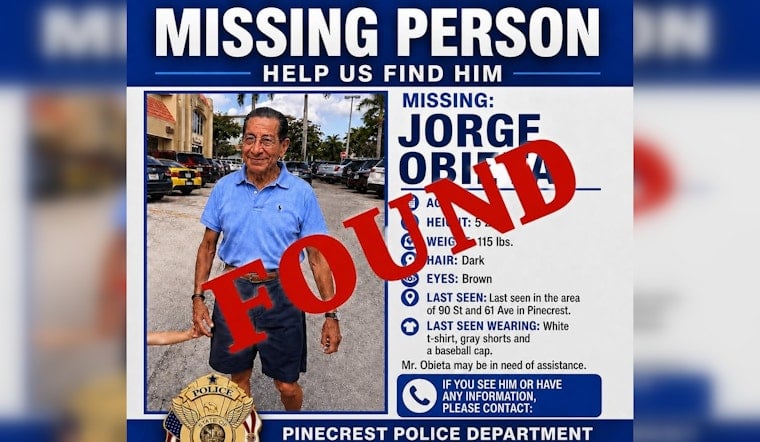
A 75-year-old Pinecrest man reported missing was found safe on Tuesday, according to police. Jorge Obieta had been reported missing from the affluent Miami-Dade village before officers located him unharmed later that day.
The Pinecrest Police Department said Obieta was found safe on Tuesday, as first reported by WSVN. The station's report did not detail where Obieta was found or how long he had been missing before officers located him.
Police have not publicly said whether Obieta was enrolled in any special needs registry or whether a Silver Alert was formally issued in connection with his disappearance, according to the available reporting. Those details remain unclear, and no further information about the circumstances of his disappearance has been released.
Why Missing Senior Cases Move So Fast in Florida
Cases involving missing older adults carry particular urgency in Florida, a state with one of the largest populations of seniors living with cognitive decline in the country. The Florida Department of Health has estimated that roughly 573,806 Floridians aged 65 and older, or about 11.3% of the state's senior population, are living with probable Alzheimer's disease, according to the Florida Department of Health. Research cited by UF Health Jacksonville found that roughly six in ten people with dementia will wander at least once, a tendency that can create serious risks of injury or disorientation if they are not found quickly.
That risk is part of why Florida law imposes strict deadlines on police once a senior is deemed endangered. Under Chapter 937 of the Florida Statutes, officers investigating a missing endangered person must enter that person's information into the Florida Crime Information Center database within two hours of determining they are endangered, triggering a BOLO notification, according to Online Sunshine. State law categorizes missing adults with cognitive impairments under that endangered-person umbrella.
How Florida's Silver Alert System Works
Florida's Silver Alert program, run by the Florida Department of Law Enforcement, requires a missing person to be at least 60 years old — or between 18 and 59 without legal capacity — along with law enforcement verification of an irreversible cognitive impairment such as Alzheimer's or dementia before an alert can be activated, per the Florida Department of Law Enforcement. The program was originally established by executive order in 2008 before later being codified into state statute. When a missing senior is believed to be traveling in a vehicle, FDLE guidelines call for state Silver Alerts to trigger dynamic highway messaging signs run by the Florida Department of Transportation, displaying vehicle descriptions and license plate numbers for up to six hours to solicit tips from drivers.
Separately, Florida's Protect Our Loved Ones Act, which took effect on January 1, 2024, authorizes local law enforcement agencies to maintain voluntary, confidential databases of residents with cognitive disabilities, including Alzheimer's and dementia, to help during emergency disappearances, as reported by News4JAX. Caregivers or individuals can voluntarily submit emergency contact information and behavioral traits to local police departments ahead of time under that law.
Pinecrest's Aging Population and Local Police Resources
Pinecrest, an affluent village of roughly 18,400 people south of downtown Miami in Miami-Dade County, has a notably older demographic profile than much of the region. U.S. Census Bureau estimates put residents aged 65 and older at approximately 17.5% of the village's total population as of 2025, meaning nearly a fifth of Pinecrest is at an age where cognitive conditions become more common.
The Pinecrest Police Department, led by Chief Jason Cohen since his appointment in July 2021, patrols a 7.54-square-mile jurisdiction and operates around the clock out of the Pinecrest Municipal Center on US 1, according to the Village of Pinecrest. Cohen is the department's fourth police chief and the first to have risen through its internal ranks. Beyond standard patrol duties, the department maintains a Criminal Investigations Section and a Community Resource Team, and it participates in the Blue Envelope Program, a public safety initiative designed to assist residents with communication needs during police encounters.
State officials have also directed significant funding toward supporting families caring for seniors with memory conditions. In December 2025, the Florida Department of Elder Affairs announced $73.8 million for the Alzheimer's Disease Initiative and $126.5 million for community and home care programs aimed at vulnerable older adults, according to the Florida Department of Elder Affairs. That funding is intended to help prevent out-of-home placement and provide respite for caregivers statewide.





