

























































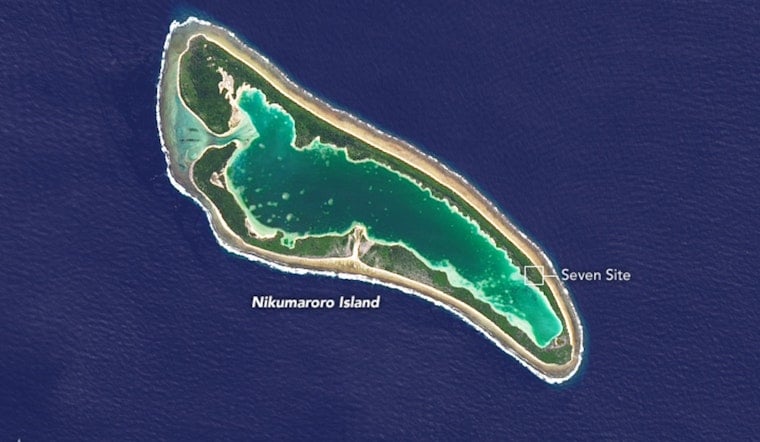
A strange shape sitting in a lagoon on a remote Pacific atoll has revived one of aviation history's most enduring mysteries. Researchers say the Nikumaroro lagoon contains an unidentified feature, nicknamed the Taraia Object, that may be linked to Amelia Earhart's missing Lockheed Electra 10-E, and a 16-person expedition is now preparing to travel there in October 2026 to find out for sure.
The object was first identified through satellite imagery, according to Cleveland.com, and Purdue University says investigators hope the mission will help locate remains of the aircraft Earhart was flying when she and navigator Fred Noonan disappeared on July 2, 1937, during a flight from Lae, Papua New Guinea, toward Howland Island. The Nikumaroro hypothesis holds that the pair reached the island and became stranded after an emergency landing, a theory distinct from the most widely accepted account, which holds that Earhart's aircraft ran out of fuel and crashed into the ocean near Howland Island. The U.S. government conducted extensive searches for Earhart, Noonan, and their aircraft in the aftermath of the disappearance, but no wreckage was ever confirmed.
According to Newsweek, the anomaly's discovery traces back to 2020, when former U.S. Navy veteran Michael Ashmore spotted an aircraft-shaped shadow in Apple Maps satellite imagery of the Nikumaroro Lagoon. The shape had become visible only after Cyclone Pam cleared lagoon floor sediment in 2015, and the object was later cross-referenced across 26 satellite image sets spanning 2009 to 2024 by the Archaeological Legacy Institute. Nikumaroro Island itself, formerly known as Gardner Island, is a remote, isolated atoll roughly midway between Hawaii and Australia, per Cleveland.com, and falls within the Phoenix Islands Protected Area administered by Kiribati.
A Long-Delayed Expedition Finally Gets Its Green Light
The expedition, led by archaeologist Richard Pettigrew, was originally scheduled to launch in November 2025 but was postponed. Purdue News reports the delay stemmed from Kiribati permit clearance procedures and the need to avoid the South Pacific cyclone season, with formal Kiribati Cabinet approval arriving in July 2026. Kiribati officials have now approved the expedition, and per the same account, team members will fly out of Indiana on October 3 and depart Tarawa by sea on October 7.
The 16-member crew includes notable names beyond its scientific leadership. The Indianapolis Business Journal reports the roster includes Purdue alumni Sirisha Bandla and Marc Hagle, both commercial space travelers connected to Purdue's so-called “Cradle of Astronauts,” alongside Purdue general counsel Steve Schultz and maritime archaeologist Michael Krivor. Bandla previously flew to space aboard Virgin Galactic's Unity 22 mission, according to her official biography.
Once on site, the mission crew will use specialized equipment to remove sediment around the lagoon anomaly and will search for distinctive rivets and other components linked to the Electra's construction, per Cleveland.com. Purdue officials are also discussing potential custody of any recovered wreckage with Kiribati, and the university says it plans to preserve and display significant artifacts should the expedition produce a breakthrough. Organizers have said they will launch a larger recovery and excavation operation if evidence suggests the object is genuinely part of Earhart's aircraft.
Why Purdue Has Skin in the Game
Purdue's involvement is not new. The university's connection to Earhart dates to 1935, when then-president Edward Elliott hired her as a career counselor for female students and an aeronautics advisor for a $2,000 annual salary, according to the Purdue Research Foundation. The foundation funded her Lockheed Electra 10E as a “flying laboratory,” and Earhart reportedly intended to return the plane to Purdue for aeronautical research once she completed her round-the-world flight. Purdue University Libraries in West Lafayette, Indiana, now holds the George Palmer Putnam Collection, the world's largest repository of Earhart artifacts, including her personal logbooks, flight maps, correspondence, and flight gear, donated by her husband. The current expedition is backed by both the Purdue Research Foundation and the Archaeological Legacy Institute.
Circumstantial Evidence Keeps the Theory Alive
The Nikumaroro hypothesis rests on more than a satellite shadow. Historical photographs and satellite imagery are cited by advocates of the theory as evidence consistent with aircraft debris, and researchers point to 1930s artifacts discovered on the island, reported radio signals, and analyses of human remains once found there as additional support. Historical research by TIGHAR and the Archaeological Legacy Institute, as detailed by Grunge, indicates that in 1938, one year after Earhart vanished, a New Zealand survey party taking aerial photos of Nikumaroro while scouting the island for a coconut plantation captured images showing an anomaly in the same lagoon location.
Past British and TIGHAR archaeological surveys on Nikumaroro also recovered 1930s-era American artifacts near castaway campsites, including fragments of a woman's shoe, a sextant box matching the type used by navigator Fred Noonan, and a Benedictine bottle known to be carried by Earhart, according to ScienceDaily. Those items were found near the site where human bones were recovered in 1940. A 2018 study published in Forensic Anthropology, led by Dr. Richard Jantz, concluded that the 13 human bones recovered on the island were more similar to Earhart's body measurements than 99% of individuals in a modern reference database, even though a 1941 British assessment had classified the bones as male. The original bones were later lost in Fiji, leaving only metric measurements behind.
A Field Littered With False Alarms
Project leaders are careful to temper expectations. Purdue and expedition officials have said the mission is designed to test a theory rather than prove one, and researchers acknowledge they simply do not know whether the lagoon object is connected to Earhart's aircraft or represents another dead end. That caution is rooted in recent history. A high-profile deep-sea search near Howland Island conducted by Deep Sea Vision in 2023 and 2024 targeted a possible aircraft-shaped object roughly 16,000 feet underwater, but the effort was formally debunked in November 2024 when high-resolution submersibles revealed the sonar target was actually a natural rock formation, as reported by Smithsonian Magazine. That company had spent $11 million mapping 1,500 square nautical miles of ocean floor before confirming the disappointing result. With that precedent looming, the Purdue-backed team heading to Nikumaroro this October is framing its work as a careful test of a decades-old hypothesis, not a guaranteed rewrite of Earhart's final chapter.





