

























































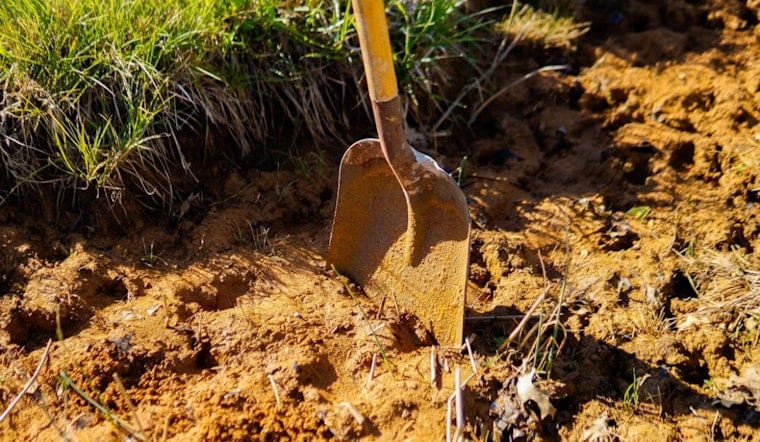
Greg Gatwood was doing routine landscaping work in the backyard of his Russian Hill home when his shovel hit something that definitely was not a rock or a root. What he pulled out of the ground was a carved limestone head and neck of a woman, and now he and his partner are trying to figure out how it got there, and who might have made it.
Gatwood showed the sculpture to his partner, artist Judy Gittelsohn, and the pair began digging into the mystery themselves, according to NBC Bay Area. The couple is searching for a specialized committee or university that can help verify the sculpture's origins, and they are investigating why it was buried in their yard in the first place — whether it was quietly tossed away or deliberately hidden. Gittelsohn told the San Francisco Chronicle that she hopes to have a dream about the piece to help her understand where it came from, according to a report from HENI.
Gittelsohn believes the sculpture could have been created by Ralph Stackpole, the renowned muralist and sculptor whose fingerprints are all over San Francisco's early 20th-century art scene. Stackpole created the statue in front of the city's old stock exchange and also contributed to the murals inside Coit Tower, a project Hoodline covered back in a 2015 look at the tower's 25 muralists. The theory is not far-fetched geographically: the sculpture surfaced just blocks from where Stackpole once taught.
A Direct Line to the Old Art Institute
Stackpole served as head of the Sculpture Department at the California School of Fine Arts, later renamed the San Francisco Art Institute, for more than two decades between 1918 and 1941, per askART's biography of the artist. That campus sits at 800 Chestnut Street, close enough to the Russian Hill backyard that the connection struck Gittelsohn and Gatwood as more than coincidence.
Stackpole's résumé extends well beyond the classroom. In 1930 he helped bring Diego Rivera and Frida Kahlo to San Francisco, hosting Rivera at his Montgomery Street studio while the muralist worked on major local commissions, according to background compiled by SFMOMA. That same year, architect Timothy Pflueger commissioned Stackpole to carve the massive Yosemite granite statues titled Agriculture and Industry, which still flank the entrance of the former Pacific Stock Exchange at 301 Pine Street, as detailed by Art and Architecture SF. Stackpole remained active in the city's art world until 1949, when he relocated permanently to Chauriat, France, where he lived and worked until his death in December 1973, askART notes.
Why Proving It Is So Hard
Art historians and authentication experts caution that proximity to Stackpole's old workspace is not enough to legally attribute the piece to him. Unprovenanced sculptures require physical material testing and a documented chain of ownership before any formal attribution can be made, per the HENI report. Without paperwork explaining who buried the piece and why, experts say authenticating it as a genuine Stackpole work is virtually impossible, and a buried sculpture lacking documentation is likely to remain classified simply as attributed or unknown.
Gittelsohn brings her own artistic instincts to the puzzle. Before turning to visual art, she was a fixture of San Francisco's late 1970s art-punk scene, performing in bands including Pink Section — named for the Chronicle's former entertainment section — and Inflatable Boy Clams, according to the East Bay Express. Pink Section grew out of the San Francisco Art Institute community before Gittelsohn shifted fully into painting, giving her a personal history with the very institution now tied to the sculpture's possible origin.
Gatwood's own background offers a different kind of relevant expertise. He operates Modern Irrigation and Landscaping and previously served as secretary for the San Francisco Bay Area Chapter of the California Landscape Contractors Association, per that organization's newsletter. It was that landscaping work that put his shovel in exactly the right patch of dirt.
An Institute in Transition
The timing adds another layer to the story, since the school where Stackpole once taught has itself been through dramatic change. The San Francisco Art Institute filed for Chapter 7 bankruptcy protection in April 2023 and permanently closed after 152 years of operation, as KQED reported at the time — a closure Hoodline also covered when the historic campus went up for sale with an undisclosed asking price. In February 2024, a nonprofit backed by philanthropist Laurene Powell Jobs purchased the vacant campus for $30 million, and in June 2025 the group announced the site will reopen as the California Academy of Studio Arts, a free artist residency program, according to Hyperallergic. The acquisition also protected the campus's historic 1931 Diego Rivera mural.
For now, Gatwood and Gittelsohn are left holding a piece of limestone with an unresolved past, still hunting for an institution or committee that can examine it properly. If the sculpture is never officially connected to Stackpole, the couple says they will have to decide what to do with the artwork on their own terms.




