

























































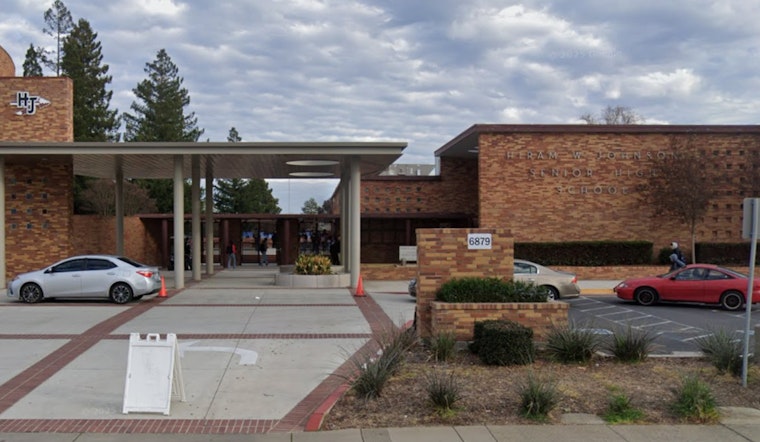
Two solar-powered charging stations for e-bikes and scooters made their debut at Hiram Johnson High School on Wednesday morning, marking the first installation of its kind anywhere in the Sacramento City Unified School District. The stations let students plug in their e-bikes and scooters during the school day, and the ribbon-cutting came just ahead of the district's new school year, which begins next week.
According to KCRA 3, the district partnered with SMUD and CALSTART on the project, which officials say builds on SMUD's broader clean-energy vision. Kevin Burdick told the station that alternative transportation can be encouraged by giving students accessible bike parking and charging on campus.
Behind the $82,648 Solar Contract
The infrastructure traces back to an $82,648.96 purchase agreement the SCUSD Board of Education approved in April 2026 with Enerfusion Inc. to procure and install the solar charging equipment, according to board meeting records. The contract was funded through the CALSTART and SMUD grant rather than district general funds.
The stations address a crowding problem that had been building for a while. Before the outdoor chargers went in, roughly 30 e-bikes and e-scooters lined the walls of the Hiram Johnson auditorium each morning as students competed for a handful of indoor electrical outlets, per the Sacramento Bee.
Part of SMUD's Bigger Clean-Energy Push
The Hiram Johnson project is layered onto an existing state and utility partnership. In 2024, SMUD helped secure a $750,000 planning grant from the California Office of Planning and Research to develop school-based microgrids and clean energy infrastructure at the campus, with SMUD serving as a sub-grantee receiving $360,000 of that total. The chargers also fold into the utility's board-mandated Zero Carbon Plan, which calls for eliminating carbon emissions from its power supply by 2030 through community microgrids and localized clean mobility hubs, according to SMUD documentation.
On the technical side, UC Davis researchers have shown that a 750-watt solar array paired with battery storage can reliably support off-grid micro-mobility charging stations in Northern California, maintaining power even on overcast days, according to UC Davis research.
A Statewide Crackdown on High-Powered E-Bikes
SCUSD's embrace of charging infrastructure comes as state officials scrutinize the vehicles it's designed to power. A December 2025 study commissioned by the California Legislature found that nearly 88% of electric two-wheelers parked at high school bike racks in surveyed Northern California districts exceeded legal e-bike limits and functioned as higher-powered e-motos, per findings from the Mineta Transportation Institute detailed in Hoodline's earlier reporting.
California Attorney General Rob Bonta issued a statewide consumer alert in April 2026 warning that two-wheeled vehicles providing motor assistance over 20 mph via throttle, or 28 mph via pedal assist, exceed legal e-bike definitions and require driver licensing and vehicle registration. Separately, state Assembly Bill 1557, introduced in January 2026, would cap e-bike motor output at 750 watts amid national emergency room data showing annual e-bike injuries climbing from 751 in 2017 to roughly 23,493 in 2022, per Hoodline's coverage of the bill.
Not every Sacramento-area district is leaning into e-bikes the way SCUSD is. Rocklin Unified School District instituted a campus ban on high-powered, throttle-equipped e-bikes in February 2026 after city police reported that 68% of local bicycle collisions involved e-bikes, as Hoodline previously reported.
SCUSD's Budget Crunch Makes Outside Grants Essential
The reliance on outside money isn't incidental. SCUSD faced a $43 million budget deficit in early 2026 and enacted spending freezes under the threat of a possible state takeover, according to CapRadio. That financial strain has made partnerships like the one with SMUD and CALSTART essential for funding capital projects such as the Hiram Johnson chargers without dipping into general funds.
Left unanswered so far are questions about how campus staff will monitor or regulate which kinds of e-vehicles get plugged into the new stations, whether the program will expand to other SCUSD high schools, and how the district plans to enforce California's evolving e-bike safety classifications on campus. Those questions remain unresolved as students prepare to return next week.



