

























































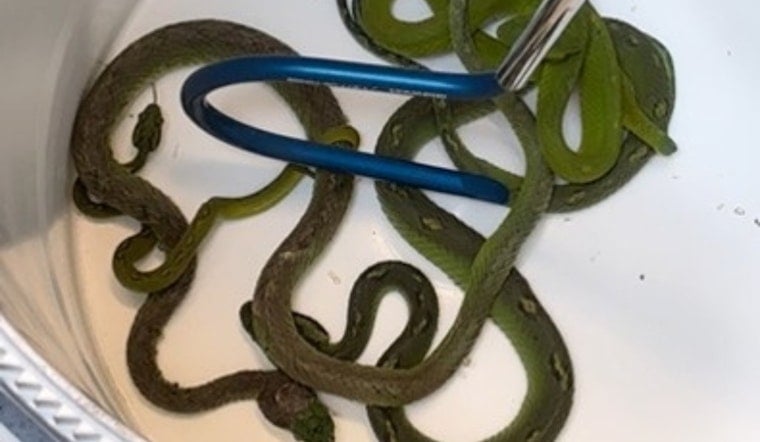
Federal officers at the San Ysidro Port of Entry pulled 69 live animals out of a hidden compartment behind the rear seat of a Volkswagen last Tuesday, discovering dozens of rare lizards, four venomous pit vipers and a handful of reptiles packed into pillowcases that had been knotted shut and sealed with tape. Three caimans inside the car did not survive. Georgina Bribiesca Chavez, the 66-year-old Tijuana resident driving the vehicle, had been arrested a day earlier at the crossing and was ordered held without bond.
According to the New York Post, U.S. Customs and Border Protection officers seized Chavez's Volkswagen after a records check turned up an outstanding warrant tied to a wildlife trafficking investigation. The animals inside included 60 Abronia lizards, four venomous yellow-blotched palm pit vipers, an indigo snake, a baby crocodile and three caimans, all protected under international treaties. The U.S. Fish and Wildlife Service Office of Law Enforcement is investigating the case, with assistance from the National Oceanic and Atmospheric Administration and the California Department of Fish and Wildlife.
Prosecutors said all three caimans died after being left inside the vehicle for nearly 24 hours in the August heat. Per an August 2026 U.S. Department of Justice press release, Chavez failed to tell arresting officers that live animals were concealed in the car, and the vehicle sat outdoors for nearly a day before officers inspected it and found the animals. Chavez allegedly told a CBP officer she had nothing to declare. The surviving 66 animals were taken to the San Diego Zoo, where they remained stable and in the zoo's care as of the week before the Post's report.
A Long-Running Smuggling Operation
Chavez is not accused of acting alone. Prosecutors allege she and a man named Salvador Pelayo, who separately used the alias Jose Lopez, trafficked wildlife together since 2023 and made tens of thousands of dollars selling exotic animals. Pelayo was arrested in Chula Vista in July 2026. Both defendants face Lacey Act trafficking charges and have pleaded not guilty; Chavez entered her plea to the federal wildlife trafficking charge, as did Pelayo.
The case stems from an approximately 18-month undercover investigation, and the U.S. Fish and Wildlife Service documented the pair sending and receiving live wildlife shipments at commercial shipping centers throughout San Diego County, according to the Department of Justice. As CBS8 reported, the sting included a March 2025 purchase in which Chavez delivered four protected Mexican box turtles to an undercover agent after crossing the border, receiving $2,600 cash. Those turtles were believed to be wild-caught and suffering from respiratory disease, prosecutors said, and they were in poor health when acquired. All four later died within two months of the transaction after being transferred to the Oakland Zoo. Pelayo, for his part, is separately accused of shipping four protected Mexican and Yucatan box turtles to an undercover agent in New York.
Why Traffickers Target Rare Reptiles
The financial incentive behind the smuggling is steep. Tree-dwelling Abronia lizards, nicknamed “little dragons” in the exotic pet trade, can fetch up to $2,000 per specimen in illegal international markets, according to a 2019 Mongabay report. The entire Abronia genus was placed under CITES Appendix II protection in 2016 after a proposal by Mexico, which strictly regulates international trade due to severe wild population declines from habitat destruction and poaching, per Defenders of Wildlife. The yellow-blotched palm pit viper found in the car is classified as Vulnerable by the International Union for Conservation of Nature due to its restricted cloud forest habitat in Mexico and Guatemala.
Under the federal Lacey Act, knowing felony wildlife trafficking carries a maximum penalty of five years in prison and a maximum fine of $250,000 per defendant, along with mandatory forfeiture of the wildlife and vehicles involved, according to legal guidance from ArentFox Schiff. A December 2025 Justice Department release on the government's Operation Terrapene noted that federal agents regularly intercept illegal reptile shipments concealed in knotted socks, taped bags and mislabeled parcels, a pattern that mirrors the pillowcase method used in the San Ysidro case.
Busiest Crossing in the Hemisphere
The bust unfolded at a facility already straining under enormous traffic. The San Ysidro Port of Entry is the busiest land border crossing in the Western Hemisphere, processing more than 70,000 northbound personal vehicles and tens of thousands of pedestrians daily, according to U.S. Customs and Border Protection operational data. The U.S. Attorney's Office for the Southern District of California, which covers San Diego and Imperial counties along a 140-mile stretch of border, ranks as the fourth-busiest federal judicial district in the country and has filed more than 100 border-related criminal cases in a single week.
The case adds to a string of similar prosecutions Hoodline has tracked along the border and beyond, including an Oxnard smuggler's sentencing earlier this year and a Texas bridge seizure involving dozens of live pythons. It remains unclear whether additional domestic buyers or international suppliers identified during the federal surveillance will face charges, and the long-term placement of the 66 surviving animals at the San Diego Zoo has not been announced.





