

























































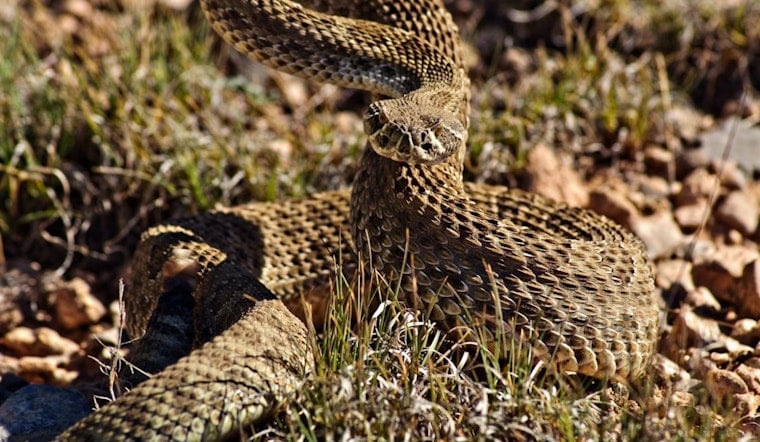
A 25-year-old San Diego State University graduate student is spending his week checking on a group of rattlesnakes he knows by name, including one called Ruby, who was recently found coiled in a hunting position along the Grassland Loop Trail. Vincent Marcantonio leads the red diamond rattlesnake study for SDSU's Clark Lab, and he and his research partner track the snakes several times a week through Mission Trails Regional Park to see how the animals cope with the crowds of hikers, cyclists, climbers, and even an ongoing sewer pipeline project that shares their habitat.
The research is now in its second year of a two-year project, according to The San Diego Union-Tribune, which detailed how Marcantonio caught 10 red diamond rattlesnakes and brought them to the SDSU laboratory this year. Once captured, each snake was implanted with an accelerometer and a small radio, tools the lab uses to determine a snake's general location and whether it has moved since the last check-in. Harshita Vallabhaneni, who helps Marcantonio with the Mission Trails research, is also working on her own master's project examining how relocation affects red diamond rattlesnakes near the San Diego Zoo Safari Park.
How the Tracking Actually Works
The team's telemetry system relies on a radio antenna that picks up each snake's individual frequency from its embedded radio, letting researchers zero in on a general location without needing eyes on the animal right away. The accelerometers layered on top of that system capture movement data researchers will use to understand how the snakes behave in a heavily trafficked stretch of parkland, according to the Union-Tribune's reporting. Later this fall, Marcantonio's team plans to recapture the snakes to remove the accelerometers, and they may repeat the whole process again over winter if they manage to find and catch more animals.
The approach builds on a breakthrough the San Diego Zoo Wildlife Alliance and SDSU announced in January 2024, when the two institutions began attaching external radio transmitters and accelerometers to snake rattles using glue and thread instead of surgically implanting the devices. Hoodline covered that rattlesnake tracking breakthrough when it first emerged, and the non-invasive method now underpins the high-resolution behavioral data the Mission Trails team collects in the field.
Individual Snakes, Individual Personalities
Each snake in the study has a name. Marcantonio named one Pigpen after its particular behavior in the SDSU lab and another Wil, after former Padres player Wil Myers. Ruby, the red diamond found coiled near the Grassland Loop Trail on August 13, was spotted by a Union-Tribune photographer near the students during a recent check-in. Another tracked snake, Beatrice, has appeared thin lately, the paper reported.
Marcantonio's affection for the animals extends well beyond the field study. He keeps 12 pet snakes of his own, and SDSU biology professor Rulon Clark, who runs the Clark Lab, has observed that working in the lab can shift students' entire career trajectories. Clark said he hopes education efforts like this one can help turn public fear of snakes into respect and interest instead.
What the Data Might Show
The Mission Trails findings will eventually be compared against an earlier study conducted on land largely untouched by people near the San Diego Zoo Safari Park, giving researchers a side-by-side look at how red diamond rattlesnakes behave with and without heavy human traffic. Vallabhaneni's parallel research into snake relocation found that most relocated snakes try to return to where they were originally captured, though Marcantonio noted that responses vary widely from animal to animal — some snakes moved miles from their capture point, while others moved only feet.
The stakes of that research are shaped by the species' legal status. The California Department of Fish and Wildlife classifies red diamond rattlesnakes as a species of special concern, and under the department's regulations the species carries a possession and bag limit of zero, making it the only native California rattlesnake fully protected from recreational take or collection. That protection reflects how narrow the species' range really is: red diamond rattlesnakes are confined largely to coastal sage scrub, chaparral and arid slopes across southwestern California and Baja California, one of the most restricted ranges of any rattlesnake in the country, according to the San Diego Zoo Wildlife Alliance. Habitat in that coastal sage scrub zone is increasingly squeezed by human development, adding pressure the Mission Trails study is specifically designed to measure.
A Park Built for Collisions Between People and Wildlife
Mission Trails Regional Park spans roughly 8,000 acres and 65 miles of trails, drawing nearly 2 million visitors a year as one of the largest municipal urban parks in the country, according to the Times of San Diego. That volume of foot and bike traffic means hikers and cyclists have a good chance of crossing paths with a rattlesnake on any given outing, and the study is built around examining exactly how red diamond rattlesnakes respond to those human factors, from footpaths to the sewer pipeline construction underway in the park.
The research arrives amid a broader statewide spike in rattlesnake activity. In May, the California Poison Control System logged 77 rattlesnake-exposure calls and three confirmed bite fatalities statewide through mid-May, a sharp early-season jump compared with California's typical annual average of around 200 calls and one death, according to a report from BEACON. Closer to home, the San Diego Humane Society's Humane Law Enforcement team fields nearly 1,000 rattlesnake-related emergency calls a year across 14 San Diego County cities, per KPBS, prioritizing responses where a venomous snake poses an immediate threat to people or pets. Hoodline recently reported on a related close call when a City Heights man grabbed a rattlesnake bare-handed to protect his dog.
SDSU's involvement with rattlesnakes in San Diego's urban parks isn't new. Clark's lab previously conducted radio telemetry tracking on Southern Pacific rattlesnakes at Cabrillo National Monument in 2017 to study how roads, trails and other infrastructure fragment urban snake populations, according to the National Park Service. That earlier project laid groundwork for the more advanced, non-invasive tracking now deployed at Mission Trails, and this June, SDSU and the San Diego Zoo Wildlife Alliance expanded their partnership to include formal technology-transfer support aimed at scaling up the conservation tools the lab has developed.


