

























































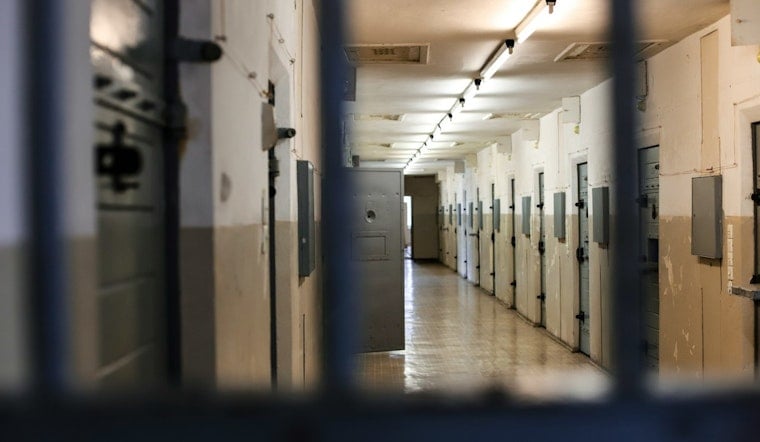
Sean Grayson, the former Sangamon County sheriff's deputy convicted of killing Sonya Massey inside her Springfield home, has died in prison. Grayson died on Sunday, according to his defense attorney, Daniel Fultz, just months after a state board rejected his bid for early release on medical grounds.
Grayson, who is white, was convicted of second-degree murder in October 2025 and received the maximum possible sentence of two decades in prison for shooting the 36-year-old Massey in the face inside her home, as reported by NBC Chicago. Body camera footage showed Grayson and another deputy entering Massey's home in Springfield, Illinois, before the shooting that sparked protests over systemic racism and prompted a review by the U.S. Department of Justice.
According to the outlet, Grayson had colon cancer before the 2024 shooting, and his attorney said the disease had advanced to his liver and lungs by January 2026, the same month Grayson apologized for Massey's death at his sentencing. Six months into his sentence, in May 2026, Grayson filed an application for early medical release, per Capitol News Illinois.
The Fight Over Early Release
Grayson's petition relied on Illinois' Joe Coleman Medical Release Act, a law that took effect in January 2022 and allows terminally ill or medically incapacitated prisoners to apply for release if medical assessments indicate a condition likely to cause death within 18 months, according to the Illinois Prisoner Review Board. The board, which has three members, voted in July 2026 to deny Grayson's application, according to board spokesperson Liz Mitchell.
Sangamon County State's Attorney John Milhiser filed a letter opposing Grayson's release, writing that to release Grayson under those circumstances would be a miscarriage of justice and an insult to Sonya Massey's memory and family. Milhiser also said in his letter that Grayson's medical condition had already been considered at sentencing. In his own writing to the board, Grayson claimed Massey had attacked him with a pot of boiling water, and Massey herself was recorded saying, “I rebuke you in the name of Jesus,” moments before the shooting.
The denial reflected how rarely the mechanism succeeds statewide: out of dozens of applications filed under the Joe Coleman Act in 2024, the board approved only 34 individuals for medical release, according to the Prison Policy Initiative.
A Hiring History That Drew Scrutiny
Massey, a single mother, was killed in July 2024, and the case exposed how Grayson had moved through Illinois law enforcement despite a troubled record. Before joining the Sangamon County Sheriff's Office in May 2023, he had worked at six different law enforcement agencies across Central Illinois within four years, according to KSDK.
Military records showed Grayson was discharged from the U.S. Army in February 2016 for serious misconduct following a DUI arrest in which he was also found carrying an unregistered weapon, per WTTW. In 2022, while working for the Logan County Sheriff's Department, he was reprimanded for disobeying a supervisor's order to stop a high-speed pursuit, an episode that led his superior officer to publicly question why he was still employed, Capitol News Illinois reported.
Political and Legal Fallout Across Illinois
Sangamon County Sheriff Jack Campbell retired and resigned effective August 31, 2024, after public outcry and calls from state leadership over his department's failure to properly vet Grayson, according to the Illinois Times. The Sangamon County Board later approved a $10 million wrongful death settlement with Massey's family in February 2025, the largest civil settlement in the county's history, according to IPM Newsroom.
In January 2025, the U.S. Department of Justice Civil Rights Division reached a resolution agreement with Sangamon County and its dispatch services, mandating reforms to policies and training on race discrimination and mental health crisis response. To address the pattern of officers moving between departments without full disclosure of their records, Governor JB Pritzker signed the Sonya Massey Act in August 2025, requiring state law enforcement agencies to obtain and review full background and disciplinary files before extending job offers to police candidates.
Grayson's criminal trial was ultimately moved from Sangamon County to Peoria County due to widespread pretrial publicity, where a jury convicted him of second-degree murder in October 2025 after 12 hours of deliberation, as reported by NPR Illinois. Massey's killing drew national attention the year before, including a Chicago rally where family and activists demanded justice for her death.





