

























































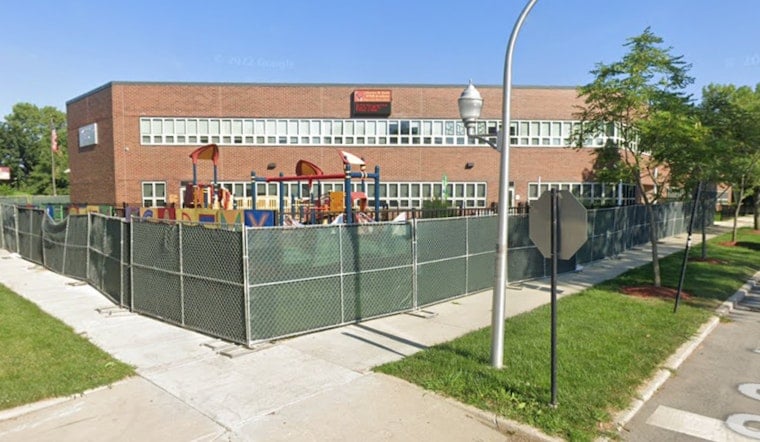
A century-old school building that sat empty for more than a decade in Englewood has reopened its doors, this time as home rather than a classroom. Earle Residences, a 50-unit affordable housing development inside the former Charles Warrington Earle School, is now nearly half occupied, offering apartments to residents earning less than $50,000 a year living alone, or families of four earning less than $73,000 annually.
Chicago Public Schools closed Charles Warrington Earle School in 2014, one of nearly 50 schools shuttered that year, according to ABC7 Chicago. The building then sat vacant for years before Wisconsin-based developer Gorman & Company purchased it from CPS for $200,000 in 2017, after earlier plans to turn the site into senior housing had fallen through, according to Multi-Housing News. It took nine more years of planning and financing before the $34.9 million adaptive-reuse project welcomed its first residents.
Krystal Peters, who moved into Earle Residences a few weeks before ABC7's report, said she views the development as a gift from her late father, who was a teacher, per the outlet's account. Her sentiment threads through a building designed to preserve the historic character of the century-old school even as it takes on an entirely new purpose.
A Landmark Building Finds New Life
Designed in the Renaissance Revival style by Chicago school board architect William August Fiedler in 1897, with a 1900 addition by William Bryce Mundie, the Earle School is listed on the National Register of Historic Places, according to Preservation Chicago. That historic designation made the building eligible for federal and state historic tax credits, which helped fund the conversion.
The redevelopment team demolished an unsalvageable 1974 auxiliary wing while restoring the original brick structure, and converted the old school gymnasium into an indoor sports court for residents, per Urbanize Chicago. The project was developed through a partnership between Gorman & Company and Chicago non-profit The Phoenix Foundation, designed by local firm Beehyyve, and built by Black-owned general contractor Burling Builders, as reported by The TRiiBE.
Deep Affordability and Supportive Services
All 50 units are restricted to low-income households, with four units set aside for those earning up to 15% of the Area Median Income, 20 units at or below 30% AMI, six units at 50% AMI, and 20 units at or below 60% AMI, the same outlet's report notes. Lisette Castaneda said the 50 apartments will serve residents below those specified income thresholds, according to ABC7.
The Phoenix Foundation provides supportive services to Earle Residences residents, and Sherri Allen-Reeves said the organization intends to help residents maintain their housing and eventually move beyond housing that requires supportive services, per the ABC7 report. Chicago Mayor Brandon Johnson said the original school closure directly impacted student safety and forced students to travel long distances for their education, the outlet reported.
Financing Nine Layers Deep
The project's $34.9 million cost was covered through a highly layered financing structure. According to a City of Chicago release, the Chicago Department of Housing contributed $4.2 million in Tax Increment Financing and $540,000 in Chicago Recovery Plan funds, alongside Low-Income Housing Tax Credit equity, $17.5 million from the Illinois Housing Development Authority, and $6.8 million in historic tax credits.
The building was also designed to meet Enterprise Green Communities standards, securing $250,000 in ComEd energy incentives and projected to save 816,000 kilowatt-hours of electricity annually, according to Gorman & Company. ABC7 reports the building is energy efficient and has greatly reduced carbon emissions.
Part of a Larger Englewood Pattern
Earle Residences did not close in a vacuum. The 2013 Chicago Board of Education vote under then-Mayor Rahm Emanuel shuttered 50 elementary schools in the largest single-wave public school closure in U.S. history, leaving dozens of South and West Side buildings vacant for over a decade, as Hoodline previously reported. Institute for Housing Studies at DePaul University data cited by The TRiiBE shows Englewood's population plummeted from roughly 97,000 residents in the 1960s to about 30,000 by 2010, a decline driven by sustained urban disinvestment that also explains the steep enrollment losses behind the school's closure.
Earle Residences now joins a growing list of former CPS campuses being converted into housing across West Englewood, including a project led by former WNBA player Devereaux Peters transforming the closed Bontemps Elementary School into 72 affordable apartments and 60 senior units. Not every conversion has gone smoothly: a Humboldt Park school's housing plan has stalled as its new owner pursues cash, and a Little Village school suffered a fire days before an affordable housing sale was set to close, underscoring how uneven the path from shuttered classroom to occupied apartment can be across the city.



