

























































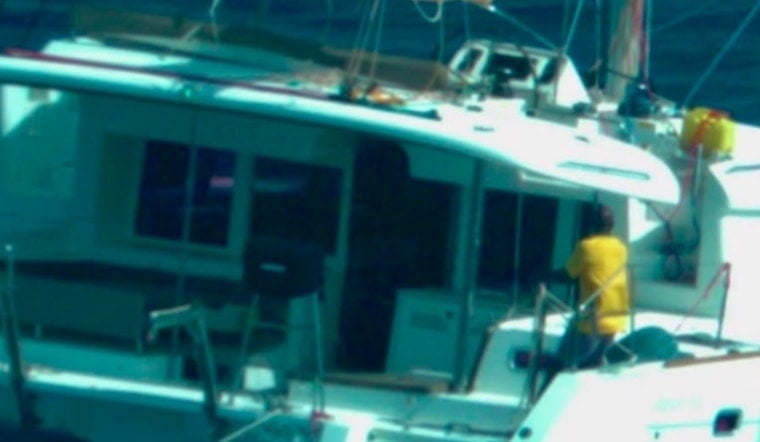
A 58-year-old delivery captain steering his catamaran with a makeshift emergency tiller was found alive about 10 miles west of Sint Maarten, capping a multi-day, multi-nation search that began when his family reported him overdue. Peter Baron had set out alone from Tortola in the British Virgin Islands, attempting to hand off the 45-foot catamaran Ocean Time to its new owners across 81 nautical miles of open Caribbean water, and it was not his first attempt at the crossing.
A Boat With a History of Trouble
Baron had tried the same voyage a week earlier but turned back after Ocean Time suffered a steering failure, which he repaired himself before setting out again on August 9, according to Virgin Islands News Online. Video recorded before he left Tortola also showed the catamaran already bearing visible signs of disrepair, including a large hole in the starboard bow netting, as reported by the St. Thomas Source. Those mechanical red flags set the stage for what would become a race against time once Baron went quiet at sea.
Baron's family reported him overdue on August 12, according to facts confirmed by WPEC. Coast Guard watchstanders at Sector San Juan later learned that Baron had last spoken with his daughter on the morning of August 9, and that his mobile phone had no active cellular plan, working only over Wi-Fi, per boatwatch.org's tracking of the case. That detail helps explain why hours, then days, passed without word from a captain who had already proven his boat could fail him once.
Coast Guard Launches a Wide Search
Once the overdue report came in, Coast Guard Sector San Juan launched an MH-60T Jayhawk helicopter from Air Station Borinquen in Puerto Rico and broadcast Urgent Marine Information Broadcasts and Enhanced Group Calls to shipping traffic across the region, according to the same Virgin Islands News Online report. The search fell within Sector San Juan's enormous coverage area, which spans 1.3 million square nautical miles across the Eastern Caribbean and touches nearly 20 sovereign nations and territories, per Vertical Magazine's reporting on the command. That scale is backstopped by U.S. Coast Guard District 7, which oversees South Florida and the Caribbean across 1.8 million square miles and holds the service's largest concentration of cutters and aviation assets.
The aircraft that ultimately found Baron was an HC-144 Ocean Sentry launched from Air Station Miami, a twin-engine turboprop equipped with Minotaur mission systems capable of loitering on scene for up to 10 hours while it searches for targets and directs rescue vessels toward them, according to Coast Guard background materials on the aircraft. Coast Guard crews located Baron on August 13 about 10 miles west of Sint Maarten, aboard Ocean Time and steering with an emergency tiller, per facts reported by WPEC.
International Crews Complete the Rescue
Dutch Coast Guard personnel boarded the partially disabled catamaran once it was spotted, confirming Baron was safe, verifying the vessel could still be towed, and facilitating calls to his family in St. Lucia to let them know he was unharmed, according to SMN News. Rescue crews then brought Baron to Simpson Bay in Sint Maarten, with no reported injuries from the ordeal, per WPEC. Dutch and French marine crews worked alongside U.S. Coast Guard personnel to complete the rescue near Sint Maarten, WPEC reported, reflecting the kind of cross-border cooperation the region's vast, multinational waters routinely demand.
Coast Guard video released afterward shows Baron being brought to safety. Cmdr. Matthew Romano said he was incredibly proud of Coast Guard servicemembers and commended the agency's French, Dutch, and Virgin Islands partners for their role in the case, according to WPEC. Romano also reminded boaters of the importance of proper communication equipment and emergency signaling before getting underway, a point that echoed the specific gaps exposed in Baron's own voyage.
Officials Renew Calls for Emergency Beacons
Following the rescue, Coast Guard officials reiterated guidance urging offshore boaters to carry registered Emergency Position Indicating Radio Beacons or Personal Locator Beacons, which transmit satellite distress signals when steering or communication systems fail. The recommendation lands squarely on the circumstances that nearly cost Baron his safety: a boat with a known steering problem, a phone that could not reach cell towers, and an 81-nautical-mile stretch of open water separating him from help. For a region where a single search-and-rescue sector can be responsible for territory the size of a small continent, officials say that kind of equipment can be the difference between an overdue report and a tragedy.




