

























































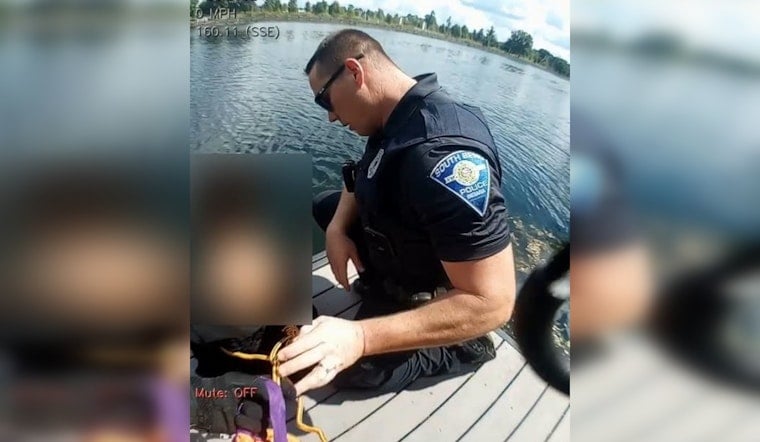
A South Bend police officer found a child sitting on the edge of a dock with their feet dangling in the St. Joseph River last Thursday, just steps from a drop into deep, swift-moving water near the Jefferson Boulevard Bridge. The child, who has autism, had run away from a parent and nearby clinic employees before climbing down a ladder to reach the unsteady dock. What followed was a slow, careful conversation rather than a rush to grab the child away from the ledge.
According to the South Bend Police Department, Officer Robert Anton approached the child slowly and began talking with them on the dock rather than moving in quickly. The department said these types of interactions happen regularly on South Bend streets, but this one carried heightened stakes given the child's proximity to the river. During the conversation, the child mentioned being hungry, and Officer Paul Strabavy drove to a nearby restaurant to pick up takeout while Anton kept talking.
Officer Anton eventually convinced the child to move from the dock to steadier ground, and both officers then helped the child move further away from the river. Once the child was safe, officers spoke with the child's care team to establish a plan going forward, and the department said officers ensured the child was fed before the situation was resolved. South Bend Police commended Anton and Strabavy for what it described as a compassionate approach to the call.
Why the Riverside Location Made This Call So Dangerous
The stretch of the St. Joseph River beneath the Jefferson Boulevard Bridge near Century Center is lined with steep concrete embankments and riverfront structures that create sharp drops into deep water, according to background documented by the Indiana Department of Homeland Security. That terrain is part of why the South Bend Fire Department maintains the Indiana River Rescue School along the St. Joseph River and East Race Waterway, a nationally recognized swift-water training center built specifically because of the corridor's hazards, as reported by Firehouse Magazine.
The danger of water proximity for a wandering autistic child is not incidental. Research from the National Autism Association found that accidental drowning accounts for 91% of U.S. wandering fatalities among autistic children under 14, making any elopement toward open water an emergency in its own right. A study published in Pediatrics and cited by the CDC found that 49% of children with autism spectrum disorder attempt to wander or elope from safe environments after age four, a rate nearly four times higher than their neurotypical siblings, with more than half of those episodes lasting long enough to raise serious safety concerns.
Slow, Low-Pressure Tactics Reflect Recommended Practice
Academic research published in 2025 in a law enforcement journal cautions that autism spectrum disorder is a developmental disability rather than a mental health crisis, and that standard high-pressure police tactics can escalate sensory overload in neurodivergent youth. The approach officers took on the dock — moving slowly, talking calmly, and addressing the child's hunger before pushing them toward safer ground — lines up with the low-sensory de-escalation strategies that research identifies as essential when building rapport with autistic individuals.
That training does not happen by accident. Indiana law requires all law enforcement officers to receive training on mental illness, autism, dementia, and developmental disabilities, alongside voluntary 40-hour Crisis Intervention Team programs operating across northern Indiana departments, according to The Times of Northwest Indiana. Locally, the St. Joseph County Crisis Intervention Team runs a specialized first-responder partnership across law enforcement, healthcare providers, and community stakeholders, and celebrated a graduation class of newly certified officers this past March.
Part of a Broader Push on Autism and Missing-Person Response
The South Bend case arrives as federal officials work to standardize how first responders nationwide handle missing autistic individuals. In August 2026, the U.S. Department of Health and Human Services announced the launch of the National Autism Missing and Endangered Person Alert Initiative, partnering with the Department of Justice and FEMA to build autism-specific emergency response protocols and alert capabilities across the country, Disability Scoop reported.
South Bend has seen this kind of call before. Hoodline previously reported that Indiana State Police issued an urgent Silver Alert for 15-year-old Zania Mason, a South Bend teenager with autism who went missing after running away from home in February 2025. South Bend Police have also recently clarified how they classify these cases: the department has pointed to Indiana Code § 10-13-5-4, which draws a legal distinction between juvenile runaways and missing endangered children who qualify for a statewide Silver Alert based on evidence of medical necessity or physical danger.
In this case, the child was located and stabilized locally before any broader alert was needed, with officers coordinating directly with the child's care team rather than escalating to a search. South Bend Police did not release additional details about the child's identity or the parent involved, consistent with how the department has described the call publicly.




