

























































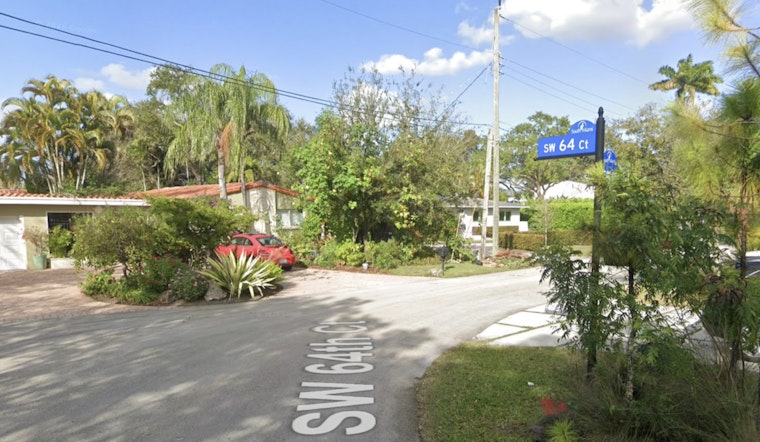
A dog was killed Thursday morning in a reported crocodile attack near the 6200 block of Southwest 64th Court, prompting South Miami police to issue a public safety warning to residents living near the city's canals and waterways. The attack was reported around 9:30 a.m., and police say no other details about how it happened are yet known.
South Miami police confirmed the dog's death and issued the warning, according to NBC 6 South Florida. Officers are advising residents, pet owners and visitors to remain vigilant around nearby canals, ponds and other bodies of water, and they say anyone who regularly walks dogs or otherwise uses the area should hear the warning and pass it along to neighbors.
What Police Are Telling Residents To Do
Police are urging people in the area to exercise extreme caution and to avoid attempting to injure, capture, harass or relocate any crocodile they encounter, per the same NBC 6 report. Anyone who comes across a nuisance or dangerous crocodile is asked to contact wildlife officials rather than confront the animal directly. American crocodiles are protected under both state and federal law, the outlet notes, which limits what residents or even local police can legally do if one turns up in a neighborhood canal.
That protection traces back to a remarkable recovery. Florida's native American crocodile population has rebounded from fewer than 300 individuals when the species was listed as federally endangered in 1975 to an estimated 1,500 to 2,000 adult crocodilians today, according to the Florida Fish and Wildlife Conservation Commission. That comeback led the U.S. Fish and Wildlife Service to downlist Florida's population to threatened status in 2007.
Why A Crocodile Could Turn Up Miles From The Bay
The recovery also helps explain how a large crocodile could end up in a residential canal far from open water. A 2025 FWC satellite tracking study found that American crocodiles frequently navigate South Florida's extensive drainage canal networks undetected, traveling long distances through residential neighborhoods while actively avoiding human contact, as reported by The Guardian. Lead researcher Vincent Deem noted that each tracked crocodile showed its own distinct movement pattern, meaning the animal behind Thursday's attack could keep moving through the canal system rather than staying put.
That mobility is part of why wildlife managers rarely try to permanently remove a problem crocodile. Researchers with the University of Florida's Croc Docs program note that translocating problem crocodiles often fails, because the species has strong homing instincts and frequently swims back to its original territory, according to FOX 35 Orlando. Because American crocodiles remain federally protected, lethal removal is far more restricted than it would be for a nuisance alligator.
Telling A Crocodile From An Alligator
South Florida is the only place in the country with native breeding populations of American crocodiles, and the only place on Earth where wild alligators and crocodiles share the same habitats, per the Everglades Foundation. Crocodiles here sit at the northernmost edge of their global Caribbean range, and they primarily favor brackish and saltwater environments, though they venture inland through freshwater canal networks like the one near SW 64th Court, according to FWC identification guides.
Those same guides note that crocodiles can be identified by their grayish-green skin, narrow V-shaped snout, and an exposed lower fourth tooth when the mouth is closed — a contrast to an alligator's black skin and broad, rounded snout. Despite that fearsome look, crocodiles rarely bite people: historical FWC wildlife records show alligators have committed nearly 500 unprovoked bites on humans in Florida since 1948, while American crocodiles have been implicated in only two unprovoked human bites in state history, neither fatal, according to bioGraphic. That single dual-bite incident happened in 2014, when two swimmers entered a Coral Gables canal at 2 a.m.
Pets Remain The Bigger Risk Near Canal Banks
Small pets walking along canal banks present a far easier target for an opportunistic predator than an adult human does, and Thursday's reported attack is not an isolated case in Florida. In October 2025, an 11-foot American crocodile killed a pet dog in a Brevard County canal before state wildlife officers responded, according to ClickOrlando.com. Neighbors in that community said they had spotted the same crocodile in local waterways multiple times before the attack.
Feeding or enticing a wild crocodile is also illegal under Florida Statute § 379.412, carrying civil fines for a first offense and possible misdemeanor charges for repeat violations, a law Hoodline previously reported in the context of a wandering Tampa gator. Wildlife officials say feeding causes crocodilians to lose their natural fear of people and start associating suburban neighborhoods with food.
Safety Guidance For Canal-Area Residents
The FWC advises residents to stay at least 20 feet away from any crocodile they spot, keep pets on short leashes away from canal banks, and avoid swimming between dusk and dawn, when the reptiles are most active, according to CBS News. Anyone who is attacked is advised to make noise and strike the animal's eyes in an attempt to escape, per the same FWC guidance. Residents who spot a nuisance or aggressive crocodile can also report it to the state's Nuisance Alligator/Crocodile Hotline at 866-392-4286.





