

























































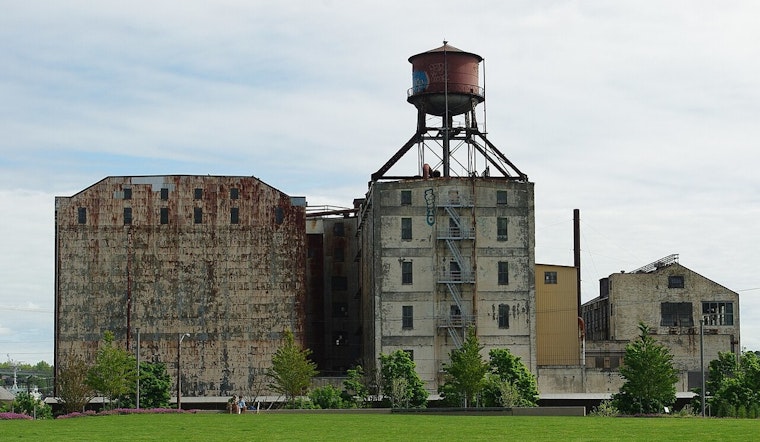
Thirteen rail cars carrying residual chlorine, a designated Toxic Inhalation Hazard, rolled directly past the collapsing shell of Centennial Mills on Tuesday, despite Union Pacific's earlier pledge to keep such shipments away from the site through August 21. Portland officials say they only learned of the shipment through the AskRail mobile app, an emergency-responder tool that tracks hazardous rail cargo, raising alarm just as the city races to demolish the fire-gutted mill before its brick walls give way onto a Pearl District rail corridor and roadway.
The discovery prompted Portland City Administrator Raymond C. Lee III to send an August 11 letter demanding Union Pacific immediately halt all Toxic Inhalation Hazard traffic near the site, according to a City of Portland letter. Lee's letter warns that residual chlorine left in a single tank car can total as much as 1,500 gallons, enough to create a fatal gas plume if falling masonry from the eight-story brick shell were to strike a passing car. The letter followed an earlier commitment from the railroad to restrict such toxic shipments through the corridor after the fire, a commitment the city says was broken by Tuesday's 13-car movement.
The warning comes as KATU reports Portland Fire and Rescue crews stayed overnight at the vacant Pearl District warehouse, continuing to monitor the burned-out structure for flare-ups. The station notes the building's interior has been reduced to crumbled floors, with only the exterior walls still standing following the fire that gutted the mill on August 2.
Mayor Declares Emergency Over Collapse Risk
Portland Mayor Keith Wilson signed a local emergency declaration on August 10, eight days after the four-alarm fire tore through the mill's interior, warning that ground vibrations from passing freight trains could trigger a collapse of the unbraced brick shell onto Northwest Naito Parkway, according to the Portland Tribune. Structural assessments conducted this month found the walls are leaning west toward active train tracks, and the paper notes city inspectors stationed outside the collapse perimeter have reported noticeable ground vibrations each time a train passes.
Union Pacific has resumed freight service through the area at a reduced 10 mph speed limit, but the disruption has rippled into passenger rail across the region. Amtrak has suspended all passenger travel between Portland and Seattle through at least Friday, relying on substitute bus bridges to move displaced travelers, per Mass Transit. Passenger rail traffic into Portland Union Station remains restricted as a result.
Demolition Complicated by Possible Human Remains
Efforts to tear down the mill quickly have been complicated by an earlier discovery. Human-remains detection K9 teams from Portland Fire and Rescue signaled the potential presence of human remains inside the burned debris on August 6, according to the Northwest Examiner, a finding that came after initial searches conducted immediately following the fire had returned negative results. The outlet reports that finding is forcing investigators and demolition crews to plan a slow, cautious deconstruction rather than a rapid teardown, even as the city races against the collapse risk.
Environmental hazards have compounded the crisis. Oregon Department of Environmental Quality testing confirmed that ash and debris blown into the Pearl District and nearby Fields Park contained asbestos, according to Ground News, prompting park closures and city instructions for residents to clean window sills with damp towels rather than dry sweeping.
Owner Faces August 14 Demolition Deadline
Portland Permitting and Development has issued a dangerous building notice to property owner Stuart Lindquist, ordering him to begin removing the mill's rooftop water tower and demolish the structure no later than Friday, KGW reports. Property owners are required to secure the site with 24-hour security under the order.
The site's troubled history stretches back decades. Built in 1910 as Crown Mills, the waterfront complex was acquired by the Portland Development Commission, now known as Prosper Portland, in 2000 for $7.7 million, according to Willamette Week. Taxpayers spent more than $27 million over two decades on maintenance and failed redevelopment plans before the property was eventually sold to private real estate interests. Hoodline previously reported on nightclub revival plans for the site's Mounted Patrol building months before the fire.
In the wake of the disaster, Oregon State Representative Shannon Isadore has announced intent to introduce 2027 state legislation strengthening government oversight and maintenance enforcement for long-vacant historic buildings, Willamette Week reports. The move follows a pattern of major fires striking vacant historic structures around Portland in recent years, including a Union Pacific freight derailment near the Steel Bridge that Hoodline covered in July.
Portland city leaders have held press briefings to share updates on the site as the situation develops, with drone imagery from operator Ric Peavyhouse, credited by KATU, showing the extent of the mill's destruction from above. For now, the fire-scarred hulk of Centennial Mills remains standing over an active freight corridor, with the city's authority limited to persuasion and public pressure against a railroad it cannot legally force to reroute.





