

























































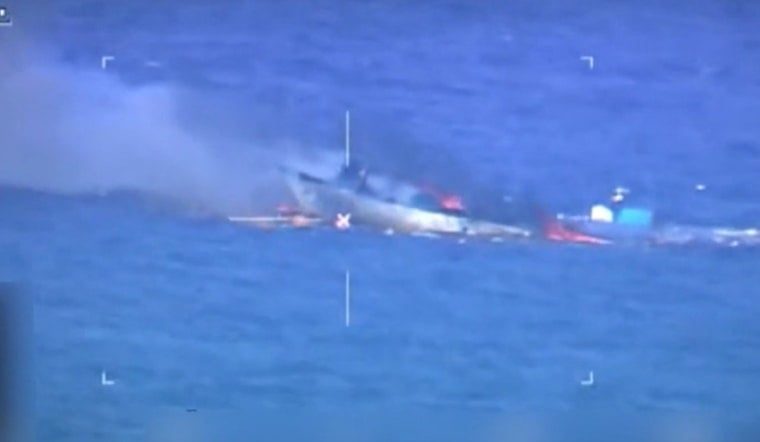
U.S. Marines and sailors boarded a suspected drug-trafficking vessel in the Eastern Pacific on Friday, searched it, cleared it without incident, and then sank it after removing everyone on board. The people found on the boat were taken safely to Ecuador rather than harmed, and U.S. Southern Command says the vessel had been serving as a floating refueling station for a maritime cocaine-smuggling network tied to the Ecuadorian criminal organization Los Choneros.
The operation was carried out by Joint Task Force Western Hemisphere, which coordinated with the government of Ecuador as Ecuadorian authorities helped facilitate the mission, according to The National News Desk. Marines and sailors involved in the boarding launched from the USS San Antonio, an amphibious transport dock ship that had transited the Panama Canal into the Pacific in early August following maritime interdiction rehearsals in the Caribbean Sea, as detailed in materials from U.S. Southern Command. The ship had embarked Marines from Littoral Combat Force-24 specifically to run maritime interdiction profiles across the command's area of responsibility.
A Sanctioned Target Eight Days in the Making
The vessel had been identified and targeted under Treasury Department sanctions, and intelligence linked it to Los Choneros, according to SOUTHCOM. That legal groundwork was laid just eight days before the sinking: on August 20, the Treasury Department's Office of Foreign Assets Control sanctioned 15 Ecuadorian individuals and entities and designated 10 commercial fishing vessels as blocked property for running logistical and refueling networks for cocaine traffickers, per the department's own announcement. Treasury officials said Ecuador-based commercial fishing vessels had been operating under commercial cover to transfer cocaine and supply fuel and food to go-fast boats crossing the Eastern Pacific.
Those floating refueling stations matter because they let smugglers push powerboats and low-profile vessels carrying multi-ton cocaine payloads far beyond the reach of coastal patrol radar, Treasury has explained. SOUTHCOM described the boat destroyed Friday as an important part of that at-sea drug-smuggling network, and said it could supply fuel to trafficking vessels operating far from shore.
A Blow to the Network, Commander Says
Marine Corps Gen. Francis L. Donovan directed the operation and said it demonstrated the Americas Counter Cartel Coalition's power to dismantle clandestine narco-terrorist trafficking capabilities. He added that the coalition dealt a decisive blow to a narco-terrorist operation moving significant amounts of drugs through the region, and said the coalition remains committed to defeating narco-terrorists in the Western Hemisphere. Destroying the vessel disrupted the organization's logistics chain, SOUTHCOM said.
Joint Task Force Western Hemisphere itself is a newly permanent fixture in this fight. U.S. Southern Command officially stood it up on August 4 as its permanent operational headquarters for counter-cartel missions, replacing the temporary Joint Task Force Southern Spear, according to U.S. Southern Command. The task force, led by Marine Corps Maj. Gen. Kevin Jarrard, coordinates counter-drug operations with 18 member nations across the Americas Counter Cartel Coalition.
From Prison Gang to Cartel Proxy
Los Choneros did not start out as a maritime smuggling operation. The group originated in Ecuador's coastal Manabí province in the 1990s and expanded from controlling the country's prison network into serving as a primary logistics proxy for Mexico's Sinaloa Cartel, moving cocaine through Pacific port cities like Manta and Guayaquil, according to InSight Crime. The outlet notes the group has faced growing fragmentation and territorial competition from rival gangs like Los Lobos in recent years.
The U.S. government designated Los Choneros a violent narco-terrorist group, and the State Department formally named it a Foreign Terrorist Organization and Specially Designated Global Terrorist entity on September 4, 2025, expanding federal authorities to freeze assets and enforce sanctions against individuals or equipment supporting the group under Executive Order 13224. That campaign has already reached the group's top leadership: in July 2025, Ecuadorian authorities extradited Los Choneros leader José Adolfo Macías Villamar, known as “Fito,” to the United States to face federal narcotics charges — the first time an Ecuadorian citizen had been extradited to the U.S. under updated bilateral security protocols. Fito's January 2024 prison escape in Ecuador had previously triggered a national state of emergency before his eventual capture.
Boarding Instead of a Strike
Friday's operation stands out for what it was not: another lethal strike. It came just days after a string of deadly U.S. military actions, including an August 23 Eastern Pacific strike that killed two suspected narco-terrorists and an August 25 Caribbean strike that killed four, as reported by Just The News. U.S. forces have been combining lethal kinetic missile strikes with non-lethal boardings and vessel scuttlings depending on the operational rules of engagement in play, the outlet noted — Hoodline previously covered an earlier deadly Caribbean strike and the broader escalation in a report on a related Puerto Rico gang bust.
That contrast underscores an open legal question hanging over the broader campaign: the distinction between non-lethal boarding-and-sinking operations, where crew members are transferred safely to custody as they were with Friday's operation, and kinetic strikes that have killed people during other recent interdictions. Boardings like Friday's are typically grounded in the Maritime Drug Law Enforcement Act, a federal statute that grants U.S. forces extraterritorial jurisdiction over stateless vessels or foreign ships operating with flag-state consent, without requiring a direct geographic nexus to U.S. territory, according to the Legal Information Institute. But the lethal strikes have drawn international pushback: in December 2025, United Nations High Commissioner for Human Rights Volker Türk formally called on the United States to halt lethal strikes on suspected drug-trafficking vessels, arguing that high-seas kinetic strikes risk extrajudicial killings under international human rights law and that counter-narcotics actions in international waters should conform to law enforcement standards rather than combat rules.





