

























































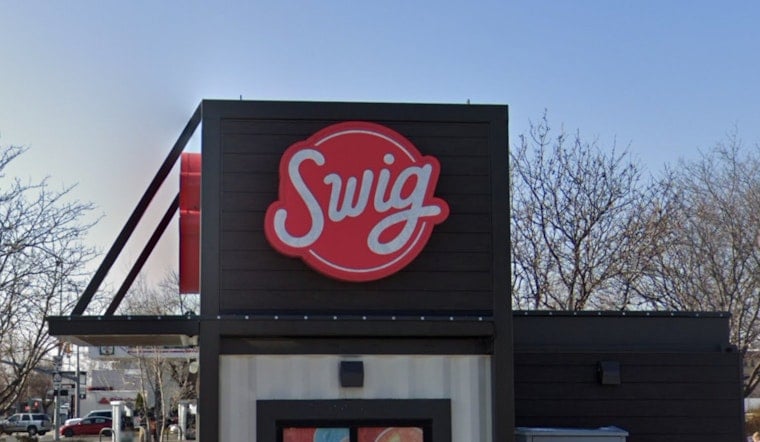
Swig, the Utah chain credited with creating the dirty soda category, announced it will make its Massachusetts debut next year with plans for six drive-thru locations across Greater Boston. The company has not revealed exact addresses for any of the stores, but it expects to open its first Greater Boston location in early 2027.
The expansion is being spearheaded by Ryan Nolan, a partner with Athena Franchise Group, which has signed a multi-unit franchise agreement with Swig to bring the brand to the region, according to MassLive. Nolan said Swig's brand is unlike anything else in the beverage industry, a pitch that has apparently resonated with real estate and franchise partners well beyond Utah's borders. Founded in 2010 in St. George, Utah, Swig grew from a single drive-thru concept into a chain that now operates in 16 states with more than 150 locations, per the same report.
What Exactly Is a Dirty Soda
For the uninitiated, a dirty soda is a non-alcoholic beverage made by mixing a standard soft drink with flavored syrups, dairy or creamer, and often citrus, the outlet notes. Beyond its signature drink, Swig also specializes in water-based refreshers and caffeinated energy drinks called Revivers, and its menu includes pink frosted sugar cookies alongside branded tumblers and stickers for sale.
The concept's roots trace back to Utah's unique religious landscape. Dirty soda originated there partly because the doctrine of the Church of Jesus Christ of Latter-day Saints prohibits hot drinks like coffee and tea but permits cold caffeinated sodas, a distinction church leaders clarified in 2012, according to Scary Mommy. That religious backdrop created an everyday social culture built around customized soft drinks long before the concept caught on elsewhere.
From Regional Habit to National Viral Hit
The dirty soda trend broke out nationally after pop star Olivia Rodrigo posted a photo holding a Swig cup on social media in December 2021, a moment later amplified by the 2024 Hulu reality series “The Secret Lives of Mormon Wives,” as reported by Al Jazeera. Dirty sodas went on to become a TikTok mainstay, with creators customizing fountain sodas with creamer and fruit purees for their followers. That viral momentum has translated into real commercial advantages beyond Utah's borders, according to private equity investor Savory Fund, which found that Swig locations operating outside its home state perform roughly 40% to 50% better financially than stores within Utah, per Fox Business.
Corporate Backing Fuels Rapid Expansion
Much of Swig's aggressive growth traces back to a corporate ownership shift. Utah-based conglomerate Larry H. Miller Company acquired a majority stake in Swig in November 2022, while early investor Savory Fund and founder Nicole Tanner retained minority holdings, according to a release distributed via PR Newswire. That deal was designed to accelerate the chain's multi-state store development and entertainment venue integrations.
The leadership team executing that push was reshuffled last October, when Swig promoted former Chief Commercial Officer Todd Smith to President and hired former Dave's Hot Chicken executive Shannon Swenson as Chief of Franchise Partnerships. Swenson previously helped scale Dave's Hot Chicken to hundreds of committed locations, a background the company is now leaning on for its own franchise growth.
Part of a Bigger National Rollout
Greater Boston is just the latest stop on a much larger map. Before this agreement, Swig secured a 25-unit franchise agreement in South Florida and a 13-unit deal across Chicago's southwest suburbs, part of a push that has the company on track to reach roughly 200 total open locations by the end of 2026, according to Restaurant Dive. Hoodline has previously covered Swig's push into Chicago's southwest suburbs, its arrival in Tempe and Glendale, and a soft opening in an old Sonic building along Greenville, South Carolina's Woodruff Road.
The stores themselves are built for speed rather than sit-down dining. Swig designs its locations around an 800 to 850 square-foot footprint focused on drive-thru efficiency, omitting traditional kitchen equipment to cut build-out costs and labor needs, with syrup stations, pebble ice, and fast drive-thru lane stacking doing the heavy lifting. That compact model also comes with a real financial barrier to entry: opening a single franchise requires a $39,500 initial fee, a 7% ongoing royalty on gross sales, and a total initial investment ranging from $505,000 to $1,118,000, with multi-unit applicants required to show at least $2.5 million in liquid assets.
Competition Heats Up as Big Chains Jump In
Swig's timing puts it on a collision course with much larger rivals. Dunkin' has launched its own dirty sodas, and McDonald's introduced specialty refreshers and dirty drinks in May, moves that place Swig's expansion within a broader shift as legacy quick-service chains chase the same high-margin afternoon snack trade. How that competition plays out in a New England market long dominated by coffee culture, rather than the Utah soda tradition that birthed the category, remains to be seen once Swig's Greater Boston doors actually open.
The brand's identity has not gone unchallenged before. Swig sued rival Utah chain Sodalicious in 2015 over the trademarked term “dirty soda,” a dispute that ended in an undisclosed out-of-court settlement in 2017 after Sodalicious argued the phrase was generic across Utah. For now, Greater Boston residents will have to wait for franchise partners to disclose real estate details, with municipal drive-thru permitting in the region's densely built towns likely to shape exactly where and how quickly the six planned locations come together.





