

























































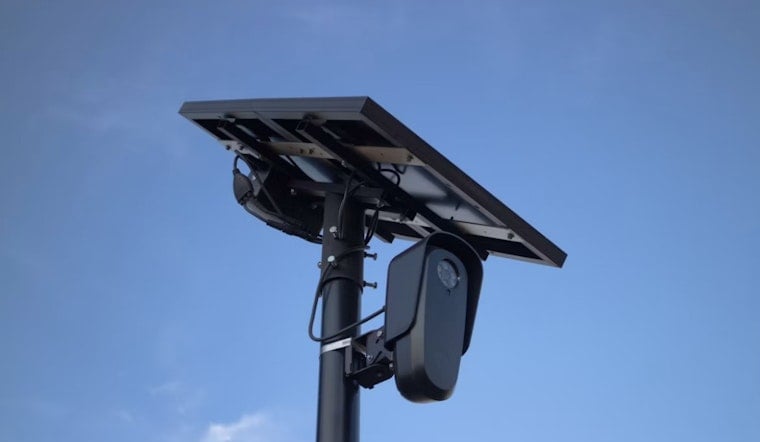
Waterford Township police are standing firm behind their network of 16 Flock license plate reader cameras, even as residents pack board meetings to complain and neighboring communities across Metro Detroit start pulling the plug on the same technology. The department recently approved a three-year, $60,000 agreement to upgrade to Flock OS-Plus, funded through federal drug forfeiture money, which will link the camera feeds with body cams, dashcams, and school district video systems.
The Waterford Township Police Department has spent just over $160,000 on its 16 cameras since first deploying eight units in January 2022, later expanding to 12 in late 2025 and 16 in 2026, according to CBS News Detroit. The department has also rolled out a Drone-First Responder program alongside the camera expansion, according to Charter Township of Waterford records. Scott Underwood, speaking for Waterford police, said the department does not use Flock information technology to track residents or conduct mass surveillance, and the cameras only capture pictures of vehicles and license plates visible to the general public.
Residents Push Back at Board Meetings
Not everyone in Waterford is convinced. The Waterford Board of Trustees has hosted meetings where residents voiced frustrations about the police department's decision to use Flock cameras, with one resident, Morgan Hitch, saying the cameras infringe on society. Another resident, Ryson Rigind, said the cameras should be taken down because they violate rights, while a resident identified only as Tyler suggested the money spent on cameras could instead go toward improving streets and other infrastructure.
Waterford police have pushed back against what they describe as misinformation and online distortion about the cameras, and say they have no plans to take the cameras down anytime soon. The images captured by the cameras are retained for 30 days, the same window that has become a flashpoint in surveillance debates elsewhere in Michigan.
A Region Moving in the Opposite Direction
Waterford's expansion stands out because so many of its neighbors are heading the other way. Sumpter Township decided against keeping its cameras, canceling a 60-day trial of 11 Flock units this month after community pushback and a desire to maintain public trust, as Hoodline reported in its coverage of the budget fallout. That decision followed an August 4 primary in which voters rejected a police funding millage by 57 percent, leaving the department facing a potential 40 percent cut to its operational budget, according to FOX 2 Detroit.
Monroe County has scaled back its Flock cameras as well. After county commissioners voted in July to terminate their Flock contract, the Monroe County Sheriff's Office cut its data retention window from 30 days down to seven and added automated software audits to catch abuse of the system, per WTOL 11. The retention cut coincided with Flock Safety rolling out automated Audit Assistance software to its customers, the outlet noted.
Vandalism and a Felony Case in Waterford
The backlash in Waterford has already turned physical once. A 24-year-old Clarkston man was charged in March with three felony counts of malicious destruction of police property after he smashed roughly $10,000 worth of Flock cameras in the township, one of which had captured images of his vehicle beforehand, FOX 2 Detroit reported. That case is not isolated: law enforcement officials across Oakland County reported this month that Flock cameras have faced a coordinated wave of vandalism in communities including Novi, Birmingham, Pontiac, Waterford, and West Bloomfield.
Other Oakland County communities have taken a different path than Waterford's continued investment. Ferndale ended its partnership with Flock Safety in November 2025 following resident outcry over data privacy and federal accessibility, switching instead to a five-year contract with Axon for its license plate readers, per C & G Newspapers. Ferndale also began requiring officers to manually verify plate matches before making traffic stops, resulting in zero misreads during its pilot period.
State Lawmakers Eye New Limits
Concerns over data retention and federal access are also playing out in Lansing. State Senator Jim Runestad introduced Senate Bill 1131 in July, which would require law enforcement statewide to obtain a search warrant before accessing license plate reader databases outside active investigations and would force automatic data deletion after 14 days. More than 180 Michigan law enforcement agencies currently operate ALPR networks without any uniform state statutory limits, a gap the bill is meant to address.
Separately, fifteen Michigan Democratic lawmakers sent a joint letter in July asking the Michigan Department of Transportation to revoke permits allowing federal agencies, including U.S. Border Patrol, to place license plate readers on state highways and trunklines, according to CBS News Detroit. Concerns over federal immigration access have driven several municipal camera cancellations across the state in recent months.
The Bigger Privacy Debate
The scale of data collection has drawn scrutiny even in communities that have kept their cameras. Sterling Heights, one of more than 180 Michigan agencies using Flock technology, logged over 1 million unique license plate scans in a single 30-day period in mid-2026, prompting city council members there to request a full year of audit logs to review how the data was queried, per The Cool Down.
Policy strategists with the ACLU of Michigan warned in January that retaining 30 days of unindexed roadway data creates detailed movement logs of drivers who are not suspected of any criminal activity, posing serious Fourth Amendment privacy risks, according to Michigan Public. For now, Waterford police say the cameras stay, even as the debate over how long departments should hold onto that data and who else can see it keeps intensifying across the region.



