

























































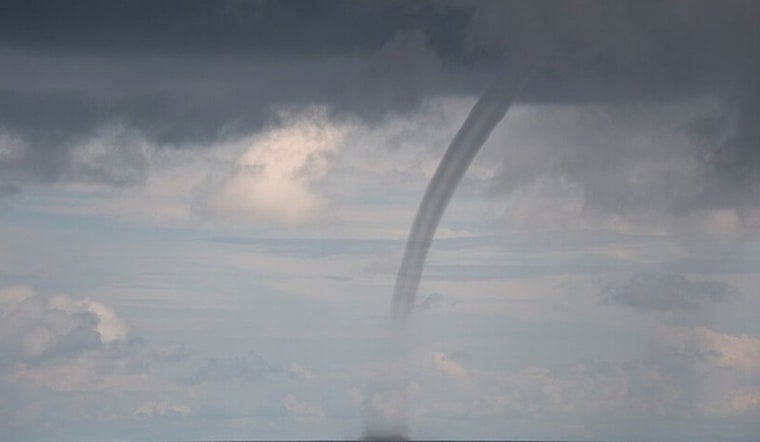
A waterspout twisted over the surface of Lake Okeechobee late Friday afternoon, spotted from the lakeside condos in Pahokee by a resident named Maria Mills, who caught the whole thing on video at 5:25 pm. It's the kind of sight that draws stares along Palm Beach County's rural lake shore, where the water stretches wide enough to spin up its own weather.
Mills's footage made its way to the National Weather Service's Miami-South Florida office, which posted a thank-you to a user identified as James on Saturday for helping relay the video, according to a post from NWS Miami. The office, which goes by the handle @NWSMiami and describes itself as the official account for the National Weather Service Miami-South Florida, is based in Miami, Florida, but keeps watch over Lake Okeechobee and the surrounding waters as part of its forecast territory.
That kind of crowdsourcing is routine for the office. NWS Miami is co-located with the National Hurricane Center at Florida International University and maintains round-the-clock surveillance over six South Florida counties and adjacent waters, including the lake, relying heavily on trained spotters and public social media reports to confirm storms that radar alone might miss.
A Lake Built for Spinning Weather
Lake Okeechobee covers roughly 730 square miles but averages just nine feet deep, making it the largest freshwater lake in Florida and the second-largest natural freshwater lake entirely within the contiguous United States, according to the South Florida Water Management District. That combination of vast open surface and shallow water helps generate localized atmospheric collisions similar to the sea-breeze fronts that spin up waterspouts along Florida's coasts.
South Florida and the Florida Keys see the highest concentration of waterspouts anywhere in the country, and among the highest in the world, with hundreds recorded each year during the summer wet season, per National Weather Service research. Forecasters generally split them into two categories: tornadic waterspouts that spin off severe thunderstorms, and fair-weather waterspouts that form from lighter cumulus clouds and typically build from the water surface upward before dissipating quickly.
The Pahokee sighting wasn't the only one on the lake this month. Another waterspout was filmed over Lake Okeechobee near Nubbin Slough in Okeechobee County in mid-August, a sign of the recurring late-summer instability that settles over the lake during Florida's rainy season.
What Happens If a Spout Reaches Land
If a waterspout crosses from water onto land, NWS guidelines say forecasters automatically reclassify it as a tornado and issue a Tornado Warning rather than treating it as a marine phenomenon. It's unclear whether Friday's Pahokee waterspout made landfall on the Herbert Hoover Dike, the 143-mile earthen levee built by the U.S. Army Corps of Engineers after the deadly 1928 hurricane flooding, or dissipated entirely over open water — a distinction that would determine how the event is ultimately logged in weather records.
Not every water-to-land transition ends quietly. In August 2020, a waterspout that formed off Sunny Isles Beach moved onshore at Golden Beach and became an EF0 tornado, damaging trees and patio furniture, according to WTSP. Most fair-weather spouts fizzle out fast once they hit land, but the Golden Beach case is a reminder that even the weaker ones can leave a mark.
For anyone out on the water when a funnel appears, NOAA safety guidance is blunt: steer at a 90-degree angle away from the spout's apparent path rather than trying to outrun or get a closer look. Even a weak fair-weather waterspout can overturn small watercraft, and when conditions turn severe enough, the National Weather Service issues Special Marine Warnings telling boaters on Lake Okeechobee to get to safe harbor immediately.
Hoodline reported on a similar moment last month when a dawn waterspout drew a crowd off Miami Beach, with onlookers posting video that NWS Miami used to verify the sighting and update its storm records. Friday's Pahokee footage follows the same pattern — a resident with a phone, a distant funnel over open water, and a forecast office that still leans on the public to know what's happening across its stretch of coastline and lake.



.jpg)