

























































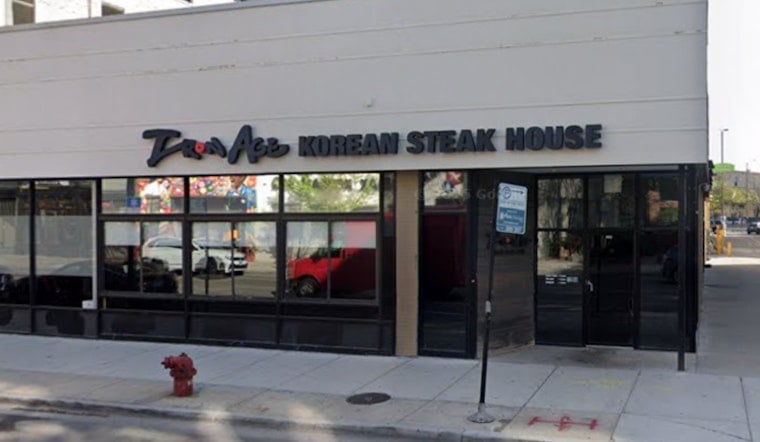
City health inspectors shut down Iron Age Korean Steakhouse in Wicker Park on Monday after finding more than 500 rat droppings scattered across the restaurant's kitchen, dishwashing area, and dining room, along with black slime dripping into an ice machine used for drinks served to customers.
The Chicago Department of Public Health suspended the all-you-can-eat barbecue chain's license on August 20 following the inspection, according to Block Club Chicago. Inspectors also found the restaurant had no chemical test kit on site, incomplete food handler certificates for employees, and inadequate lighting in a mop closet, per the inspection report cited by the outlet. The closure falls under what the city classifies as a Priority violation — the most severe tier of health code infraction, which mandates instant license suspension until a restaurant passes a follow-up inspection and submits a signed affidavit, according to Chicago's Department of Public Health.
Municipal inspection records reviewed by Chispections show the August 20 failure was logged as a Priority violation under Code 16 for ice machine contamination and Code 38 for rodent droppings found across prep, dishwashing, and dining areas. That same record shows city inspectors had attempted an earlier visit on August 11 that was logged as a No Entry, days before the infestation was ultimately documented.
A Pattern Stretching Back Months
This is not the restaurant's first brush with health code trouble. Chicago Department of Public Health data reviewed by Chispections shows Iron Age's Wicker Park location failed inspections in December 2025 for lacking a certified food manager and holding food at unsafe temperatures, then again in March 2026 for improper food storage — passing reinspections both times before this latest, more severe shutdown.
City complaint records tell a similar story from the outside. Property Sentinel data shows a history of health and rodent complaints tied to the building at 1265 N. Milwaukee Ave., including restaurant complaints filed in November 2025 and January and July of this year. A Streets and Sanitation rat baiting complaint was filed at the address on August 21 — one day after the health department's closure order, according to Property Sentinel. Separately, a West Town restaurant health analysis published by CleanPlate Chicago this year listed Iron Age among establishments scoring in the lower tier of health compliance evaluations in the neighborhood.
What It Takes To Reopen
Per the inspection report, Iron Age must eliminate all evidence of pest activity and clean and sanitize the affected areas before it can reopen. Block Club Chicago reported that restaurant management could not be reached for comment on the closure.
Iron Age opened its Wicker Park location in 2019, replacing Tozi Korean BBQ at the Milwaukee Avenue address, and quickly became a neighborhood draw. Hoodline reported at the time that the opening marked the Georgia-based chain's sixth location overall and noted an 81.2% surge in monthly Yelp review volume shortly after it launched. The restaurant operates as an all-you-can-eat tabletop barbecue concept, with embedded gas grills at customer tables, high-energy K-Pop music videos, and pricing around $23 for lunch and $29 to $30 for dinner, according to Wanderlog. Beyond Wicker Park, the chain also runs a suburban Glenview location along with additional sites in Georgia and elsewhere on the East Coast.
Part Of A Wider Neighborhood Pattern
Iron Age's shutdown echoes a similar case just a few months earlier in the same neighborhood. In April, Hoodline reported that Wicker Park's Vajra failed a health inspection and faced closure over cockroach activity, defective equipment and sanitation violations that inspectors said had gone uncorrected. Taken together, the two closures suggest health inspectors have been actively cracking down on pest and sanitation issues at prominent Wicker Park dining establishments this year.
The infestation also lands amid a broader citywide rodent battle. Pest-control firm Orkin reported last October that Chicago had dropped to No. 2 on its national Top 50 Rattiest Cities list, ending a 10-year run at the top spot that began in 2014, according to CBS News. For a fast-growing, high-volume concept that expanded from Georgia into Illinois and the Mid-Atlantic, restoring customer confidence will likely require more than a single passed reinspection — it will mean demonstrating sustained pest control in a neighborhood where inspectors have shown they're willing to shut restaurants down.





