

























































A female southern hairy-nosed wombat joey is now emerging from her mother's pouch at Zoo Miami, marking the first successful birth of the species in the zoo's history and the only one recorded anywhere in the United States in 2026. The joey was born January 19 to mother Adelaid and father Gordon, and after months of hidden development, she has finally begun poking her head out into public view at the Posner Australian Center.
Zoo Miami announced the birth, according to Miami's Community Newspapers, noting that Adelaid arrived at the zoo from Brookfield Zoo in Illinois, while Gordon came from the Los Angeles Zoo. Adelaid is 9.5 years old and Gordon is 8.5, and their pairing reflects the kind of multi-institutional coordination that keeps the tiny North American population of this species going. Brookfield Zoo, where Adelaid originated, was the first facility outside Australia to successfully breed southern hairy-nosed wombats back in 1974 and has since recorded more than 20 births while managing the species studbook for the Association of Zoos and Aquariums, according to CBS News.
Wombat pregnancies last only about 30 days, and what emerges is barely a wombat at all — a newborn joey is hairless and roughly the size of a bumblebee, relying purely on instinct to crawl into its mother's pouch, per the same account. Once inside, the joey nurses continuously for months, developing out of sight until it is ready to face the world.
A Pouch Built for Digging
Unlike most marsupials, female wombats have a pouch that opens toward the rear rather than the front, an adaptation that helps keep dirt out while the mother digs through her burrow. Zoo Miami's joey continued developing in that pouch for up to six months before beginning to emerge, according to Miami's Community Newspapers. Wombats are known for constructing extensive systems of burrows and tunnels called warrens, which can extend hundreds of feet and offer shade, shelter, and refuge to other wildlife, even protecting animals from dangers such as brushfires, per the same report.
The animals themselves are built for that underground life: round, robust bodies, powerful claws for digging, and a broad snout covered in fine hairs. Wombats also carry a distinctive defense mechanism — a heavily reinforced rear end containing strong cartilage that they use to block burrow entrances and fend off predators when threatened, the outlet notes. As if that weren't enough of a party trick, wombats are also the only mammals known to produce cube-shaped droppings.
A Rare Species Outside Australia
The southern hairy-nosed wombat is the smallest of Australia's three living wombat species and typically weighs between 45 and 65 pounds, feeding primarily on grasses and other vegetation in the drier grassland and woodland habitats it prefers. Globally, the International Union for Conservation of Nature classifies the species as “Least Concern,” though wild populations remain fragmented and are designated as endangered in New South Wales, according to Billabong Sanctuary. Wild wombats also face ongoing threats from agricultural land clearing, drought, and sarcoptic mange.
That contrasts sharply with the species' status in North American zoos, where fewer than 10 southern hairy-nosed wombats live across just a handful of institutions. In August 2026, the Columbus Zoo and Aquarium welcomed one of its own, becoming only the fifth zoo in North America to house the species, as reported by Sunny 95. The species also holds a special place in its native country — it has served as the official state animal and faunal emblem of South Australia since 1970, according to Wikipedia. For comparison, the northern hairy-nosed wombat, a close relative restricted to small protected sanctuaries in Queensland, has only around 300 to 400 individuals left in the wild, according to The Wombat Foundation.
A Long Life Ahead in South Florida
If Zoo Miami's new joey follows the pattern set by others of her species in managed care, she could be around for decades. Southern hairy-nosed wombats in zoos have reached exceptional ages exceeding 30 years — including a male named Carver at Brookfield Zoo who lived to 34 — compared with a wild lifespan of 15 to 25 years, per Wikipedia. Captive care removes natural risks like drought and predators that shorten lifespans in the wild.
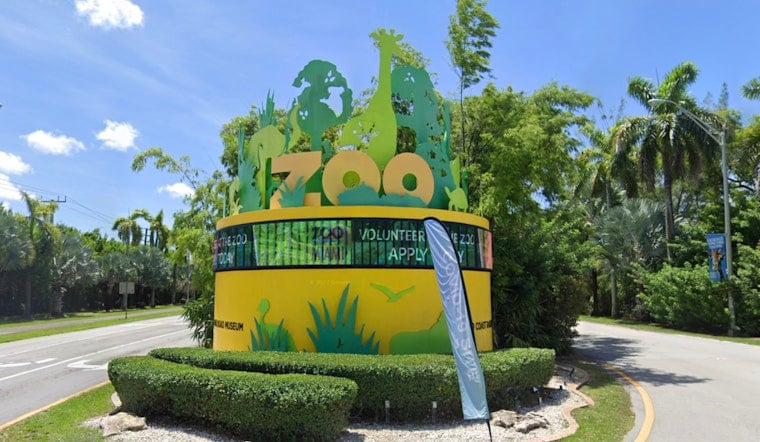
She'll spend that life at the Posner Australian Center, the exhibit precinct that also houses koalas, tree kangaroos, and cassowaries, as Hoodline has reported previously. Zoo Miami, formally the Miami-Dade Zoological Park and Gardens, spans 750 acres and is Florida's largest zoo and the fifth-largest in the United States. It operates as the only subtropical zoo in the continental U.S., using South Florida's climate to maintain outdoor habitats for more than 3,000 animals across nearly 1,000 acres of tailored plant life, according to the zoo's own background.
For now, visitors to the Australian precinct have a new reason to look closely at Adelaid's enclosure, where a joey barely out of the pouch represents both a family milestone for Zoo Miami and a small but meaningful boost for a species that remains exceedingly rare outside its native Australia.





