

























































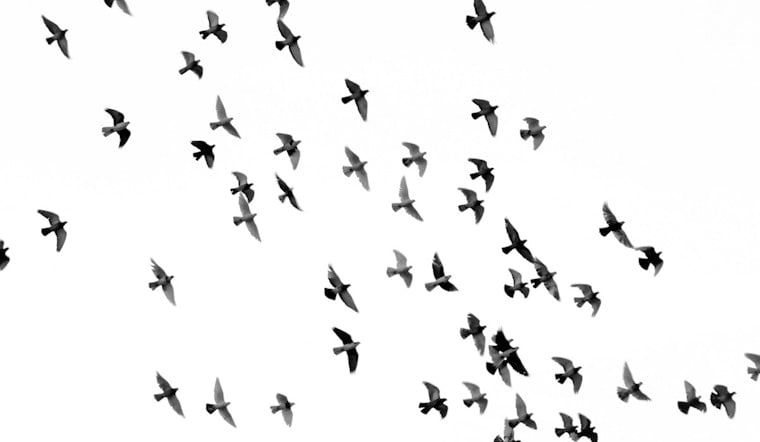
More than 800,000 birds crossed Davidson County as the fall migration season ramps up over Nashville, with radar forecasters calling regional bird traffic high and warning that hundreds of thousands more are likely to pass overhead in the coming weeks. Nationwide, forecasters projected that upward of 250,000 birds would take flight after sundown, funneling a share of that movement directly over Middle Tennessee.
The numbers come from WKRN News 2, which reported that BirdCast rated the region's bird traffic as high and tracks the movement using weather surveillance technology. That system, run by BirdCast, blends data from 140 Next Generation Radar stations nationwide with machine-learning models trained on 23 years of atmospheric radar observations to forecast nocturnal bird movement in real time, according to BirdCast.
Warner Park Nature Center has reported that fall migrants moving through Davidson County this season have included black-and-white warblers, chestnut-sided warblers, gray-cheeked thrushes, Swainson's thrushes and veeries, per the station's report. Laura Cook, the center's bird research coordinator, said fall migrants generally spend more days at Warner Parks as a migratory stopover compared to their spring pace, when birds move quickly to reach breeding grounds and claim territory, the same account notes.
Why the Skies Stay Busy Into October
Nocturnal migrants are expected to have fully crossed Tennessee by mid-October, and BirdCast researchers expect bird numbers to remain high in the state until that point, the outlet reported. That timeline gives birdwatchers more opportunities to spot the listed species in the coming months as the migration wave continues to move through.
The pattern fits into a much larger hemispheric picture. Roughly 70 percent of North American bird species migrate, and about 80 percent of those migrants fly at night to avoid predators, stay cool, and conserve energy, according to data published by DarkSky International and the National Audubon Society. Nocturnal migrants rely on natural celestial cues like stars and the moon to navigate their routes.
Davidson County's heavy traffic is also a function of geography. Roughly 60 percent of all North American migratory bird species, more than 325 distinct species in total, depend on the Mississippi Flyway corridor that passes through Middle Tennessee during their twice-yearly journeys between breeding grounds and wintering habitat, according to the Land of Lakes Bird Alliance. That corridor follows major river systems stretching from Canada to the Gulf of Mexico.
Decades of Ground-Level Research Back Up the Radar
Long before radar forecasting existed, Warner Park Nature Center was already tracking these birds by hand. The center's bird banding station has operated continuously since 1982 under a federal permit from the U.S. Geological Survey's Bird Banding Laboratory, monitoring long-term avian health and migration trends, according to Friends of Warner Parks. The lab distributes standardized aluminum leg bands used to track bird movement across the continent.
More recently, researchers there began outfitting migratory songbirds such as wood thrushes with miniature radio telemetry transmitters starting in 2021, using the Motus wildlife tracking network to follow individual birds traveling thousands of miles between Nashville and Central America, the Nashville Banner has reported. Telemetry data has confirmed that several tagged songbirds returned to the exact same breeding territories in Warner Parks year after year.
Urban Lights Remain a Persistent Hazard
All of this movement passes directly over a growing city, and that creates risk. Building collisions fueled by artificial light disorientation and glass reflections kill more than one billion birds annually in the United States, according to an August 2024 study highlighted by the National Audubon Society. Bird Safe Nashville reported that Nashville ranks 17th nationally in artificial night sky brightness among metro areas, a finding behind local Lights Out campaigns asking residents and building managers to dim non-essential lighting from August through October.
Those campaigns have precedent elsewhere. Long-term studies on high-rise buildings in downtown Chicago found an 83 percent reduction in migratory bird collision deaths when building lights were extinguished during seasonal night migrations, according to the Forsyth Audubon Society. More than 45 North American cities now participate in similar seasonal Lights Out initiatives.
Federal law also protects the species moving through Davidson County's skies. Under the Migratory Bird Treaty Act of 1918, it is illegal to pursue, hunt, take, capture or kill native migratory birds, or to disturb their active nests and eggs, without a valid federal permit, according to the U.S. Fish and Wildlife Service. Non-native invasive species such as rock pigeons and house sparrows are explicitly excluded from those protections.
The surge follows an earlier 100,000-bird Purple Martin roost that gathered in downtown Nashville in August, another sign of just how much migratory traffic moves through Middle Tennessee each fall. With weeks of heavy movement still ahead, Warner Park's long-running banding program and BirdCast's radar forecasts will keep offering both scientists and casual birdwatchers a window into just how much is passing overhead after dark.





