

























































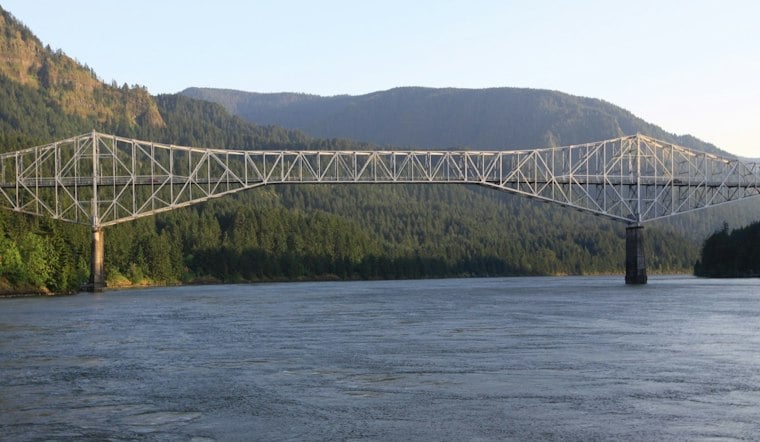
A century after it first stretched across the Columbia River, the Bridge of the Gods is getting its own birthday party. The Port of Cascade Locks is throwing a free celebration Saturday at Marine Park, running from noon to 8 p.m., to mark 100 years since the steel span opened in 1926 and forever linked the Oregon side of Cascade Locks with the Washington shore.
The daylong event will feature live music, historical presentations, family activities, a vintage car show and local vendors, according to OregonLive. The bridge itself has long been considered one of Oregon's most photographed landmarks, a crossing point not just for daily commuters but for tourists, cyclists and thru-hikers making their way along the Pacific Crest Trail.
Jeremiah Blue, executive director for the Port of Cascade Locks, told the outlet that the span represents generations of connection between people, cultures, and communities. He added that the centennial offers an opportunity to celebrate Cascade Locks history and invite visitors and residents to experience the Columbia River Gorge.
A Name Rooted in Legend and Landslide
The bridge's name traces back long before the steel structure existed. Native American oral histories describe a natural land bridge that once spanned the Columbia River at the same location, providing a vital connection between tribes on both sides of the river, per the same account relayed by OregonLive. Modern research attributes that natural land bridge to a massive landslide off the slopes of Mount Hood, one that may have been triggered by an earthquake.
Separately, geological studies and centennial exhibits point to the Bonneville Landslide as the source of the Gorge's dramatic namesake, describing a debris wall 200 to 300 feet high that dammed the Columbia before eroding into a natural stone arch that ultimately collapsed in the late 17th century, according to Cascade Locks Tourism. Native American accounts reportedly called that natural stone formation The Great Cross Over. Today's modern steel bridge stands near where that former natural land bridge once existed, a physical echo of the older crossing described in tribal oral histories.
From 1926 Opening to a Bigger, Taller Span
The current bridge wasn't always the structure Gorge travelers know today. Between 1936 and 1940, crews raised the Bridge of the Gods 44 feet and extended it to its current length of 1,858 feet to accommodate rising water levels caused by construction of the downstream Bonneville Dam, according to the Port of Cascade Locks. Before the dam backed up the river, the original bridge stood 91 feet above the water, per the U.S. National Park Service.
The bridge briefly brushed with aviation history, too. In 1927, Charles Lindbergh flew under the newly completed span. Decades later, the bridge found a different kind of fame when it appeared in the 2014 film Wild, based on Cheryl Strayed's memoir about her journey along the Pacific Crest Trail.
Ownership, Tolls and a Long-Hidden Blueprint Mystery
Ownership of the bridge shifted from private hands to public stewardship decades ago. The Port of Cascade Locks acquired the structure on November 1, 1961, issuing $950,000 in revenue bonds to buy it from private hands. Interstate Construction Corporation began the project, the Wauna Toll Bridge Company acquired the interest in 1926, and the Columbia River Bridge Company acquired the bridge in 1953. Those tolls remain in place today: standard passenger vehicles pay $3.00 in cash or by credit card, or $1.25 for drivers enrolled in the port's BreezeBy electronic tolling system.
For decades, no one could say for certain who actually engineered the bridge, since original blueprints had gone missing. That changed in April 2025, when David McCurry found photographs and records suggesting that the Puget Sound Bridge & Dredging Co. may have designed and built the span in 1925, as Columbia Gorge News reported.
Still a Freight Corridor — and a Pinch Point for Hikers
Beneath the celebration lies a more complicated reality: the bridge is still doing heavy lifting for the regional economy. It averages roughly 1.6 million vehicle crossings a year and carries an estimated $35 million worth of commercial goods across the Columbia annually, with toll revenue funding maintenance, painting and port operations.
That same narrow deck also happens to be the lowest elevation point on the entire 2,660-mile Pacific Crest Trail, with Cascade Locks sitting at roughly 170 feet above sea level, and serves as the official crossing for northbound hikers entering Washington. Cascade Locks is the only incorporated city located directly along the trail, a distinction Hoodline detailed during last month's PCT Trail Days festival in the same Marine Park now hosting the centennial party. Thru-hikers currently share the narrow two-lane steel deck with semi-trucks and passenger vehicles with no dedicated walking lane, a safety gap that prompted the Port of Cascade Locks and the Pacific Crest Trail Association to petition Oregon and Washington in September 2023 for $12 million in state funding toward a cantilevered pedestrian and bicycle lane, structural analysis and seismic upgrades.
Centennial Extends Beyond the Bridge Itself
The centennial story extends beyond the bridge itself.
Back in Cascade Locks, local businesses plan to keep the centennial spirit going well past the weekend, with bridge-themed events and specials continuing into the fall. Planned offerings include a Bridge of the Dogs art exhibit, guided bike tours, a museum exhibit on the bridge's history, and bridge trivia, giving residents and visitors several more chances to mark the span's hundred years long after Saturday's party wraps up.



