

























































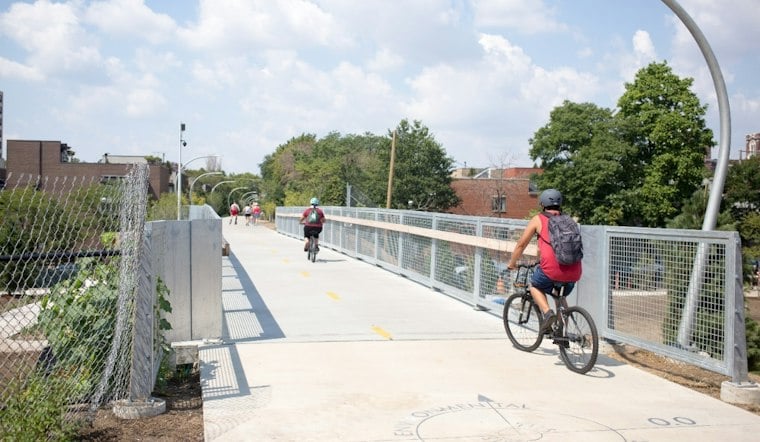
A Chicago police lieutenant who fired three shots at a suspected carjacker near The 606 trail in 2021 could be fired from the department, but a years-long legal fight over how Chicago handles police discipline means that outcome may not arrive anytime soon. Lt. Mike Keeney, who held the rank of sergeant at the time of the shooting, is now an inactive member of the Chicago Police Department while his case winds through a disciplinary process that has dragged on for more than five years.
The shooting happened when officers confronted Santiago Leon, who was suspected of committing multiple crimes while armed with a gun, including robbery and carjacking, according to WTTW News. Keeney told investigators that Leon disregarded an order to stop running and pointed a revolver at him, but Keeney did not fire in that moment. Leon was running toward a fence when Keeney fired his first round, then changed his path of flight to avoid the officer while raising and waving his left hand as he continued running toward the fence. Keeney fired the second and third shots as Leon was climbing the fence.
The Civilian Office of Police Accountability concluded the shooting violated department policy, finding that Keeney was not facing an imminent threat when he used deadly force. COPA determined that deadly force in violation of department policy is significant misconduct that undermines public trust, and the agency concluded the officer should be fired. But former Superintendent David Brown disagreed with that recommendation, describing Keeney's action as objectively reasonable, necessary and proportional to an imminent threat. Brown concluded Keeney fired as a necessary last resort to prevent Leon from shooting him or someone else and to stop him from using his firearm to escape arrest.
A Disagreement That Landed Before the Police Board
The clash between COPA and Brown sent the case to former Chicago Police Board member Steve Block, who was chosen to decide whether to uphold Brown's decision or send the matter to the full Police Board. In August, Block determined that Brown had not met his burden to overturn the recommendation from COPA's chief administrator, identified in the record as Kersten, that Keeney be fired. Under current rules, that means the Police Board would conduct a full hearing to determine whether Keeney should be fired. The Chicago Police Board is an independent civilian body that decides disciplinary cases involving Chicago police officers, according to the City of Chicago.
Even with that finding, Chicago officials will not be able to fire Keeney soon because of a broader dispute over arbitration and public hearings that has stalled discipline cases across the department. Notably, Keeney was promoted to lieutenant in August 2022 while the investigation into the shooting was still underway.
Leon's Guilty Plea and 20-Year Sentence
Leon was arrested soon after the shooting and, in 2024, pleaded guilty to several charges stemming from the incident, including armed robbery, aggravated assault of a peace officer with a firearm, and aggravated vehicular hijacking, per cwbchicago.com. That outlet reported Leon also pleaded guilty to aggravated unlawful use of a weapon with a previous conviction and ultimately received a 20-year prison sentence. Police found Leon near the west terminus of The 606, where he allegedly threatened an officer with a gun before the officer opened fire; cwbchicago.com's headline described the spree that preceded the shooting as lasting 30 minutes, while its article text put the figure at 35 minutes.
Frozen Discipline Across the Department
Keeney's case is caught in a much larger standoff over how Chicago disciplines its officers. Since September 2023, the city's longtime process for adjudicating serious misconduct cases has been largely paused, according to the Chicago Tribune. The Tribune reports that just four of the 31 CPD officers currently facing charges have opted to have their cases heard by the Police Board, while CPD has moved to fire 26 officers since that time, though most of those cases have remained on hold. COPA, meanwhile, has sustained findings of misconduct in more than 650 investigations since September 2023, including 22 tied to police shootings, the Tribune's reporting shows.
The holdup traces to a legal dispute over whether serious misconduct proceedings can be decided by a third-party arbitrator or must go through the Police Board, and whether those hearings must be conducted publicly. In August 2025, a panel of Illinois Appellate Court judges ruled that such proceedings may be decided by a third party but must be held in public, while officers facing firing may continue to be paid during the cases, per the Tribune's account. The Illinois Supreme Court heard arguments on the issue on September 24, and a decision could come before the end of 2026, according to both the Tribune and WTTW News' separate report on the case.
Pattern of Reversed Firing Recommendations
Keeney's case fits into a pattern that oversight reporting has tracked for years. The Chicago Sun-Times and WBEZ reported that Chicago Police Superintendent Larry Snelling disagreed with COPA's conclusions in 40 closed disciplinary cases and used what's known as the non-concurrence process to limit discipline in most of them, as detailed in the paper's investigation with WBEZ. Of the six officers, COPA had recommended firing for four and said firing should be considered for two. All six ultimately received far lighter punishment: three got no discipline at all, one received a reprimand, and two were suspended for a week or less. The Sun-Times and WBEZ found only three similar reversals dating back to 2019, before this more recent run of cases. In one example cited in that reporting, COPA initially pushed for the firing of Officer Fernando Ruiz over a 2022 shooting that left an armed man paralyzed, but the agency ultimately agreed to a one-day suspension instead.
The promotion of officers with contested disciplinary histories has drawn separate scrutiny. ProPublica reported that Sgt. Christopher Lockhart was promoted despite COPA's finding that his conduct seriously undermines public faith, credibility and trust in the department, after COPA recommended in January 2024 that he be fired following an investigation into allegations of domestic violence and sexual assault. Chicago police officers can be promoted based on exam scores even with problematic records on file, ProPublica noted, since roughly 70% of CPD promotions rest on test scores, according to WTTW News' reporting on the policy.
Other cases have followed a similar trajectory. The promotion of officers with contested disciplinary histories has drawn separate scrutiny. ProPublica reported that Sgt. Christopher Lockhart was promoted despite COPA's finding that his conduct seriously undermines public faith, credibility and trust in the department, after COPA recommended in January 2024 that he be fired following an investigation into allegations of domestic violence and sexual assault. Chicago police officers can be promoted based on exam scores even with problematic records on file, ProPublica noted, since roughly 70% of CPD promotions rest on test scores, according to WTTW News' reporting on the policy. Mayor Brandon Johnson called in December for the department to change how it promotes members, and WTTW News has also reported that a Chicago police sergeant was promoted this past August despite facing termination after overseeing a botched raid. WTTW News' coverage of policing and police reform, including its reporting on the Keeney case, has been supported by the Joyce Foundation.





