

























































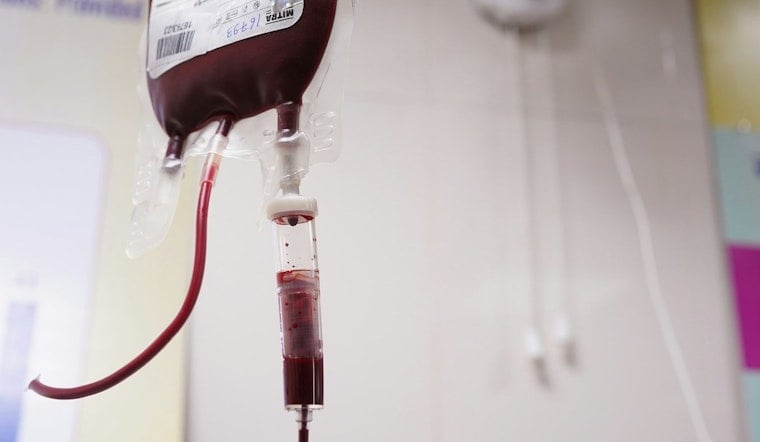
Doctors could not stop Nick Jackson's bleeding fast enough after a summer 2024 motorcycle crash near Castle Rock left him with a traumatic brain injury, a shattered pelvis, broken legs, broken hands, and life-threatening internal bleeding. He would go on to receive 274 units of blood during his hospitalization; doctors initially doubted he would survive.
Jackson was airlifted to a hospital ICU following the crash, according to News 9. Trauma physician Dr. Kaysie Banton, who treated him, said Jackson was incredibly broken. “Blood was being poured into him as quickly as he was losing it,” Banton said, and she estimated Jackson had less than a 5% chance of survival.
A Hospital's Blood Supply Pushed to Its Limit
Jackson received 274 units of blood, according to footage reported by FOX31 Denver. The scale of what Jackson needed is difficult to overstate: medical literature defines a massive transfusion as 10 or more units of red blood cells within 24 hours, roughly equivalent to replacing an adult's entire blood volume, while anything above 20 units in 24 to 48 hours is classified as ultra-massive, per StatPearls. Jackson's 274 units dwarfed even that extreme benchmark.
A single pint of donated whole blood — the standard donation — represents roughly 10% of a healthy adult's total blood volume, according to Vitalant. The American Red Cross has noted that a single motor vehicle crash victim can require up to 100 units of blood, contributing to a daily U.S. hospital demand of about 30,000 units of whole blood nationwide. Because red blood cells last only 42 days on the shelf, that demand never lets up; the country needs a blood donation roughly every two seconds, per News 9's reporting.
Learning to Walk Again
Jackson's recovery didn't end when he left the ICU. He completed months of rehabilitation, relearning how to move and how to walk again. He has since returned to almost everything he loved before the crash, though he no longer rides motorcycles. Jackson hopes his story reminds people that one blood donation can help save a life — and that a single life is sometimes saved only after hundreds of donations add up.
A Shortage That Keeps Recurring
Jackson's ordeal happened in 2024, but his story resurfaces at a moment when blood banks are again straining nationwide. The American Red Cross declared its second-ever national blood supply crisis in July after summer donations fell to a four-year low and type O-positive reserves dropped below a one-day national supply. In Oklahoma, Our Blood Institute declared its own emergency shortage in June after its O-negative inventory fell to just 65 units — less than a day's supply for the more than 160 healthcare facilities it serves across Oklahoma, Texas, and Arkansas, according to the organization's own appeal.
The passage also mentions Oklahoma Blood Institute, the April 19, 1995 bombing, and tornadoes.
The seasonal pattern behind these shortages is well documented. High school and college blood drives, which can generate up to 60% of regional whole-blood collections, pause every summer, the Red Cross has explained. Hoodline has tracked similar strain in Utah this year, with Utah donations hitting a four-year low.
Regulators have tried to widen the pool of eligible donors to ease exactly this kind of strain. In 2023, the FDA finalized updated donation guidelines eliminating time-based deferrals for gay and bisexual men, replacing decades-old restrictions dating to the 1980s HIV epidemic with individual, behavior-based risk assessments for all donors. Even with that expanded eligibility, blood collectors continue to lean heavily on seasonal donation pushes to keep hospital shelves stocked.
Jackson's case, as extreme as it was, is a reminder of what that shelf stock is for. Doctors were able to keep pace with catastrophic blood loss with a 274-unit transfusion. Whether it's a car crash, major surgery, or a natural disaster, donated blood saves millions of lives each year, and cases like his show how quickly that margin can run thin.





