

























































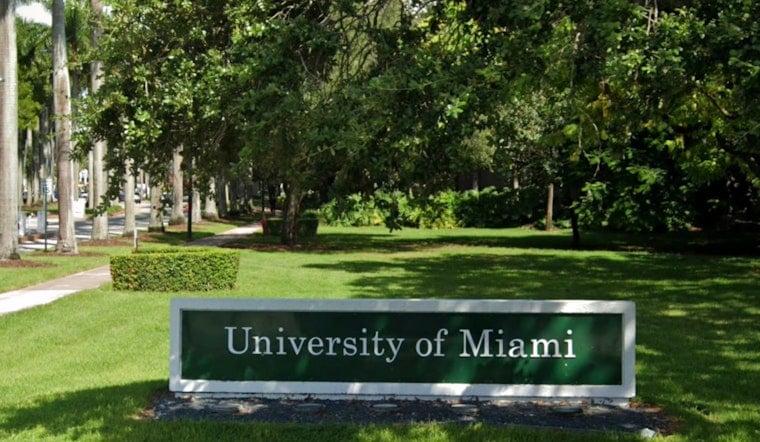
Harvey Harris walked away from his college coursework in the 1950s to serve in the military, never finishing the degree he started. Now, at 90 years old, the South Florida veteran has officially completed his undergraduate degree at the University of Miami, closing a gap of 68 years between his first classes and his diploma.
The milestone was detailed by WPLG Local 10, whose reporters Hannah Yechivi and Ryan Mackey chronicled how Harris's original education was interrupted by his military service before he eventually returned to finish what he'd started. The station's report frames Harris's journey as a testament to persistence, noting the sheer length of time between his first enrollment and his eventual degree completion.
Harris is far from the only veteran on UM's Coral Gables campus. According to VA data compiled by College Factual, roughly 505 GI Bill student veterans attend the university, making up about 4.0% of its total student body of 12,570. That figure tracks closely with national benchmarks from Student Veterans of America, which put veteran enrollment across U.S. colleges generally between 3% and 4% — and which note that military service often creates extended gaps in degree completion, exactly the kind of gap Harris closed.
How Veterans Afford a Private University Degree
Finishing a degree at UM in 2026 is not cheap. The university estimates the full cost of attendance for a domestic undergraduate living on campus at $98,872 for the 2026-2027 academic year, according to the University of Miami Undergraduate Admission office. For veterans like Harris, that price tag is typically offset by federal programs rather than out-of-pocket payment.
The Post-9/11 GI Bill and the federal Yellow Ribbon Program, in which UM participates, provide matching funds to help eligible veterans cover tuition costs that exceed standard public benefit caps, per the University of Miami Academic Bulletin. Florida residents attending private nonprofit schools like UM can also apply for the state's Effective Access to Student Education grant, an annual legislative allocation designed to offset private tuition costs, according to the University of Miami's financial assistance office. Notably, while Florida law allows public universities and community colleges to waive tuition for residents 60 and older on a space-available basis, private institutions such as UM are not bound by that rule and operate under their own financial aid and admission policies, per Kiplinger.
A Century-Long Relationship With Military Students
UM's ties to veteran education run deep. The university was founded and chartered in April 1925 in Coral Gables, and one of its largest historical growth spurts came immediately after World War II, when thousands of returning servicemen enrolled under the original G.I. Bill, according to WLRN. The university marked the 100th anniversary of its incorporation in 2025.
Today, that legacy continues through UM's dedicated Veterans Resource Center and Veteran Students Organization, run through the Office of the University Registrar, which helps military-connected students navigate benefits certification, academic transition, and peer support. It's the kind of infrastructure that likely played a role in helping Harris re-enroll and see his decades-old coursework through to a diploma, though the dossier does not detail the exact administrative steps UM took to audit his historic credits, nor the specific major he completed or the exact years of his 1950s service.
Harris's story adds to a broader thread of UM's connection to student veterans that has occasionally made local headlines for very different reasons — Hoodline previously reported on a UM veteran's scooter case involving a graduate student and Miami Beach police. But for Harris, the outcome is simpler: a diploma nearly seven decades in the making, and proof that a degree deferred is not a degree denied.





