

























































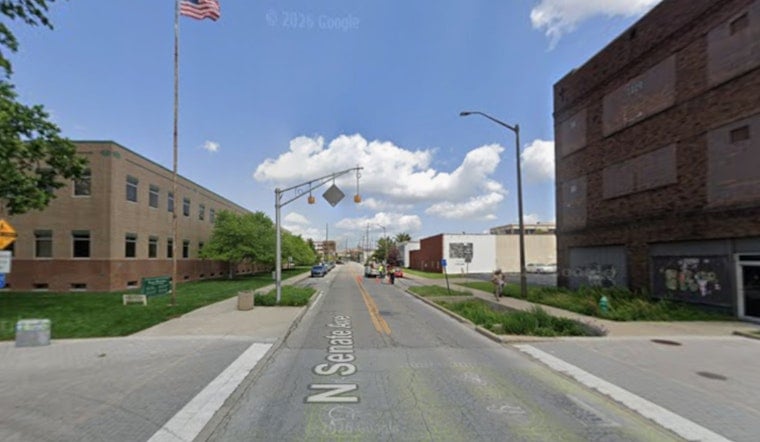
A scaffold now juts onto the Indianapolis Cultural Trail along Walnut Street, propping up the crumbling south façade of Castle Hall, the 1911 building where generations of Black Indianapolis residents gathered for parties, seminars and fashion shows during segregation. The century-old structure at the corner of Walnut Street and Senate Avenue has just been named one of Indiana Landmarks' 10 Most Endangered historic places for 2026, a designation meant to rally help before the damage goes any further.
Indiana Landmarks revealed its annual list, and Castle Hall's inclusion reflects just how precarious the building's condition has become, according to WTHR. The station reports that stabilizing the building will require a community-wide effort, and that Indiana Landmarks is actively searching for solutions and potential partners to fund the repairs. Temporary shoring and safety scaffolding already extend over the south façade directly onto the Cultural Trail, according to Indiana Landmarks, with stalled masonry and roof repairs leaving the scaffolding in place indefinitely.
“Castle Hall is too important to the history of the city,” Jamie Simek said, per the WTHR report, describing a damaged structure now in danger of disappearing altogether. Saving it will likely cost millions of dollars, the station notes, and current owner Alan Henderson cannot close that gap alone.
A Hall Built by and for Black Indianapolis
Castle Hall was constructed in 1911 by the Colored Knights of Pythias, a fraternal order created because Black Americans were excluded from the original Knights of Pythias group founded in Washington, D.C., in 1864. That original order was established in 1880 in Mississippi specifically to give Black men their own fraternal structure, according to the Indianapolis Business Journal's account cited by the same research documenting the building's history.
Four local lodges — Pride of the West No. 2, Marion No. 5, Montgomery No. 6 and Compeer No. 31 — formed the Castle Hall Association in the early 1900s, pooling their resources to buy the Senate Avenue land for $4,000 before raising roughly $40,000 to build the hall, according to Historic Indianapolis. Some of that money came from a Pythian Jubilee held at Tomlinson Hall. Architect Frank Hunter won a 1908 design competition against five other submissions, including proposals from two Black architects, and ultimately simplified his Tudor Revival design to fit the lodges' budget.
For more than four decades, Black Indianapolis residents used Castle Hall to connect and thrive, per the seed reporting, and the building served as a center of culture, commerce and community activity. Haircare entrepreneur Madam C.J. Walker attended a party there in 1914, a 200-guest formal dance that the Indianapolis Recorder at the time described as unrivaled in local Black social history, according to Indiana Landmarks. A crest etched into the ceiling still bears the motto FBC, standing for Friendship, Benevolence and Charity.
From Warehouse to Preservation Fight
The Knights of Pythias lodges vacated Castle Hall in 1946, after which the building spent decades operating as a commercial storage and moving warehouse, according to Indiana Landmarks. Alan Henderson purchased the property through Henderson Development LLC in 2017, according to a Wikipedia entry cited in the research record, with plans to restore it as a community-centered hub along the Cultural Trail. He now envisions nonprofits, businesses and perhaps a coffee shop sharing space inside once repairs are complete, per WTHR's reporting.
The building earned a place on the National Register of Historic Places on November 15, 2021, under federal reference number SG100007176, according to the U.S. National Park Service. That recognition helped attract a $1.5 million grant from the Mellon Foundation's Humanities in Place program in December 2023, along with a $25,000 grant from Indiana Landmarks in 2025 — but the renovation plans have since stalled because of funding shortages, leaving the scaffolding standing and the larger restoration incomplete.
What the Endangered Listing Could Mean
Indiana Landmarks has run its 10 Most Endangered list since 1991, and of the 172 sites named over that span, 105 have been restored or removed from threat while 21 have been lost to demolition, according to the Indianapolis Business Journal. That track record, with more than 60 percent of listed properties ultimately saved, is part of why the designation functions as an advocacy tool rather than a final verdict.
Castle Hall shares this year's list with nine other threatened Indiana sites, including Fortville's Ayres House, New Albany's City-County Building and Evansville's First Church of Christ, Scientist, according to Indiana Landmarks' 2026 announcement. For now, Indiana Landmarks says it is helping find a future for Castle Hall, working alongside Henderson to identify the partners and funding needed to take the scaffolding down for good and reopen a building that once stood as one of the city's premier gathering spaces for Black Indianapolis.





