

























































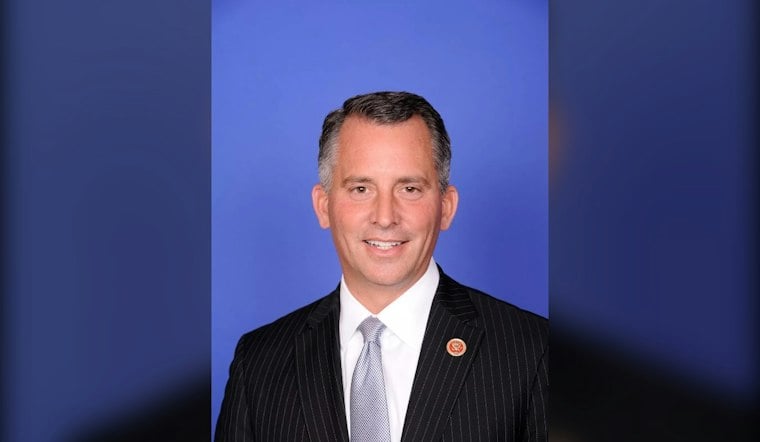
The 2026 Blue Gala in downtown Miami gave Florida Democrats a rare public display of confidence. The Miami-Dade Democratic Party event at the Frost Science Museum brought together gubernatorial candidate David Jolly and Senate nominee Angie Nixon as the party argues that competitive statewide races could turn a long period of Republican dominance into an opening. The event, however, is better understood as a test of organization than as evidence that Florida’s political structure has already changed.
The central obstacle is measurable: the Florida Department of State reported a Republican registration advantage of 1,541,333 voters in July. Republicans also control every statewide office and hold supermajorities in both chambers of the Legislature, according to the Miami Herald. Those advantages do not determine an election by themselves, but they establish the scale of the coalition Democrats would need to assemble.
A polling opening is not the same as a changed electorate
A September St. Pete Polls survey of 913 likely voters, as reported by the Herald, placed Jolly and Republican U.S. Rep. Byron Donalds essentially even in the governor’s race. The same account described near-ties between Nixon and appointed Republican Sen. Ashley Moody, and between Democrat José Javier Rodríguez and Republican Attorney General James Uthmeier.
Those results show that the races are competitive in at least one survey, not that Democrats have overcome the registration deficit. The available account does not independently establish how the poll’s likely-voter screen compares with Florida’s eventual electorate, nor whether the three contests will draw identical voters. The poll therefore identifies an opportunity while leaving the size and durability of that opportunity unresolved.
At the gala, Jolly presented himself as a moderate Democrat, while Nixon emphasized healthcare, wages, prices and accountability for the Trump administration. Their first joint appearance reflects a practical campaign question: whether a ticket can combine Jolly’s appeal to swing voters with Nixon’s potential to energize voters who are less likely to participate. The event itself cannot answer that question; turnout records after the election will be needed to assess it.
The records that can test the momentum claim
Florida’s official data make it possible to evaluate the gap more precisely than a statewide registration headline allows. The Division of Elections provides archived monthly registration reports from 1995 through 2024, creating a historical baseline for comparing the current partisan balance with earlier periods: Florida Department of State Division of Elections.
Registration is only one part of the analysis. The state says turnout is the percentage of eligible registered voters who cast a ballot, a distinction that matters when a campaign claims gains among inactive voters or voters without a party affiliation. Its statewide precinct-level files are compiled from data submitted by county supervisors of elections and include downloadable results for past contests, including 2018, 2020 and 2022: turnout data and precinct-level results.
That framework is especially important in Miami-Dade, where a Democratic event may reflect local enthusiasm without representing the statewide electorate. The county’s Supervisor of Elections publishes district-level registration analyses that break voters down by demographic categories and party affiliation: Miami-Dade district analysis. Comparing those records with precinct turnout and past margins can show whether a potential Democratic gain is broad, concentrated in a few districts, or dependent on voters who have historically participated at lower rates.
Money and organization remain part of the test
Republicans’ financial advantage is another structural condition, but it should be measured through reported receipts and spending rather than treated as a general impression. Florida’s campaign-finance database contains contribution and expenditure reports for committees dating to January 1, 1996, and the Division of Elections says candidates and committees must disclose detailed financial records: Florida campaign-finance database. Those records can distinguish candidate resources from outside-party spending and show whether a polling opportunity is matched by sustained organizing and advertising.
The Blue Gala demonstrates that Florida Democrats believe the 2026 contests are more competitive than recent statewide results suggest. The official data will determine whether that belief describes a durable shift or a campaign-season snapshot. Until registration, turnout, geography and spending are compared together, the 1.54 million-voter gap remains a substantial obstacle—and the apparent momentum remains an opening to be tested rather than a political realignment already established.





