

























































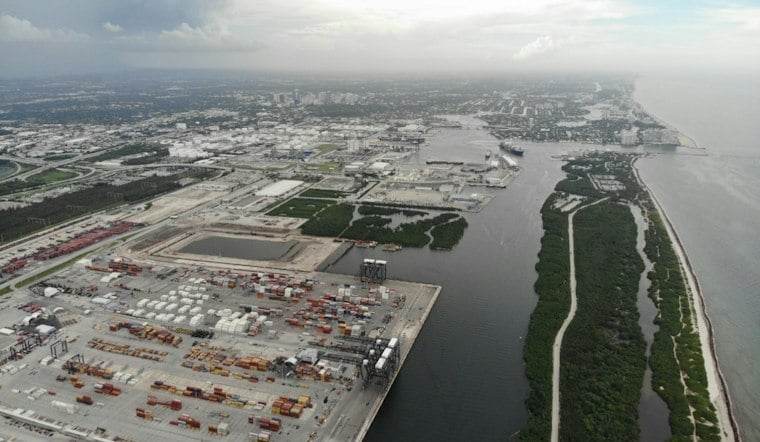
Port Everglades is getting a $30.75 million federal boost to rebuild one of its key fuel-handling slips, part of a broader push to let the Broward County port handle bigger tankers as cargo volumes grow. The money comes from the U.S. Maritime Administration's Port Infrastructure Development Program and is earmarked for the port's Slip 1 Expansion Project, which involves relocating a structural bulkhead and widening the slip to accommodate larger vessels.
According to Port Everglades, the port “has been awarded $30.75 million through the Maritime Administration (MARAD)'s Port Infrastructure Development Program (PIDP).” The grant is part of a $498 million federal investment spread across 35 projects in 19 states, the port says.
Once complete, the work is meant to widen the slip to 450 feet and relocate the aging bulkhead so the port can accommodate “significantly larger, more economical vessels such as the Aframax class,” per the port's announcement. That matters for a facility that, by its own account, offloads more than 14.9 million gallons of petroleum products every day, a volume detailed on the Slip 1 project page.
What the Expansion Actually Involves
The Slip 1 project page lays out an ambitious engineering scope: the seawall is meant to support a final depth of 50 feet, up from its current 38 feet, specifically to accommodate two Aframax-sized petroleum tankers at once. Getting there will require removing roughly 338,000 cubic yards of material, including about 80,000 cubic yards that need remediation to clear historic petroleum contamination, the port's project page notes.
The full public-private project carries a projected price tag of $184.5 million and is expected to take three to four years to complete, the port's announcement states. Construction is planned in phases, with Phase 1 slated to begin in 2028 and the broader expansion targeted for completion in late 2031, according to the same project page.
A Smaller Funding Round Than Recent Years
The $498 million round that included Port Everglades' award represents the program's lowest funding level in five years, according to the Maritime Executive. The trade publication noted that November 2024 PIDP awards totaled $580 million across 31 projects, while November 2023 brought $653 million for 41 projects and October 2022 delivered $703 million for 41 projects — a steady decline that puts this year's total well below recent norms.
That shrinking pot of federal dollars makes the Port Everglades award notable on its own, even without factoring in the political attention it's drawn. The Floridian reports that Rep. Mario Díaz-Balart touted the $30.75 million award for Broward County's port, framing it as part of the competitive federal maritime ports grant program he says he helped create to strengthen port infrastructure and expand investment nationwide.
The Congressional Angle
Per the outlet's reporting, Díaz-Balart has secured more than $74 million for South Florida ports and says he has delivered investments in port infrastructure, public safety, transportation and flood mitigation for his communities. The congressman serves as vice chair of the House Committee on Appropriations, chairs the National Security, Department of State, and Related Programs Subcommittee, and also sits on the Transportation, Housing, and Urban Development and Defense subcommittees, according to the same report.
Díaz-Balart said he was positioned to continue delivering federal resources to Miami-Dade and Broward communities, and the outlet notes he will continue his congressional roles after Democrats take control of the upcoming Congress. He won reelection in Florida's 26th District in the 2026 midterms by a narrow margin, per the report.
U.S. Transportation Secretary Sean Duffy said the broader investment round would upgrade ports, strengthen supply chains, lower shipping costs and create well-paying jobs, according to the same account. For Port Everglades, the practical result is a multiyear construction push that, if it stays on schedule, won't see concrete poured until 2028 and won't wrap up until nearly five years from now.





