

























































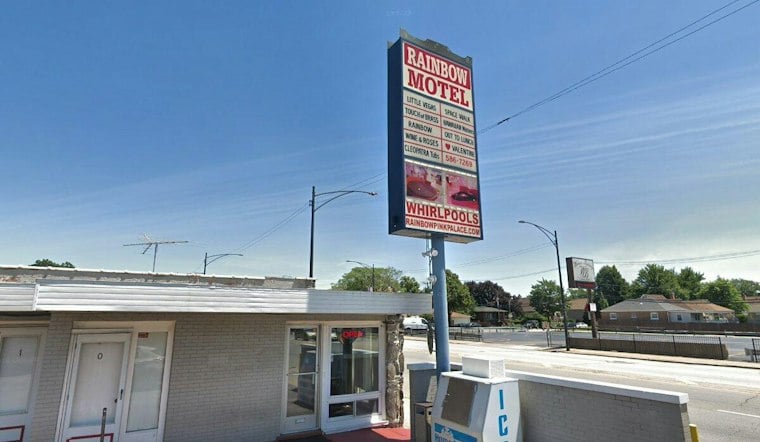
A 40-foot neon sign that has towered over Archer Avenue in Garfield Ridge for decades is now at the center of an anxious preservation effort, as the 72-year-old Rainbow Motel undergoes property renovations with no public word on what will happen to its neon signage. The sign has become a focus of preservation efforts at the property.
The uncertainty was first reported by Block Club Chicago, which detailed changes underway at the property and efforts to determine what would happen to its signage. According to the outlet, it remained unclear whether one or both of the motel's signs would be altered or what would happen to the existing signage, and the motel's owner did not respond to several requests for comment.
The Rainbow Motel sits at 7050 W. Archer Ave. A Facebook post from Alderman Michael D. Rodriguez was also cited in connection with Archer Avenue.
A Motel With A Complicated History
The motel opened in 1954 as the Rainbow Pink Palace Motel, per WBEZ reporting cited by Block Club Chicago, and later expanded with a two-story wing in the 1970s or early 1980s. It currently operates as a 27-unit property, according to Hotels.com, which also notes the motel's original 1954 opening. Beyond the large neon sign, the property still displays signs advertising themed rooms and an illuminated open sign; the motel had 11 themed rooms as of 2017, per WBEZ.
The motel's mid-century aesthetic has already been chipped away over the years. During the 2010s, some themed-room signage was removed, according to a 2020 Reddit thread tracking changes at the property. The motel has also drawn scrutiny from neighbors and city officials in the past, according to the Southwest Chicago Post. The same outlet also discussed the property's proximity to Midway Airport.
Sign Museum Races Against The Clock
The Block Club Chicago report also described efforts to preserve the motel's signs. Kelsey McClellan of the Chicago Sign Museum told the outlet that the museum was working on a plan and seeking contact with the owner. The museum would prefer the sign be restored and remain in place, while also exploring options for preserving it if the owner replaces it, with an eye toward eventually displaying collected signs at a permanent public location.
McClellan said the Rainbow Motel situation points to a broader problem facing vintage sign preservation across the city. The Chicago Sign Museum, founded in early 2024 by sign painters Kelsey and Andrew McClellan, grew out of the sudden, unannounced removal of the iconic 1954 neon sign at Duk's hot dog stand in West Town, according to The Retrologist. The couple, who also run Heart & Bone Signs, are involved in efforts to preserve vintage signage.
A Legal Gap Even With Aldermanic Backing
Chicago's vintage sign code offers some protection for existing signage, according to Block Club Chicago's reporting. But the code does not carry the same historic protections available to landmarked buildings, and preservationists say there is little financial incentive for owners to maintain vintage signs as public art.
That gap has contributed to recent losses of historic neon signs in Chicago. Another recent case is cited by preservationists as an example of the challenges facing vintage-sign preservation, according to the Chicago Tribune. Not every recent case has ended that way — a Hoodline report was cited in connection with a proposed Milshire Hotel redevelopment.
Whether the Rainbow Motel follows that path or another precedent remains an open question. Workers are renovating some rooms at the property, but the motel has offered no public confirmation of what will ultimately happen to its 40-foot neon centerpiece. For now, the Chicago Sign Museum says it simply wants to learn the sign's history, its previous owners, and the story behind the motel's name — before it potentially disappears from Archer Avenue for good.





