

























































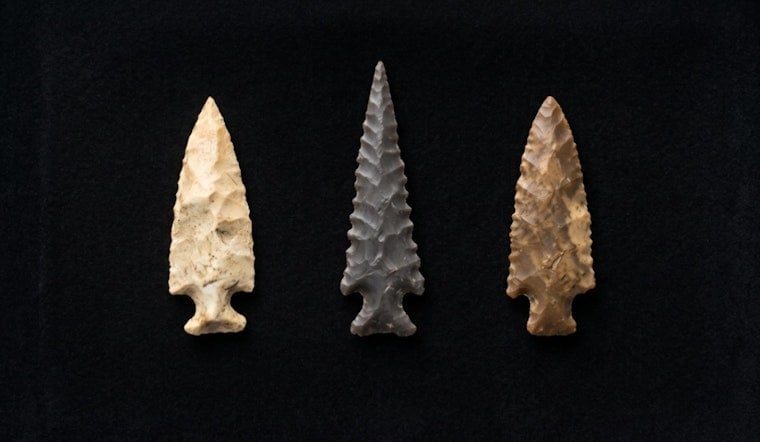
A bag of centuries-old Scallorn arrowheads, dug up illegally from federal land near Harry S. Truman Lake in Missouri, has been formally returned to the Osage Nation after a federal civil forfeiture case cleared the government's title to the artifacts. The U.S. Attorney's Office for the Western District of Missouri announced the handover on Wednesday, capping a yearslong effort to recover items looted from an ancient Native American site.
The case traces back to a March 16 civil forfeiture action filed in the U.S. District Court for the Western District of Missouri, case number 4:26-cv-00216, which targeted “One Bag of Scallorn Arrowheads,” according to court records reviewed by PacerMonitor. Civil forfeiture lets the government pursue the property itself, rather than requiring a criminal conviction of a specific person, which allowed federal authorities to secure legal title to the artifacts and set the stage for their return. As reported by FOX4KC, federal agencies investigated the unauthorized excavation near Harry S. Truman Lake for years before the artifacts could be repatriated.
R. Matthew Price, speaking for the U.S. Attorney's Office, said culturally significant items are more than objects — they are a connection to history, traditions, and identity. He added that the items were being returned to their rightful home and that the federal government was upholding its commitment to protecting Osage heritage and sovereignty, per the same account.
A Years-Long Dig That Tore Up an Ancient Camp
The recovery stems from a criminal case first brought in April 2022, when a federal grand jury in Kansas City indicted 70-year-old Johnny Lee Brown of Clinton, Missouri, on 11 felony counts. Prosecutors alleged Brown conspired between June 2016 and September 2021 to illegally excavate Native American archaeological resources on federal land at Truman Lake near Tightwad, Missouri, according to the U.S. Department of Justice. Investigators said Brown and co-conspirators used excavation tools at a peninsula site.
A professional archaeological damage assessment submitted in federal court found that the illegal excavations caused more than $300,000 in physical damage to a prehistoric Native American camp dating back to the Late Archaic Period, between 3,000 and 5,000 years ago. The damaged peninsula had served as an ancient camp and stone-processing location for Indigenous peoples long before European settlement, the Justice Department noted. The recovery and restoration of the artifacts was made possible by the U.S. Fish and Wildlife Service and the U.S. Army Corps of Engineers, according to the U.S. Attorney's Office.
Federal Law Treats Looting as a Felony
Under the federal Archaeological Resources Protection Act of 1979, unauthorized excavation or trafficking of cultural items more than 100 years old from public lands is a federal felony, carrying penalties of up to five years in prison and $100,000 in fines for repeat offenses where damage exceeds $500, per the National Park Service. Congress passed the law to replace a weaker 1906 statute and to deter commercial pillaging of Indigenous archaeological sites.
Following a civil forfeiture judgment entered by Chief U.S. District Judge Brian C. Wimes, the Osage Nation and the federal government executed a settlement agreement transferring the recovered arrowheads back to the tribe after no competing claims were filed. Federal civil forfeiture under 18 U.S.C. § 981 allows the government to secure title to stolen cultural property and return it to sovereign tribes, the Justice Department's announcement explained. Harry S. Truman Reservoir is managed by the U.S. Army Corps of Engineers.
What the Arrowheads Tell Archaeologists
Scallorn arrowheads were primarily used around A.D. 700. Scallorn arrowheads are archaeological artifacts associated with Indigenous history. Separately, the National Park Service announced in February that multiple cultural artifacts held at the Museum of Kansas City would also be returned to the Osage Nation, which had requested repatriation of those items under the Native American Graves Protection and Repatriation Act, according to FOX4KC's reporting. Remaining artifacts from the Truman Lake case are expected to be handled using appropriate cultural resource protocols in accordance with federal law.
Part of a Broader National Reckoning
The Truman Lake case lands amid mounting federal pressure to speed up repatriation nationwide. Regulations updated in January 2024 under NAGPRA eliminated the “culturally unidentifiable” category for ancestral remains and objects, requiring federal agencies and museums to obtain tribal consent before researching or displaying cultural items, as Hoodline previously reported. In June, U.S. Senator Brian Schatz sent inquiry letters to 15 major universities and museums demanding concrete counts and timelines for returning un-repatriated Native American ancestral remains and cultural objects, a push Hoodline covered in its report on slow-walking museum collections.
Harry S. Truman Lake is in Missouri. The article also references other Osage Nation matters but does not provide details about them.




