

























































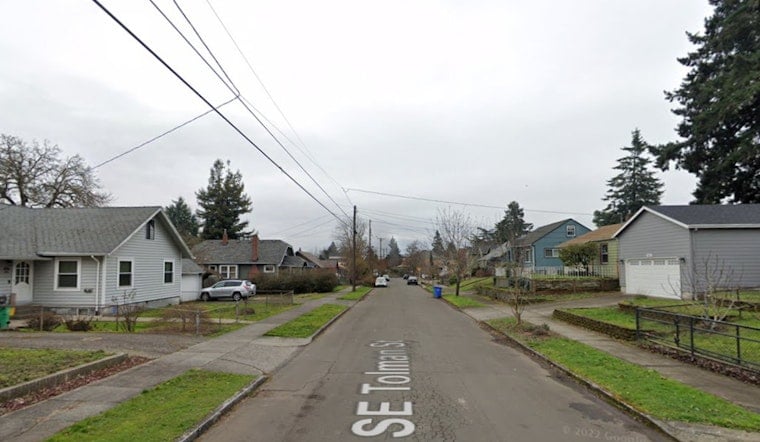
A man in crisis died in Portland police custody Wednesday evening after officers used a Taser on him following reports that he was stabbing himself inside a Southeast Portland home. Portland Police Bureau East Precinct officers and Enhanced Crisis Intervention Team members responded to the 7800 block of Southeast Tolman Street at around 5:47 p.m. after dispatch received a call about an adult male cutting himself with a knife.
According to a news release from Portland Police, officers arrived to find the man barricaded inside the residence, actively stabbing himself. When he refused commands to come outside, officers formulated a plan to carry out what's known as a Police Officer Hold in order to get him emergency medical treatment. After deploying at least one Conducted Electrical Weapon, officers took him into custody and handed him off to American Medical Response paramedics, who pronounced him dead before he reached the hospital, the bureau said.
The Police Officer Hold that officers attempted to execute is grounded in Oregon Revised Statute § 426.228, which allows peace officers to take someone into custody without a warrant if there's probable cause the person is dangerous to themselves or others and needs immediate mental health care, according to Eugene.gov. The statute requires that the person then be transported to the nearest appropriate medical or psychiatric facility.
Homicide Unit Takes Over Investigation
The bureau has assigned Case No. 26-257393 to its Homicide Unit to investigate the in-custody death, and Southeast Tolman Street was temporarily closed between Southeast 77th and 80th Avenues while investigators worked the scene. Chief Bob Day personally responded and issued a statement emphasizing the sanctity of human life, per the same release.
The officers who responded included members of the bureau's Enhanced Crisis Intervention Team, a group of volunteer patrol officers who complete an additional 40 hours of specialized training in crisis communication, de-escalation, and behavioral health emergency management, the bureau notes on its website about the Behavioral Health Unit. ECIT members otherwise perform standard patrol duties until they're called on for complex mental health calls.
Why Armed Officers, Not Crisis Responders, Answered the Call
Because the call involved a knife and active self-harm, the city's unarmed civilian crisis team, Portland Street Response, was not an option. Operating protocols prohibit those unarmed units from responding to 911 calls involving weapons or active physical violence, leaving armed police as the designated responders, according to reporting from Oregon Public Broadcasting. That divide between civilian crisis teams and armed police intervention has long been a point of debate among local advocacy groups.
Under Portland Police Bureau Directive 1010.10, any in-custody death automatically triggers a mandatory Homicide Unit investigation, an independent grand jury review by the Multnomah County District Attorney's Office, and an internal evaluation by the Police Review Board, with the Independent Police Review division also participating. That layered review process will now apply to Wednesday's death as investigators work to determine what happened.
A Familiar and Painful Pattern
This is not the first time a Portland mental health hold has ended in death. In a similar incident on June 27, 2025, 52-year-old Damon Lamarr Johnson died in Portland police custody during a mental health hold attempt, a case Hoodline covered as an unfolding crisis and later as Johnson's identity was confirmed. A Multnomah County grand jury declined to file criminal charges against the officers involved in that case in November 2025, and the medical examiner ruled Johnson's cause of death as prone restraint cardiac arrest with drug toxicity as a contributing factor, according to KATU.
The bureau has operated under a federal settlement agreement with the U.S. Department of Justice since 2012 that requires ongoing federal oversight and updated directives governing Taser use and force against people in behavioral health crises, including limits on Conducted Electrical Weapon cycles, according to the Law Enforcement Knowledge Lab. Hoodline reported last month that federal officials warned a real fix remains years off for the bureau's crisis response and use-of-force practices.
Several key facts remain unresolved. The state medical examiner has not yet released autopsy findings on the man's cause and manner of death, and the bureau has not disclosed the number or duration of Taser cycles used during the encounter. How this death will be weighed against the city's ongoing DOJ settlement compliance reviews is also still unknown.




